Evenings Feel Different When Walls Catch the Light
Wall lighting reduces evening flatness by lighting walls and activity areas, enhancing comfort and function with proper fixture placement.
You notice it quietly—usually sometime after dinner, when the overhead light is on and the rest of the room is falling away. Corners dissolve into shadow. Shelves become indistinct and the far end of the table softens until it barely exists, unless you lean forward and try to catch the outline of whatever you left there.
It took longer than I expected to realize that ceiling lights, for all their straightforward neatness, leave a room unfinished in ways you only see through daily use. Over time, the space grows less comfortable in small, cumulative ways. You don’t notice it immediately.
But you feel it.
When Shadows Start to Matter
For a while, I tried to ignore the dim corners and the faint eye strain that appeared during late meals or while searching a bookcase. Overhead lighting promises efficiency, but its coverage is uneven: the middle of the room blazes, while edges and surfaces drift into shadow.
I remember how often I reached toward the wall for a switch that wasn’t there, half expecting the room to respond with a different kind of brightness. Maybe during one of those small, annoying searches for a serving spoon, or when conversation seemed to fade toward the friend sitting in the darkest corner.
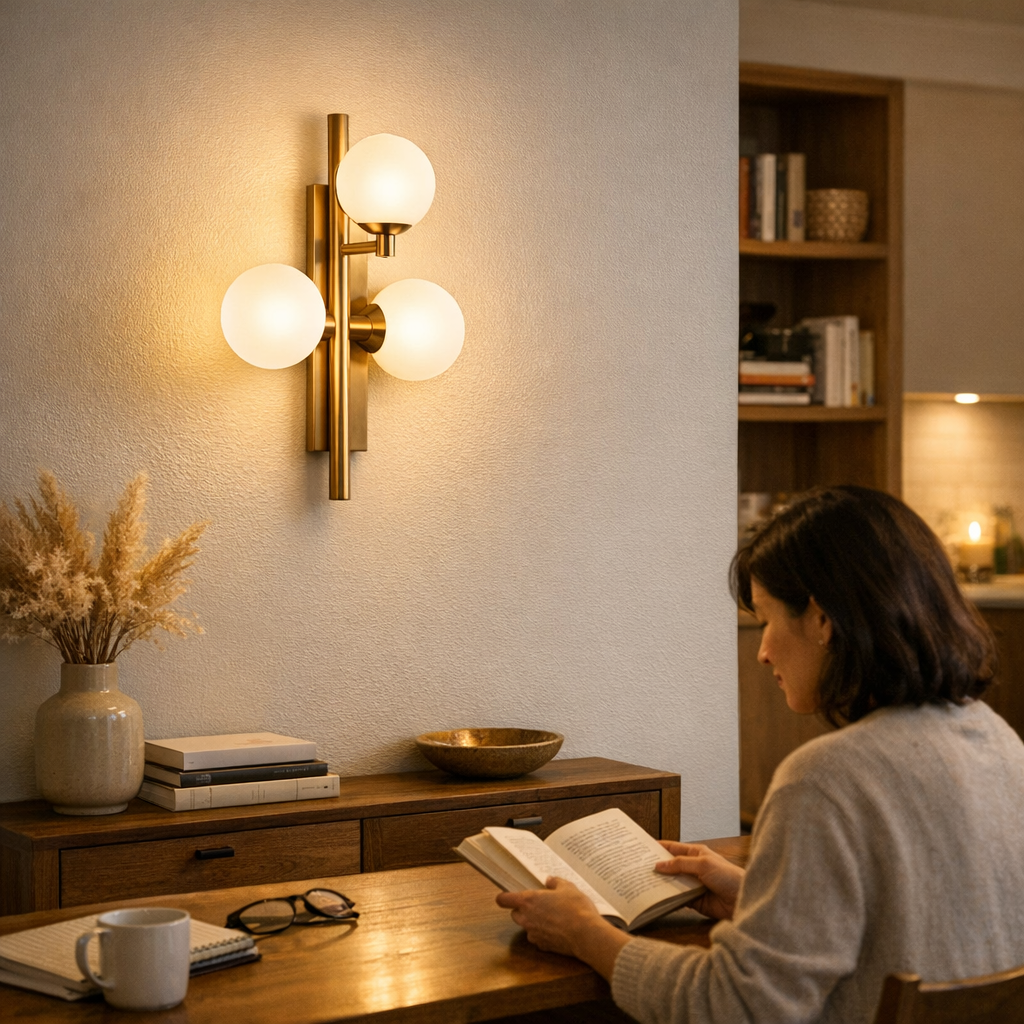
Adding a wall-mounted fixture—a slim bracket lamp set lower than conventional ceiling lights—quieted some of that restlessness. The change was subtle. Corners remained visible, and I didn’t have to shuffle task lights or stretch desk lamp cables across the floor just to spot what I’d left behind. That was the part I kept coming back to.
The Clutter Hiding in Plain Sight
There’s something visually clean about an uncluttered ceiling: no cords, no brackets, just blank space above. It’s a kind of purity that seems practical until real life elbows in. Table lamps drift. Portable desk lights gather in places neither here nor there, their cables snaking across surfaces and underfoot.
I ended up moving the same lamp twice in a single evening—once to read, once to sort paperwork—never quite meeting the room halfway. All the while, those clean ceiling lines were quietly undermined by improvising.
A wall light with its cord clipped down quietly and out of the way did something the ceiling fixture never managed. It kept surfaces workable and shelves visible, without adding clutter or making each light a major commitment. It’s easy not to notice at first. But over a week, I saw that no one went searching for extra lamps. Dinner conversations kept everyone equally in view, no matter where they sat.
Lines That Stay Useful
I started seeing the room less as a container and more as a set of surfaces needing attention at different times. Lighting that follows real use—mounted low enough to sweep over work areas and seating, but out of reach of wandering elbows—became less about design and more about steadying the edges of daily life.
There’s a small difference between a space that looks tidy and one that feels untroubled. When shelving, desks, and corners stop falling away into shadow, the room stays ready, even if nothing else has changed. No big leap, just a routine made smoother by staying visible.
It’s still an ongoing process. I keep noticing small moments when the light makes movement easier, or just lets a sentence finish without squinting across the table.
Sometimes it’s worth seeing how others arrange things—this page has a few more examples: http://www.lightsupport.myshopify.com