Living with Doors That Don’t Get in Your Way
A narrow storage door reduces congestion and eases resets in entryways, unlike wide-swing doors that create blockages in tight spaces.
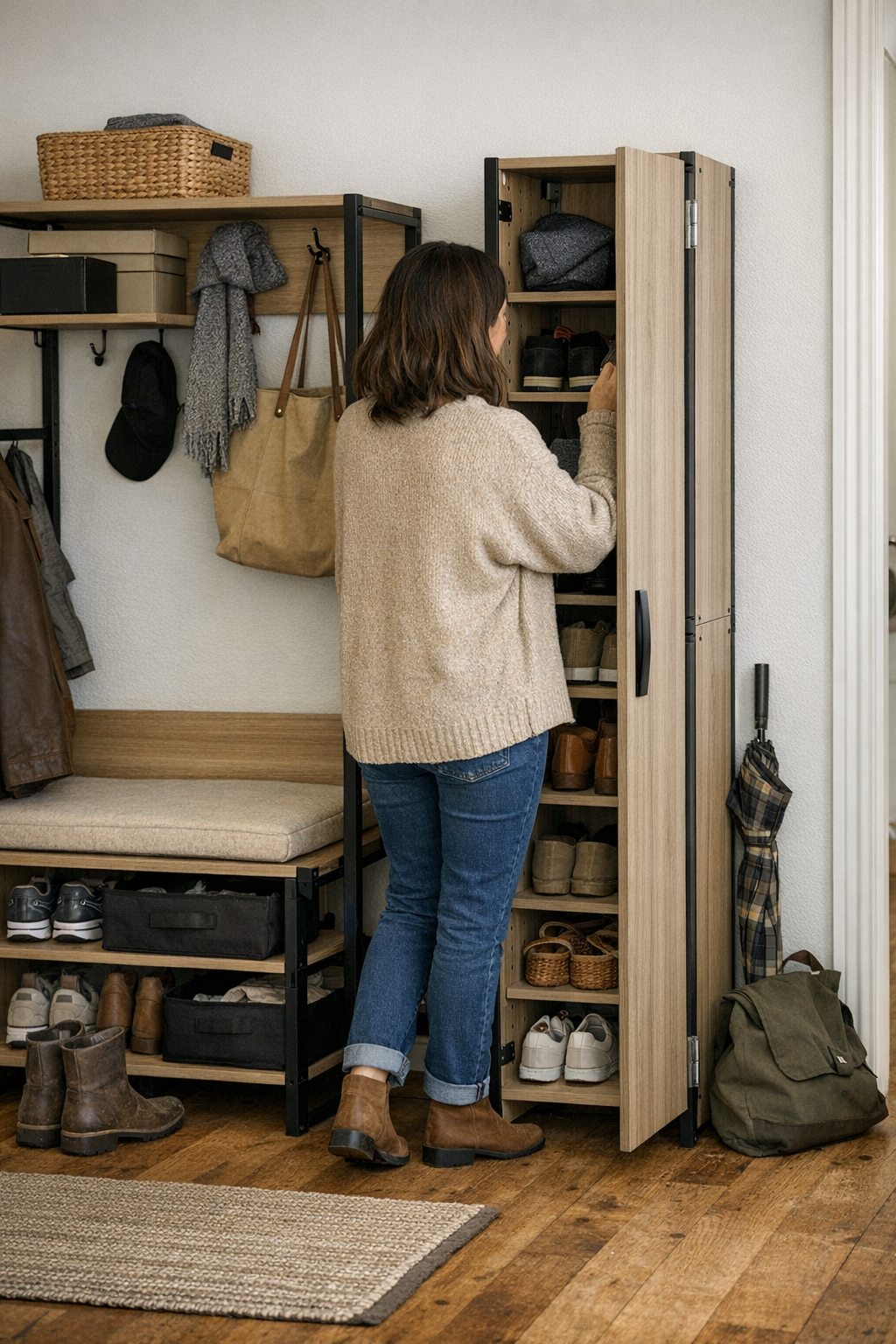
I didn’t expect that choosing a door style for a storage cabinet could matter so much—at least, not until I was living with the constant churn of shoes fanned out in uneven rows, bags dropped wherever the last hand let go, and the delicate balance between just enough order and the usual morning rush. Whether a narrow, pivoting cabinet door or a wide-swing one belongs in this transition space felt like a minor design detail at first. But it quietly adds friction to daily routines, especially when paths get tight or hands are full.
I noticed it most in the little pauses.
When Movement Overlaps With Storage
A wide-swing door does feel welcoming initially. Swing it open and everything is laid out, wide and accessible, as if clutter might magically fall into place. But over time, its big arc becomes more of a hurdle. Shoes creep closer to the threshold, bags drift into path lines, and the door’s wide swing demands its own clearance. Before long, something—boot, bag, umbrella—is nudging or being nudged, slowing down the flow.
You don’t really register it at first. But you feel it.
By contrast, a narrow storage door, especially one that pivots on a tighter arc, changes that experience. It barely pushes into walking space. The rhythm at the threshold is smoother and quieter. It behaves predictably—nothing needs to be shifted out of the way for it to do its job. That small difference made movement easier, not more complicated.
How the Edge of the Zone Holds Up
Transition spaces are rarely about just one element—they gather pressure at the edges, where a bench collects stray mittens or a wall-mounted unit shelters overflow gear. The wide-swing cabinet draws attention on setup day but continually requests extra clearance, staking out its own domain in a shared zone. On a muddy evening, balancing an armload and catching a shoe underfoot, I found myself blocked at the moment I needed a clear path most.
Switching to a slimmer, vertically stacked unit meant never needing to reset the floor just to open a door. The passage stayed open and functional. Not perfectly free of clutter, but better in a small, crowded entry area with all the usual scatter.
The slow tide of things—shoes multiplying, bags drifting, threshold space shrinking—calmed. The door’s small footprint didn’t demand extra room or constant vigilance; it simply stayed out of the way.
Shaving Inches, Saving Headspace
It’s a small but practical shift. When a cabinet’s swing stays close to the wall—inside its own modest footprint—bags and shoes are less likely to block it. I stopped thinking about stumbling or awkward shuffles. Even on busy mornings, I could grab what I needed without negotiating for space. The transition zone stayed as close to usable as it has ever been, even when every square inch mattered.
Sometimes small adjustments are what keep transition spaces livable, especially when every reset is just a minute reclaimed.
Of course, there’s more to consider—materials, routines, weather protection—but the feeling of reduced friction stuck with me. If you’re curious where this line of thought goes, there’s something quietly fitting about Betweenry’s world: