Living with Less Clutter in the Entryway’s Quiet Corners
Shallow-depth storage keeps entryways functional by making all items visible, preventing hidden clutter, and easing daily transitions.
Sometimes it’s the smallest habits that reveal what really works—and what quietly gets in the way. I started noticing this on busy weekday mornings, when each extra reach or shuffle at the door felt heavier than it should. Deep storage in transition spaces can look generous and promising, but it changes how every arrival and departure feels in practice. It’s never just about appearances—something about hidden layers turns quick routines into tangled ones.
When Things Disappear Without Ever Really Leaving
You don’t notice it right away. A deep bench fills up little by little. Shoes settle in rows, but over time, pairs drift backward or vanish behind slumped bags that collect at the edge. Each day adds another temporary placement: gloves dropped on top of shoes, a tote sliding in front, a stray hat wedged too deep to be seen.
It seems manageable—until an urgent exit. The threshold clogs when the practical volume of the space invites overflow. The more hidden spots deep storage offers, the easier it is for bits of daily life to get lost inside them.
What Stays in Sight Becomes the Real Routine
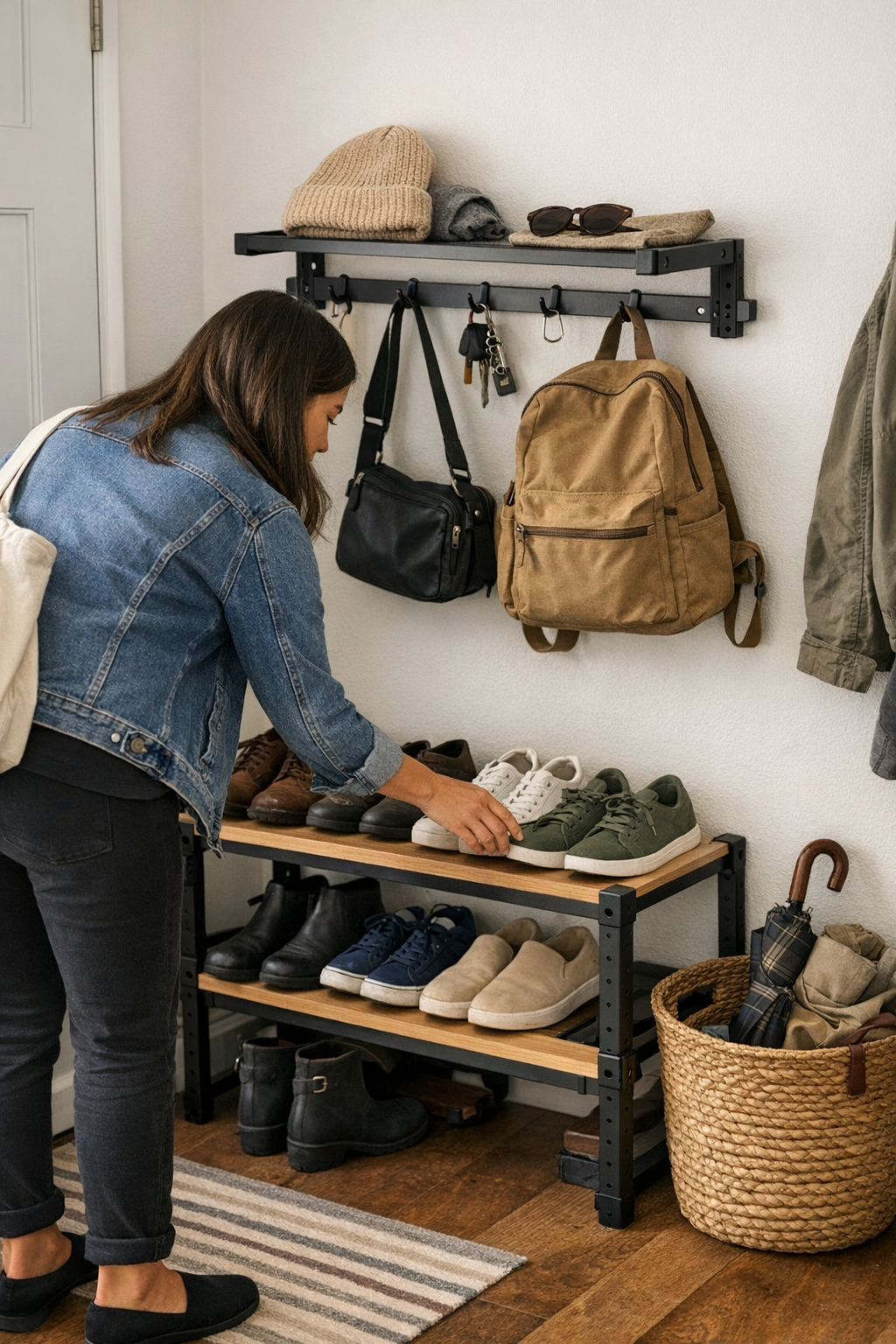
With shallow storage, there’s no back row. One bench, one row of shoes—what you see is truly what’s there. On rushed mornings, the difference is subtle but unmistakable: you can’t leave something hidden for another day, or bury yesterday’s bag under tomorrow’s pile.
There’s relief in crossing the entryway and reading the space in one glance. A missing shoe is obvious; a bag out of place blocks the path brazenly. There’s no searching behind layers—just a clear pattern to add, remove, and reset. This visibility quietly holds you accountable.
Clutter doesn’t disappear; it just finds quieter ways to exist when the setup allows it. The shift happens not with storage that hides the drift, but with storage that keeps movement visible. It makes each reset smaller, and in its way, lighter.
The Subtle Cost of Hidden Capacity
There’s comfort in the illusion of “plenty of space,” but more room tucked away can slow the very routines a transition space is meant to support. Each layer adds a mental step. Each hidden item adds to the background noise of forgetting.
After switching to a wall-mounted, single-row rack, my nightly reset changed. Every misplaced shoe stood out—there was nowhere to tuck and forget. Overflows met the threshold immediately—sometimes annoying, but never invisible.
What surprised me was how this stripped-back visibility kept the entry pathway open, even during the busiest cycles. Shoes and bags still multiplied, but without deep corners to fill, every pattern was clear, and course-corrections happened naturally. The space still felt lived-in, but with an honesty I hadn’t expected.
Sometimes, the simplest layouts work hardest—especially where every arrival and departure leaves its small mark. For anyone who values function at the threshold, there’s more to see at www.betweenry.myshopify.com.