Living with Shelves That Shift as Life Changes
Modular shelving enables fast, tool-free changes that adapt to evolving storage needs, preventing clutter and easing frequent reorganization.
There’s a quiet frustration that creeps in when your storage no longer matches your day-to-day life. At first, shelves feel like a solution—roomy, reliable, neatly lined in place. But change happens. New hobbies, shifting routines, or something as simple as a winter jacket, and suddenly what once felt organized becomes a subtle daily hassle.
You often don’t notice the true impact of shelving—fixed or modular—until something stops fitting and you catch yourself nudging things around.
The Shelving Decision Hiding in Plain Sight
It’s not something most people dwell on: whether to choose fixed shelves or modular ones. The difference doesn’t announce itself right away. At first, everything looks tidy. Baskets line up, bins slot in, and there’s a fleeting sense that you finally have storage under control.
But life finds ways to test the setup.
Before long, the calm gives way to the small annoyances—books stacked sideways, winter boots jostling for headroom, a new box orphaned on the floor. You don’t notice it immediately. But you feel it.
Fixed shelves make each change into a bigger deal than it needs to be. Stack on top or shove things to the side, and soon you’re double-layering, crowding, losing track of what you own. Modular shelves, meanwhile, offer a quiet option to adjust and shuffle things around, no tools required.
When Mess Becomes Momentum
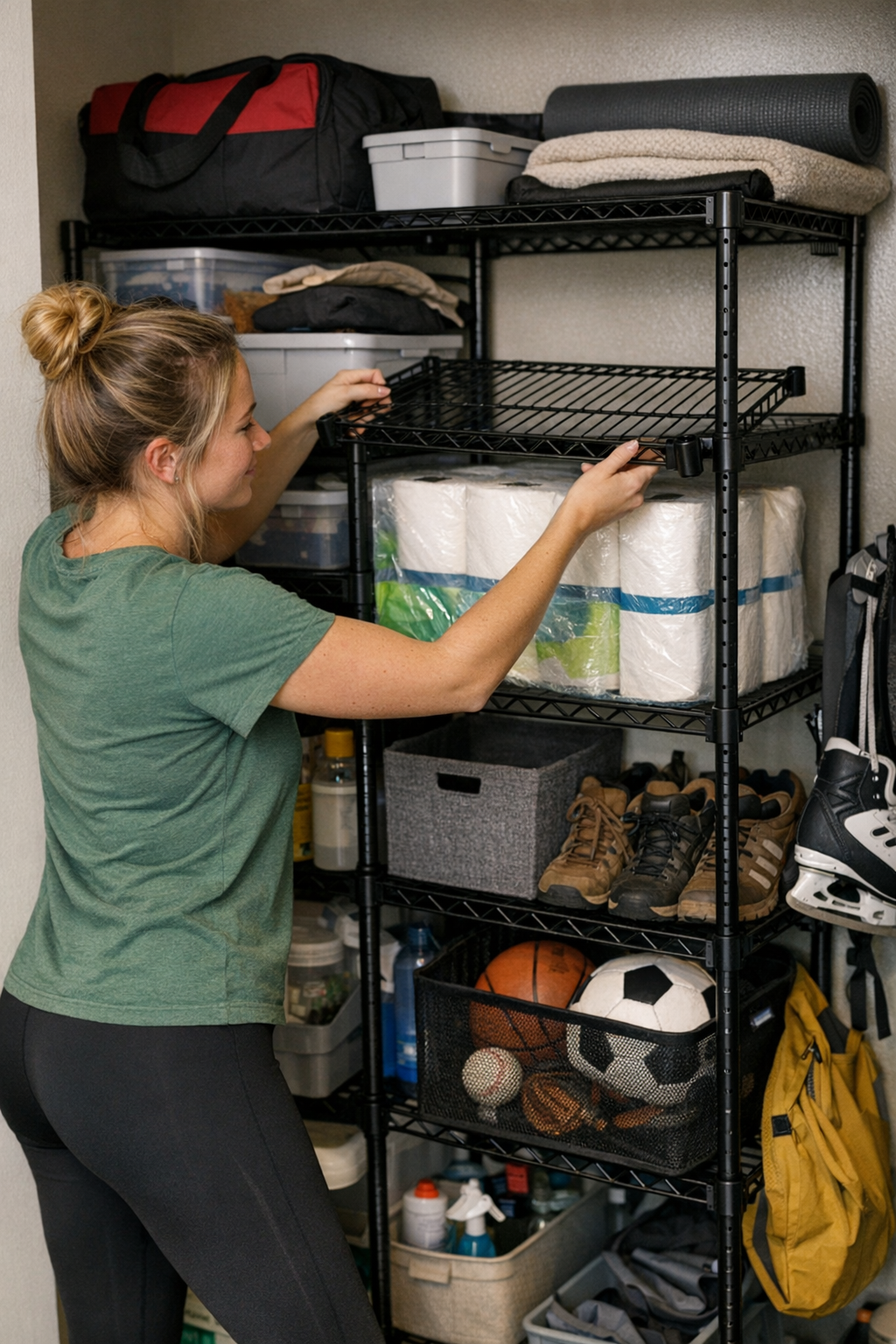
I remember one ordinary closet, mostly home to shoes, sports gear, a tangle of tote bags. After the holidays, three bulk packages had nowhere to land. For a few days, they loitered in the hallway, another thing to step around.
The reset took three minutes—move a shelf up, shuffle a bin, slant the boots. Just that. Suddenly, the closet fit again. No need to empty everything or rethink the order. Daily motions—grab shoes, swap jackets—inched back to effortless.
Sometimes, it’s just about leaving room. Literally: not filling every slot, not wedging baskets into every gap. That bit of restraint becomes the difference between a five-minute tidy and a reluctant afternoon project.
It’s rarely about perfect storage. It’s about making changes possible.
The Value of a Gap
Modular shelving shows its advantage not in first impressions, but in small accommodations over time. When life rearranges itself, you want your storage to do the same—quickly, quietly, without much argument.
A little open space between shelves looks unfinished at first. But this empty slot turns out to be freedom in disguise: the key to shifting things up or down when seasons, routines, or moods change. It’s a subtle habit—leaving room to breathe—and it means resets are gentle, not overwhelming.
Overfilling is tempting. But holding back a bit, leaving space for what hasn’t arrived yet, keeps your storage honest. The practical benefit: less time spent reorganizing, fewer surprise piles on the floor, a storage system that quietly stays useful even as life refuses to stand still.
Most of these thoughts floated up while I was moving shelves around one restless Saturday. If you want a bit more context, the original conversation happened here.