Quiet Moments in a Well-Spaced Charging Station
A well-organized charging setup with 15 cm spacing and individual cable routing prevents overheating, tangling, and premature wear, ensuring uptime and battery life.
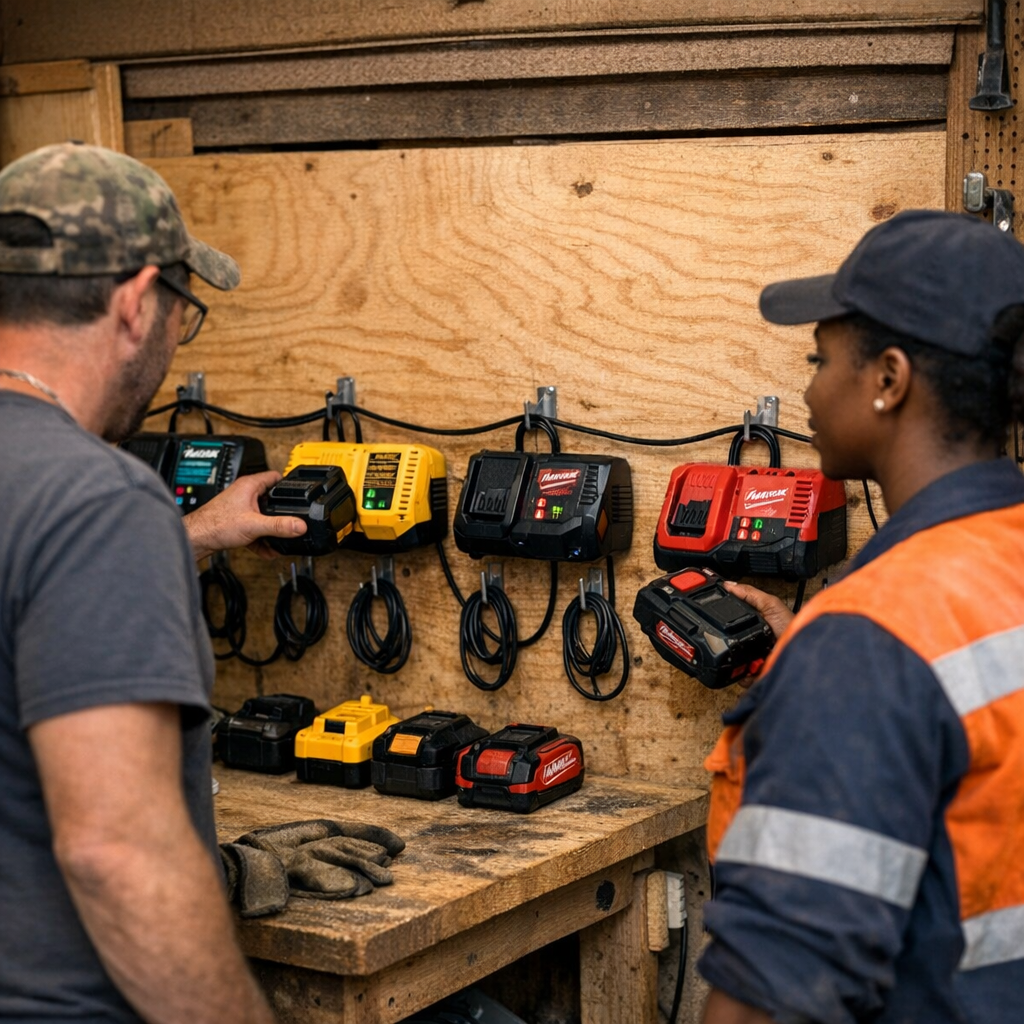
There’s a kind of silence in the workshop at the end of a long afternoon. Machines cool, signals dim, and whatever chaos filled the morning now rests in rows of idle chargers and cables. You might not think much about this little ecosystem—until suddenly, there’s a snag. A battery that should be full refuses to power on; a charger blinks its warning. In those moments, the hidden choreography of chargers and cables steps briefly into the spotlight.
When Tangled Cables Become Something Bigger
You don’t notice the slow build-up of clutter at first.
Cables knotted together, chargers fighting for space, faint warmth lingering around a dense wall socket—maybe on a quiet day, no one minds. Tools are used, batteries charge, everything ticks over in the background. But as the workday speeds up, those shortcuts show themselves: someone fumbles through a nest of cords, a charger cuts out mid-cycle, a battery comes out half-done. The workflow stutters.
It isn’t until a routine is broken that you see how easily small disarray becomes costly trouble. Blocked airflow. Overheating metal. Damaged insulation. Issues that grow quietly beneath the noise.
Why Spacing Changes Everything
A friend once walked me through his workshop—nothing fancy, just a busy space with too many tools. He’d spaced every charger apart by a modest gap, lined the cables through separate hooks. It looked almost ceremonial, a kind of respect given to everyday gear.
At first, I thought it was overkill. Now I get it.
The gap isn’t just for neatness. It’s room to breathe. Chargers kept fifteen centimeters apart don’t fight for airflow. Cables run clean and visible—goodbye tangles, no more mystery disconnections. It becomes easy to spot an emerging fray, a swollen wire, a charger humming too loud. After a while, I stopped seeing it as fussiness. It felt, instead, like a quiet sort of insurance.
You don’t notice it immediately.
But you feel it.
Steady Setups, Fewer Surprises
Most setups look tidy enough at a glance. Chargers lined up, cables bundled and tucked away with ties. In practice, though, differences emerge when the day gets full and batteries start swapping by the hour. When things are spaced and visible, you catch signs before they matter. The warm charger, the slipping plug, the LED that’s just a bit off. Fewer cables tugged at awkward angles, less worry around busy plug sockets. All of it quietly stacks up to less downtime and fewer rude surprises mid-task.
A small change—like a shared cable hook or fifteen centimeters between chargers—turns out to be the real guardrail. Sometimes, the best way to keep rhythm is to notice how the details are lined up behind the scenes.
These thoughts condensed while tinkering with my own bench—where most days, the only drama comes from a well-behaved charger, content to wait in its own well-earned silence.
Read more about the simple foundations of reliable setups here.