The Quiet Relief of a Dry Entryway After Rainy Days
A ribbed boot tray dries faster, prevents dampness, and eases cleaning, making entryway resets quicker and reducing clutter over time.
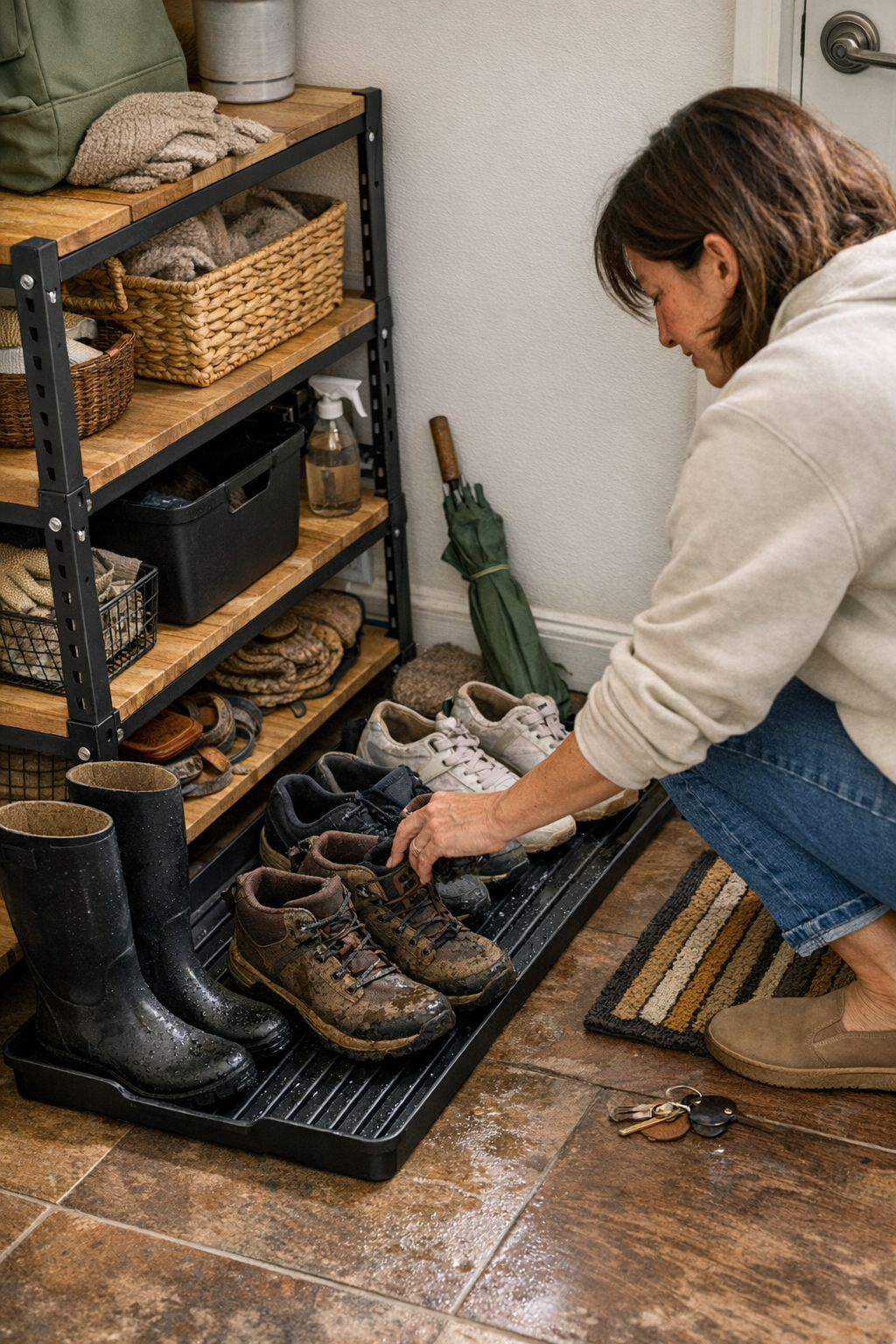
There’s a particular kind of tired that accumulates at the edge of a home, in the entryway and drop zone where shoes, bags, and gear transition from outdoors to inside. It’s not a loud disruption—more like a soft persistence, creeping in with damp shoes, mud tracks, and the slow drift of jackets to every surface near the door. Over months of rain and repeated arrivals and departures, I began to notice how much energy gets lost managing this transition zone, especially the difference between ribbed and flat boot trays, and what actually helps a busy entryway breathe. This is a problem of practical threshold flow—not just cleaning—and the material details become clearer the longer the routine stays crowded.
It Starts Subtle, then Builds
At first, you don’t think much about the tray under your feet. Shoes come in, things get dropped, and everything has its spot—until the first stretch of back-to-back wet days. That’s when flat trays turn into shallow puddles; soles never quite dry, and there’s always a faint, sticky outline underfoot. You don’t notice it immediately, but eventually grabbing for a pair means half the row is damp, and the edges get smudged, as if the mess spreads itself while you’re not looking.
Meanwhile, ribbed trays separate shoes just enough that air slips underneath, and water has somewhere to go. After several cycles of arrivals and departures, the rhythm feels different. You realize you’re not timing errands around how wet the floor is. That was the discovery I kept coming back to.
The Small, Repeating Frictions
Routine makes patterns clear. One busy morning, I found myself nudging soggy trainers to the side again, rotating them so someone else would have a dry landing spot. It’s surprising how quickly these become silent negotiations within shared use. By midweek, the flat tray edge collects a residue line—one that never fully wipes away. The ribbed tray doesn’t let the mess settle the same way. Water pools but drains into grooves, and cleaning shifts from drawn-out labor to a quick swipe. The visible difference isn’t the main story—it’s the background grind that gets lighter.
This is the slow shift: less time moving shoes around to make space, less threshold stress, fewer stops every time someone else arrives with an armful of gear. Practicality settles in not immediately, but in how much less you dread resetting the spot after a heavy week of drop-offs and returns.
Reset Becomes Routine
There’s a quiet relief in having one surface that doesn’t turn unpredictable. When boots, soccer trainers, and old sandals grow wild along the narrow pass-through, it’s easier to clear residue when it collects in defined lines, not stubborn patches. Leaving a tiny gap between the tray and the wall made cleanup almost automatic—just a tilt, then a rinse, and the channel clears for the next round of arrivals. Less lingers over time, and the floor feels a little lighter even under the pressure of repeated use.
I started to notice the benefit wasn’t just in keeping things tidy; it was in how freely everyone moved through that transition-space, how fewer arrivals caused blockages, and how the floor stayed less heavy with spillover gear and the lingering dampness of oversaturated trays or benches. The right material detail—whether a ribbed tray, a slim vertical storage piece, or weather-resistant mobile storage—helps the routine become livable when arrivals keep stacking up day after day.
Sometimes, what seems insignificant at first is really just waiting to reveal itself in the churn of daily life and repeated traffic through the threshold. If you want to see more about these quiet differences in entryway and transition-zone storage, you can find them here: http://www.betweenry.myshopify.com