The Quiet Wear That Changes Safety in Everyday Work
The practical difference between similar fall protection anchors shows after repeated use, affecting performance and site safety.
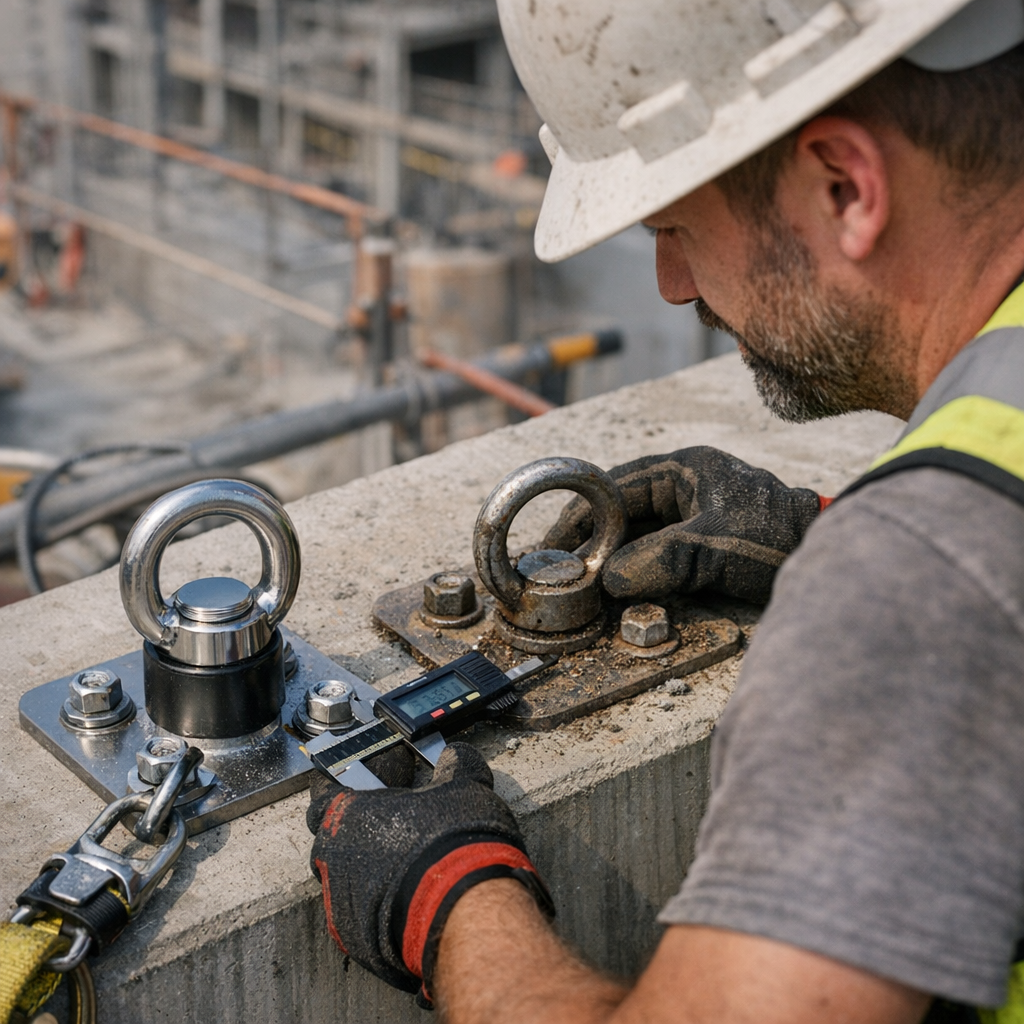
There’s something oddly reassuring about the click of an anchor point. You trust, almost without thinking, that what you’ve installed will hold tight, shift after shift. Yet, over time, that confidence has a way of slipping. It’s rarely sudden. More often, it’s a subtle unease — a slight give, a rougher thread, a sheen dulled by too many resets. That’s when you realize: not all anchor points are truly equal, even if the paperwork insists otherwise.
The Small Details We Miss
On paper, one anchor looks much like another. Rated for the same loads. Sold with nearly identical installation diagrams. At first, there’s little reason to question what the box promises. You don’t notice the gaps — not at once.
But use them for weeks in a row, and the difference quietly grows. Bolts that once set with a crisp turn begin to feel just a bit loose. Edges wear. Sometimes, a faint dust appears where metal meets metal, evidence that something inside is slowly being lost. You don’t notice it immediately. But you feel it.
Real Life Has Its Own Rules
Most jobsites are far from pristine. Concrete dust blurs into old paint; steel beams get scraped and chipped; wood bristles roughen beneath your boots. One day, I found myself rotating anchors across a run of worn concrete slabs and fresh panels, the morning sun barely warming the cold grit beneath my hands. At first, both anchors seemed to manage just fine.
By noon, there were hints of trouble. One anchor, new only weeks ago, started creaking faintly as I tightened it. A little pile of metallic dust settled along the base. Each install took longer as I double-checked the grip, knowing I’d need to come back and clean it all up again at the end of the day. Meanwhile, its sturdier cousin reset with the same steady ease, no matter the surface or debris.
Trust, it turns out, comes not from specs but from how tools behave when the unexpected piles up.
What Holds and What Fades
It’s tempting to treat anchors as fungible. Swap one for another, follow the same steps, and expect identical results. But repeated use — across shifting job sites and stubborn surfaces — reveals what paperwork can’t predict.
A well-finished anchor, protected against corrosion and fitted with a reliable sleeve, keeps its bite no matter the number of resets. The lesser ones, though, dull and drift just a little more each time. Their movements become less predictable, their hold a little less secure.
Over a dozen installs, those moments add up. Fatigue mounts. Checks become more frequent than you’d like.
There’s a quiet dignity in tools you can trust, even when circumstances are anything but straightforward. Sometimes, the solutions are humble: a sleeve swapped before it’s worn bare, or a gentle wipe to keep threads clear. Sometimes, it’s just knowing when to choose the anchor that will last through whatever the morning brings.
We don’t always see the cost of small shifts — not until we’re left cleaning up after what slipped past our notice. I found these thoughts lingering after another long shift, while working through a slow evening on a half-finished project. More on these quiet observations.