When Blades Wear Down: The Hidden Cost of Cutting Tough Materials
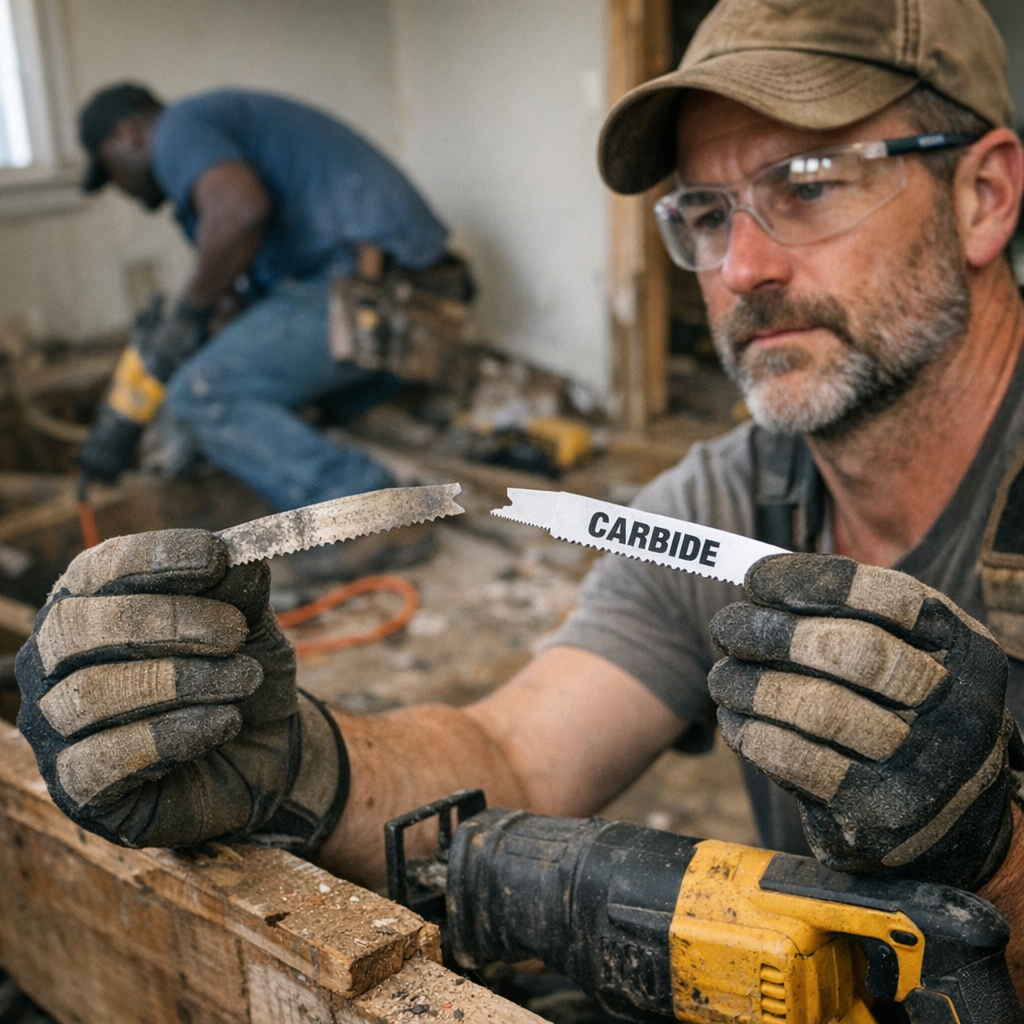
Carbide blades stay sharp longer for clean cuts in tough materials; bi-metal dulls faster, causing rough edges and more effort.
You don’t usually think about saw blades until something interrupts your work—noise, splinters, a wandering cut. It’s a quiet disruption that arrives slowly. The work flows, then suddenly, it doesn’t.
This difference is at the heart of every renovation or teardown, especially when choosing between a bi-metal and a carbide-tipped saw blade. On the surface, they look almost the same, but the real story begins once the work starts.
The Shift You Don’t See at First
Side by side, bi-metal and carbide blades are nearly indistinguishable: familiar sizes, packaged for the masses, their teeth-per-inch stats all feeling comparable. On fresh lumber or the occasional nail, both make clean work, at least for the first few cuts.
But something changes. You don’t notice it immediately.
As you push past ten or fifteen cuts—old wood, hidden screws, fiber cement—the edge on a bi-metal blade softens. The sound shifts. Cuts come slower, and you start pressing harder than you meant to. Your lines begin to wander, as if the blade itself is looking for the path of least resistance.
That’s when the work starts to feel heavier than it should.
Where the Real Difference Emerges
The truth is, the actual distinction between bi-metal and carbide doesn’t show up until the job asks a little more. Carbide-tipped blades hold their edge—their bite—much longer. Against a run of deck screws or a stretch of siding with embedded nails, they keep moving steady while their bi-metal cousins stutter.
It isn’t just about speed. It’s about the feeling in your hands.
Dragging a dull blade through a stubborn board, hearing the saw vibrate, sensing the heat rising—there’s a fatigue that creeps in, both physical and mental. All the while, the mess at the cut line grows, and sometimes you stop, quietly dreading the sanding and patching ahead.
Then you switch to carbide. Things go smoother; the saw tone evens out, and the edges clean up, almost as if the material was easier all along.
The Quiet Cost of Repetition
I held on to bi-metal blades longer than I should have—cleaning, slowing my feed, hoping for just a few more passes.
But after working through mixed demolition, the reality surfaces. Boards come out with splinters, edges fray, and the pressure it takes just to keep moving grows with every run. Relying on carbide, though, I noticed something quietly reassuring: the rhythm of work returned. Cuts stayed straight, touch-up work shrank, and time seemed to expand as cleanup shrunk. The tool just felt lighter in the hand.
These choices don’t always feel important at the start. But in jobs full of hidden nails, abrasive dust, or hours of repeating the same motion, that early investment in a better blade lingers, saving more than the cost of the blade itself.
There aren’t always loud signals when something’s wearing out. Sometimes, it’s just the slow slide from flow into friction.
These thoughts came together while rebuilding an old porch, swapping blades more often than I wanted to admit.