When Clean Entryways Hide Lingering Dirt
Fixed liners trap dirt and complicate cleaning in busy entryways, while removable liners simplify deep cleaning and prevent buildup.
Sometimes I notice the entryway settling into its own rhythm—moments when the floor is briefly clear and the storage bins form sharp lines, like a reset after a long day. But underneath that order is something quieter: how easily grit and mess seep in, pressing up against these controlled edges, especially around the busiest drop zones. The difference between storage that’s easy to reset and storage that just looks neat on the first day becomes clear slowly, over weeks of arrivals and departures. Removable liners in transition-space benches or bins didn’t seem so important until everything felt easier to reclaim.
The Promise and the Catch
A fixed-liner bench always gives that clean look at first. The fit is tight, the seams are crisp—like it’s promising to contain whatever comes its way. You don’t notice it immediately. But as boots return caked in mud and bags are dropped with their own weight and noise, the space starts collecting evidence in small, hidden ways.
Pet hair, dry leaves, grit—most of it finds the corners or settles low, just out of sight. It’s strange how a storage base that feels controlled at a glance, over time, starts to conceal more than it reveals. You feel it most in the resistance to cleaning. The brush of a wipe, each awkward reach, the way dust shows up at the seams but never fully comes loose.
What Actually Stays Clean
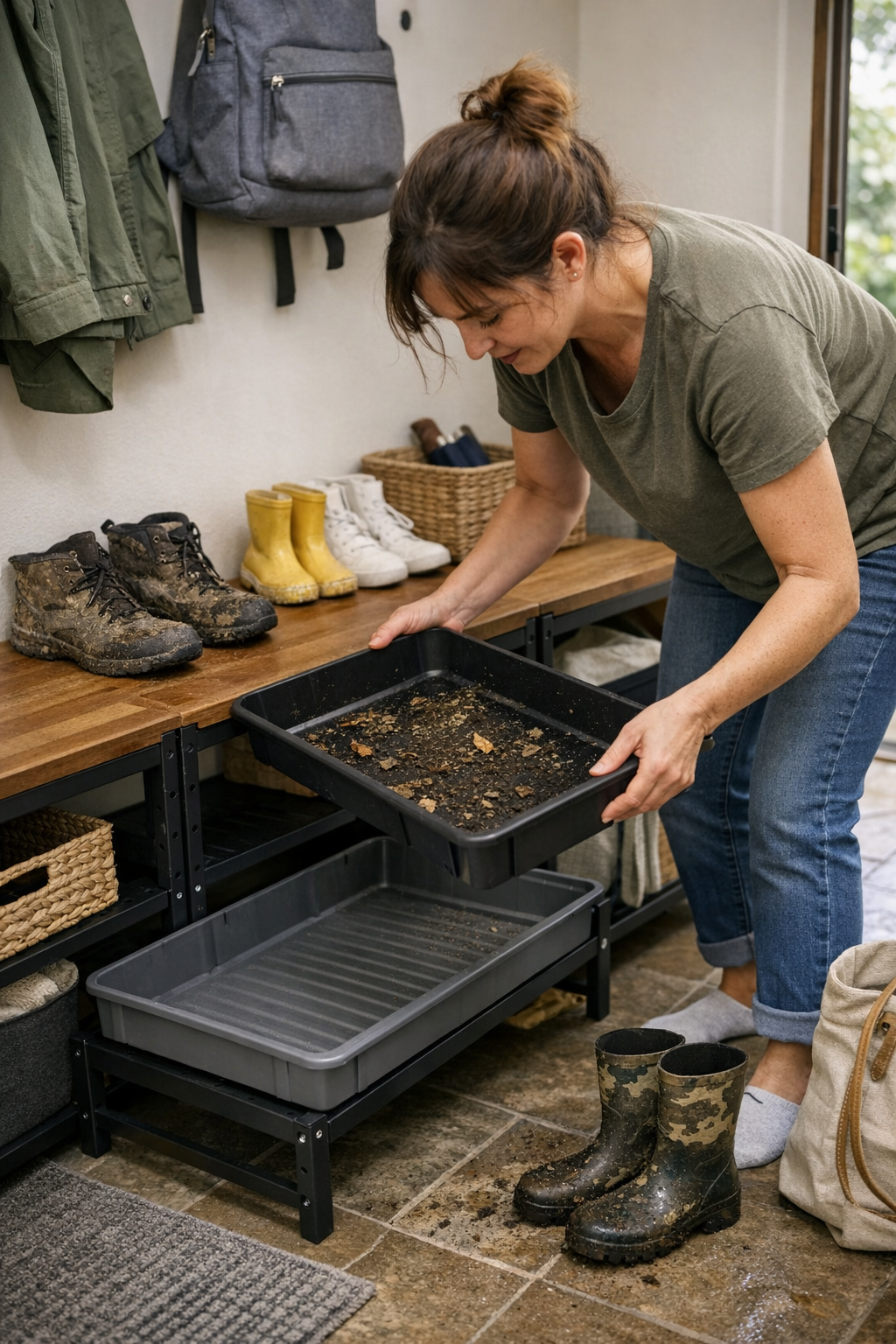
At some point, rinsing out a removable tray under the hose felt less like a chore and more like hitting “reset.” When liners could be lifted—taken outside, shaken, and rinsed—each midweek cleanup started to feel possible, not overdue. It was less about doing more, and more about how manageable the mess became. Practical in the background.
That was the part I kept coming back to. A removable base, even just beneath the zone where shoes spread or gear piles up, held back the slow creep of debris crossing the threshold. When the job didn’t require contorting into cramped corners, I found myself actually keeping up, not just letting things slide until the next big clean.
Transitions Always Show the Truth
Most transition spaces don’t stay staged for long. The flows of leaving and arriving undo cosmetic order. Rows of shoes drift, bags stay a little longer on the bench edge, walk spaces narrow, and the smallest decisions—where to place something, when to clean—compound over weeks.
It’s easy to forget, but the way a storage area resets—how fully it can return to “clear”—determines how the whole entry feels. Cleaning shouldn’t be another hurdle. A space that answers quickly to a rinse or a lift, instead of demanding a deep dig or a reluctant “later,” feels more genuinely prepared for real life, not just presentation.
On rainy days or when pet hair drifts, that difference is what holds everything together. What used to feel like an endless maintenance cycle now settles into a workable routine.
I found myself thinking about these small shifts each time I reset the space—and if you’re interested, you can see some of those ideas gathered quietly here: http://www.betweenry.myshopify.com