When Closet Shelves Shape Your Daily Routine
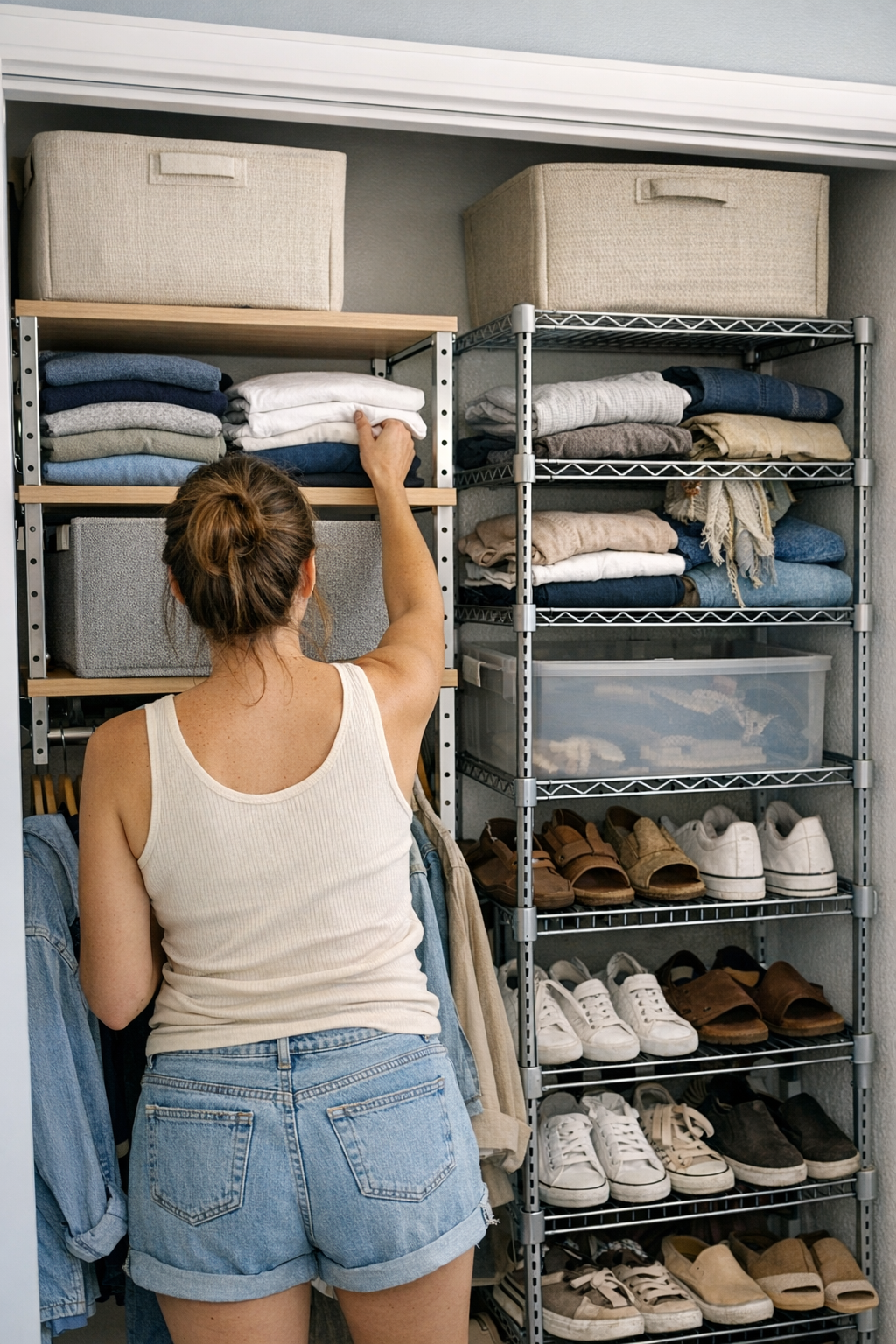
Solid shelves keep stacks stable and speed resets, while wire shelves allow airflow but let small items slip or snag during daily closet use.
Sometimes a small, stubborn disruption sneaks into our days—the kind you notice only when it breaks your rhythm. For me, it began with a closet shelf and the question of whether wire or solid shelving made any real difference. On the surface, a shelf is just a shelf—another horizontal plane smoothing out the chaos of clothing and shoes. But small design details can quietly shape the way we move through mornings and how often we find ourselves tidying up what should have stayed tidy.
You don’t see the friction until you’re reaching for a shirt in a rush, and something slides or snags.
But you feel it.
Order That Doesn’t Last
Newly installed shelves—whether wire or solid—promise a moment of order. Everything is lifted; nothing spills onto the floor. At first, this works.
But habits collect, quietly.
A row of t-shirts folded on a solid shelf stays neatly stacked, edges squared. On wire shelving, those stacks waver within days. Scarves droop, socks wedge themselves halfway through the gaps, and sometimes a small item vanishes altogether, buried or dropped to a lower tier.
It happens slowly: a gentle softening of the lines, edges blurring as the week goes by.
The Real Friction Reveals Itself
It’s easy to overlook the small corrections we make. A bin slides awkwardly as it bumps over a wire frame; a shoe collects lint falling from above.
I started to notice this in the middle of a busy week—an odd sock landing on my shoes as I pulled out a t-shirt, a tangled scarf refusing to stay on its stack. Each time, I’d pause to fix, adjust, or lift something back into place. None of these moments ruin a morning. But together, they ask for more of our attention than we realize.
You don’t notice it immediately.
But you feel it.
Quiet Experiment, Subtle Relief
Eventually, curiosity won out. I replaced one wire shelf with a solid board—just for folded laundry. Suddenly, the repeated re-stacking stopped. Each new pile sat quietly where I left it, and smaller things like socks stopped slipping through gaps. The old wire shelf found a new purpose for shoes, letting dust fall out of the way, and survived humid days without complaint.
It was a simple rearrangement, hardly worth announcing. But the relief was noticeable: no more double-handling, no more minor resets.
A little less agitation, a little more flow. In sharing space, sometimes thinking of the everyday touchpoints—like how a storage bin glides onto a flat surface without catching—can become its own kind of small grace.
It’s strange how much shelf choice can shape the hidden texture of our routines—one less thing to correct, another moment that stays undisturbed.
Change in a closet doesn’t seem monumental, but maybe that’s why it lingers quietly in the mind.
All these observations drifted together as I worked on a recent home reset—you can see more of how it unfolded here.