When Counters Become Unseen Dumping Grounds
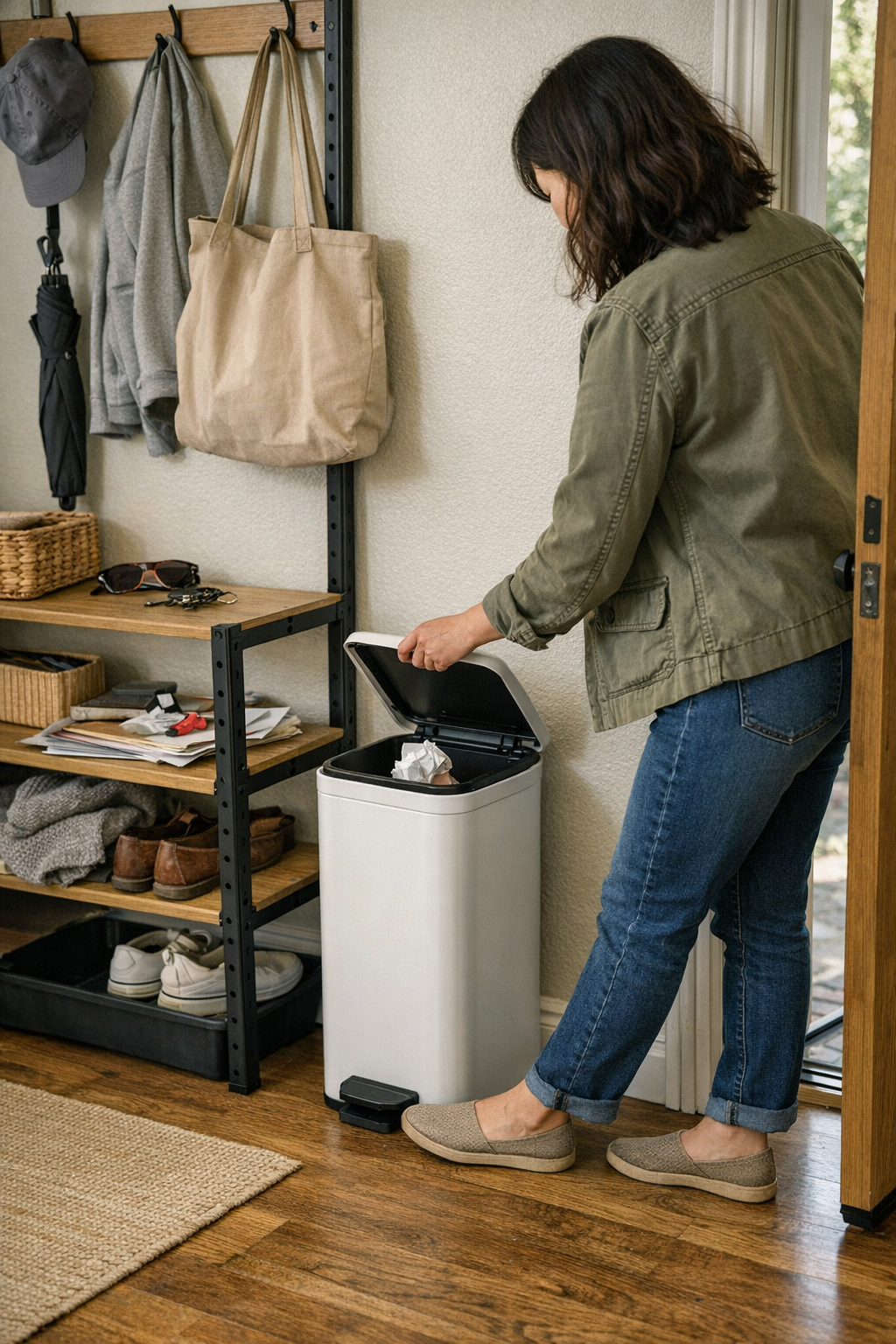
A trash bin near the entry prevents clutter buildup on counters and benches, keeping spaces clear through daily use and traffic.
The Surprising Weight of a Missing Trash Bin
Some lessons about transition spaces don’t come all at once. Each day, a bag drops, shoes kick off into a shifting row, and junk mail slips in beneath the headlines. There’s a rhythm to these routines—the push and pull at the threshold, the drift of things without a final home. It’s only when you pause at the entry, shifting wrappers from bench to shelf and back, that the absence announces itself: the trash has nowhere to go. This is where the controlled flow of a lived-in space quietly breaks down.
How Small Junk Migrates (and Never Really Settles)
You don’t notice it immediately. At first, everything seems contained; each item seems to have its place. But daily movement brings new debris—little things, always arriving, never finding their way out. Receipts, snack wrappers, a corner of cardboard freed from a package. They rest on the shoe bench or tuck beside a utility bin, and before long, edges meant for sitting or storage become mini landfills.
There’s a sameness to it, no matter how many times you clear the clutter. Without a bin right where habits converge—near the bag drop, shoe row, or entry bench—each surface becomes a temporary holding pen: a spot for all the “I’ll get it later”s. The space begins to choke, not only with stuff but with the friction of repeating an unfinished task.
It surprised me that disorder didn’t require chaos. It just needed omission—an unsolved need at the busiest spot.
When Reset Routines Lose Their Rhythm
Resetting a transition space sounds simple in theory: wipe down, gather, restore. But without a direct, easy-to-reach path for waste disposal, the cycle stretches and doubles back. I’d find myself juggling a stray cup with my coat still half-on or scooping up wrappers after noticing them mid-passage. Sometimes a family member would make a neat little stack on the bench lip “for later,” which—of course—just meant for me.
It’s not the lone item that slows things, but the way mess stacks in all these pause points. Shoes queue up on the mat, but keys, crumbs, and paper always drift to the nearest free edge or shelf. By the week’s end, the transition zone feels like a holding pattern: order on display but quiet pressure at every threshold. Oddly enough, a missing trash bin makes the bench overflow with clutter more than any extra arrivals ever did.
That was the part I kept coming back to. Disorder doesn’t always announce itself; sometimes it settles into routine and forces everything else to bend.
The Quiet Shift When Disposal Is Built-In
One afternoon, I placed a slim, lidded bin—nothing fancy—right on the path where feet shuffle in and out, near the shoe bench and coat hooks. The change wasn’t grand, but I felt it each time I emptied my hands before shoes touched down. Suddenly, resetting became less about catching up and more about keeping pace with daily comings and goings.
There was less friction: no detour past the kitchen, no awkward balancing act with every return. Surfaces stayed open, almost by default. Reset routines shrank back to something routine again. I realized this small addition wasn’t just about neatness—it cleared the way for real transition at the threshold, giving each arrival its own clean start.
You don’t need more space to make it work, just one honest spot for whatever needs to go. For lived-in entryways with continuous footsteps, shoe rows, bag drops, and shared use, a well-placed bin—whether slim vertical, mobile, or wall-mounted—changes how clutter spreads, how the bench breathes, and how routines flow. In the in-between, that’s often all it takes to keep the place moving smoothly.
Some more thoughts on daily comfort in lived-in entry spaces can be found quietly over here: http://www.betweenry.myshopify.com