When Doors and Storage Collide in Everyday Entryways
Entryway storage near swing doors clogs the path; placing storage outside the swing arc frees space and eases daily use and reset.
Every so often, you notice yourself tracing the same tight loop near the doorway—a small, involuntary dance around the shoe rack’s corner, a sideways step over the waiting umbrella or backpack. At first, it seems like a harmless habit that fades into the background of daily comings and goings. But gradually, the pressure at the threshold builds. The swing of the door, the accidental stubbing of a toe, the quiet sigh at the gradual drift of shoes and bags: these moments accumulate, subtle but insistent. Somewhere between order and overflow, you realize the real shape of the space isn’t defined by walls, but by what the door needs, what you bring in, and how those forces keep competing.
Where Things Land, and Where They Don’t
A swing door in a transition zone makes specific demands. Give it even a little less space, and over time, routines deposit clutter in places meant to stay clear. The neatness after a deep cleaning never fully lasts—the midweek scene usually features backpacks left “just for now” and a row of shoes creeping back into the door’s path.
You don’t notice it immediately. But you feel it.
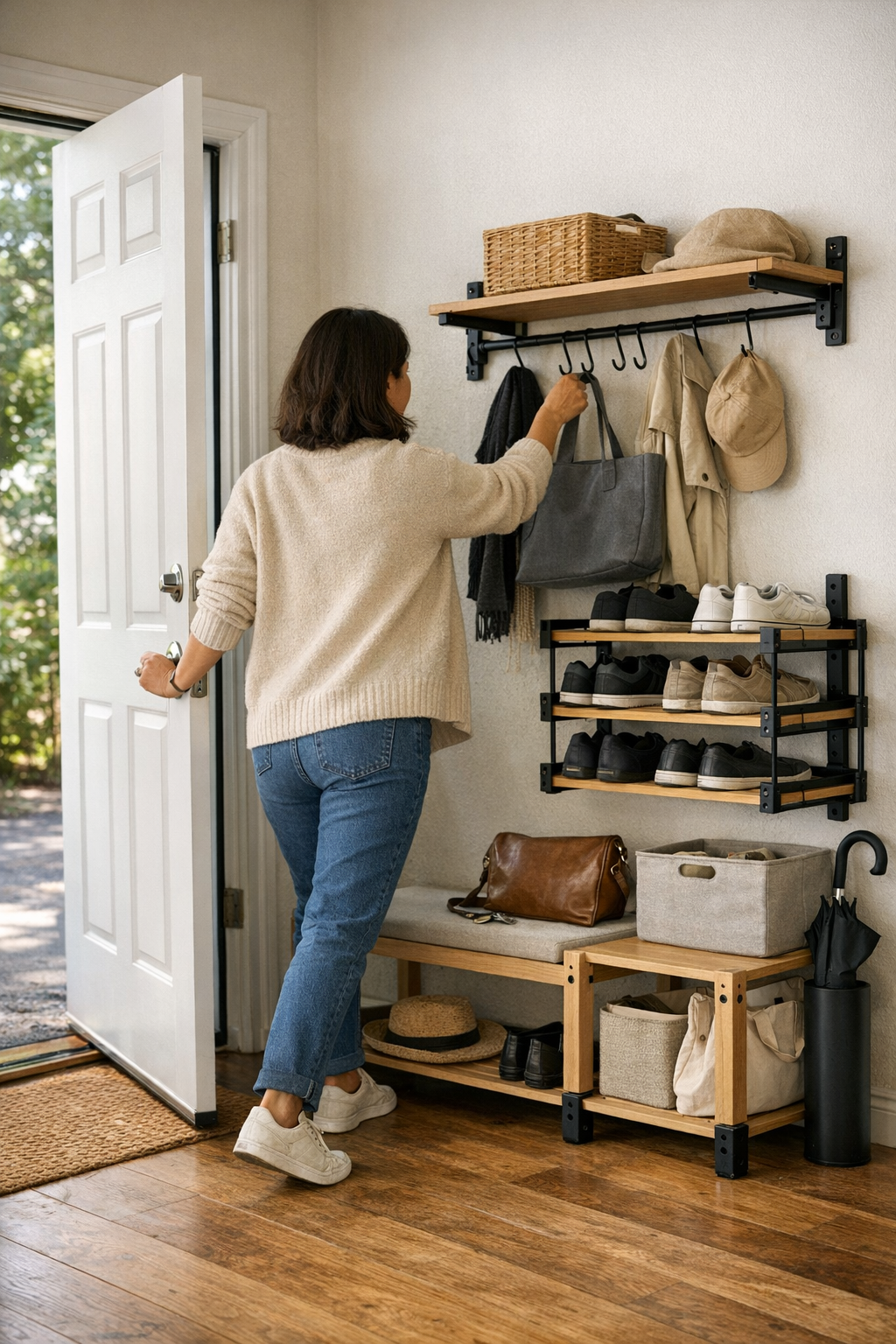
That was the part I kept circling back to: even thoughtfully chosen storage solutions, even those clever, slim wall-mounted racks, eventually start to lose the battle when the door’s arc fills with temporary items. A shelf fixed just outside the door’s swing, a narrow shoe rack mounted on the wall rather than the floor, took up less room but still allowed arrivals and departures to happen without interruption. The key wasn’t about having less stuff—it was letting the space fully reset every time the door opened.
The Cost of Almost-Fitting
It’s easy to misjudge how little clearance can work. A bench placed just barely beyond the door’s sweep functions well until a wet jacket or tote tips the balance. A utility cabinet might line up with the wall on a calm morning, but after a few cycles of returns and departures, things start lingering near the threshold—bags pushed aside, boots backed up, a wall hook gathering overflow.
There’s an invisible cost to always having something half in the way. The threshold, designed for smooth movement, becomes another surface for storage. Resetting this space demands more effort than expected. The urge to stack things behind the door eases only after a clear path—an unbroken 18 inches, roughly—is left open. When that happens, the effort to maintain order drops, and the ease of passage becomes noticeable once the friction disappears.
Routines Settle Into the Space You Allow
What finally changed the dynamic wasn’t a larger renovation, just small, silent adjustments. The bench shifted slightly further out; wall storage crept exactly to the edge of the door’s swing, not beyond. The area by the threshold felt open—not simply unblocked but quietly available.
Suddenly, leaving the house lost some of its usual fluster. The familiar movements of stepping back or sidestepping faded, replaced by a clear passage that encouraged smooth flow instead of accumulating clutter. It’s a quieter, less visible effect—but it’s felt in how unburdened you move through, even after the busiest day.
For anyone interested in transition spaces that forgive the daily routines of a busy household, there are more ideas here: http://www.betweenry.myshopify.com