When Hallway Light Stops Demanding Your Attention
A calm hallway setup isn’t just about style—it’s created by fixtures, cables, and supports that control glare and clutter every pass.
There’s a particular twitch in the eye that comes from moving through the same hallway every day, only realizing much later what’s really wearing you down. At first, the lights seem fine—simple overhead LED panel, clean lines, everything in place. But then one evening you cross that patch with your arms full, and there it is: a burst of glare from above, a thin hard shadow where you need your feet to land next. Nothing goes wrong directly, but the movement stumbles. The hallway has a way of reminding you which parts never actually faded into the background, even if you thought they would.
When “Minimal” Lighting Isn’t Really Invisible
It surprised me how many problems grew out of what looked like the simplest solution. Bare LED fixtures, flush ceiling panels, compact plug-in lights that you expect to disappear. The longer I lived with them, the more I noticed not just the glare, but the subtle interruptions—a visible cable line, a bracket breaking up a clean edge, hot spots that made the rest of the hall feel dimmer by contrast.
You don’t notice it immediately.
But you feel it.
Crossing from the living room, eyes still adjusting from a darker space, there’s always that sharp, precise moment of squinting. Sometimes I’d shift the laundry basket in my arms just to avoid catching the fixture’s reflection. If someone else was sharing the space, we both did that little sidestep to avoid spilling light into each other’s faces. What felt like a "solved" lighting setup on the first day turned into a low-level irritation. That was the part I kept coming back to.
Life Happens in the Edges—And So Does the Friction
The most lasting hallway annoyances usually come from things you’re told to ignore. A cable here, a shadow under a low shelf, the faint outline of a mounting bracket. At six in the morning—upright but not yet fully awake—pausing to avoid a hot spot at the bathroom door, I’d remember how unremarkable the fixture was supposed to be. Instead, every crossing repeated the same glitch: a moment’s pause, a minor self-correction.
You don’t plan for that. Not really.
There’s a split between light that works on paper and lighting that supports actual movement. If a fixture or its support gets in the way, you keep noticing it—never able to pass through without minor adjustments. The urge to fix it builds invisibly, just below the surface.
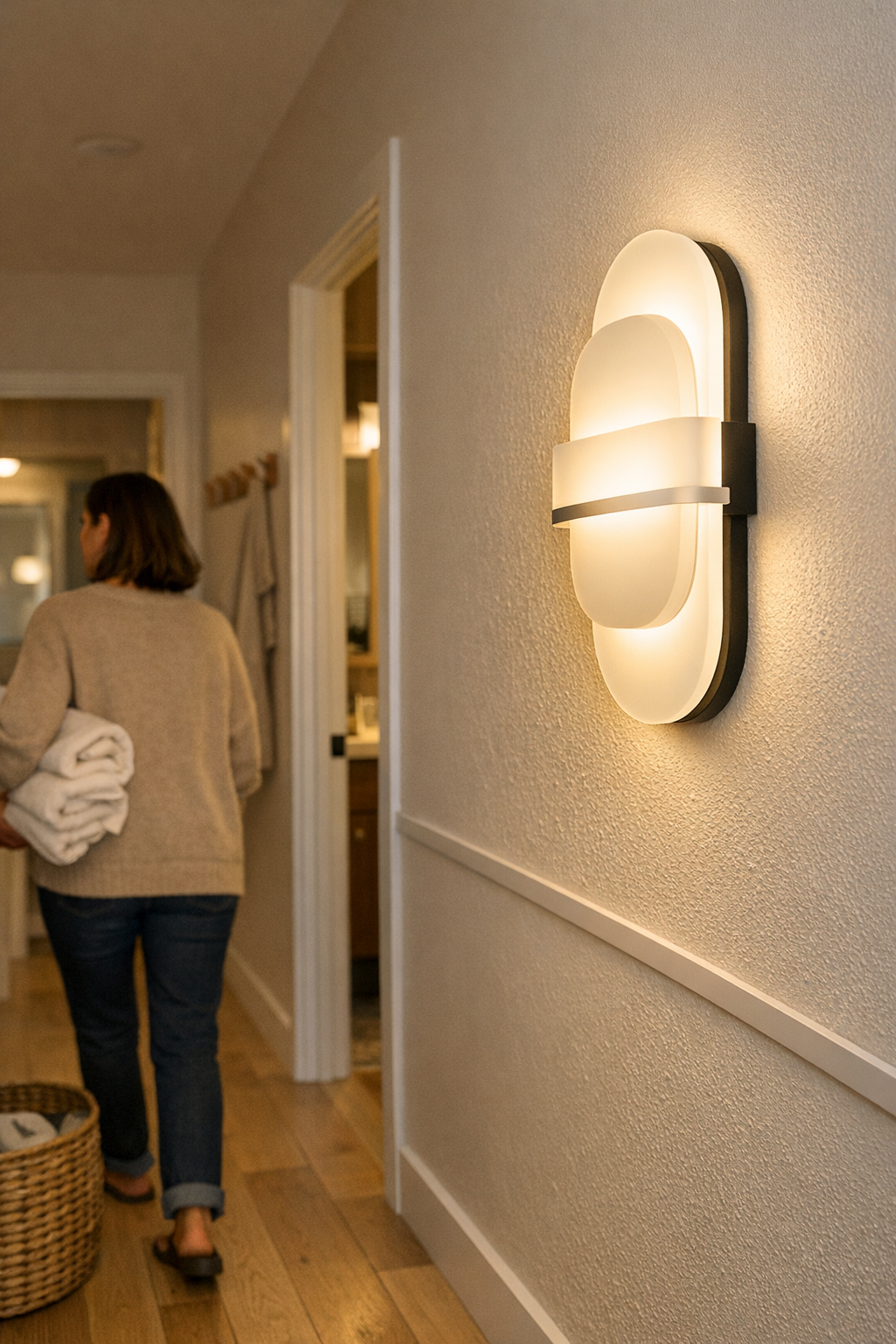
I started to see how even a simple change—using a slim, wall-mounted diffuser about a meter from the floor—could shift the mood. Light skimmed across where my feet landed. Shadows softened. The distractions began to dissolve.
The Soft Win: When the Light Stops Being a Character
Eventually there’s a moment where you walk through without noticing anything at all. The light fades from experience. Cables disappear into wall-colored channels; brightness lands where it should, not in your sightline. Instead of bracing for glare or correcting for shadow gaps, you just keep moving from the entry to the next door, unbroken.
It only took a bit of cable management and careful mounting, not a dramatic fixture swap or expensive solution.
The strange part is how quiet the change feels. It isn’t flashy—no one else remarks on it—but the hallway becomes what it was meant to be: background support for everything else, not a series of tiny negotiations on every pass.
At some point, I realized the real sign of working hallway lighting wasn’t a perfected design but a kind of unthinking passage—when you could go from one end to the other and not feel the light at all.
For anyone who feels caught up in the odd frictions of daily lighting, there are some quietly useful ideas collected here: http://www.lightsupport.myshopify.com