When Heat Guns Leave Hidden Scars on Wood Trim
Subtle differences in heat gun design, like nozzle width and heat consistency, prevent scorching and reduce rework during stripping.
It’s strange how the quality of a tool can hide in plain sight. You buy something as simple as a heat gun—judging by wattage, maybe the look of a nozzle—and feel certain they’re all much the same. At first, they seem to be. Peel away a small patch of paint, watch the surface bubble just enough. Everything works.
But then you get deeper into the job. You start noticing faint brown halos at the edges, a slight burnt aroma in the air. What was supposed to be clean, satisfying progress begins to look patchy, and suddenly the tool in your hand feels less like an ally, more like a source of trouble.
The Subtle Differences
Identical labels on the box, near-identical feel in your grip. Yet, as soon as the heat seeps into the wood’s surface, their differences become obvious. One heat gun nudges old paint away, almost gently, leaving the grain beneath undisturbed. Another—maybe just as expensive, maybe not—seems to scorch the same spot if you linger even a moment too long.
You don’t notice it immediately.
But you feel it. Sanding, later, is no longer routine but rescue. It’s that slow revelation, panel by panel, when a job that started out simple becomes painstaking—tracing burn rings with a gnawing sense you could have prevented them.
Fatigue Uncovers Flaws
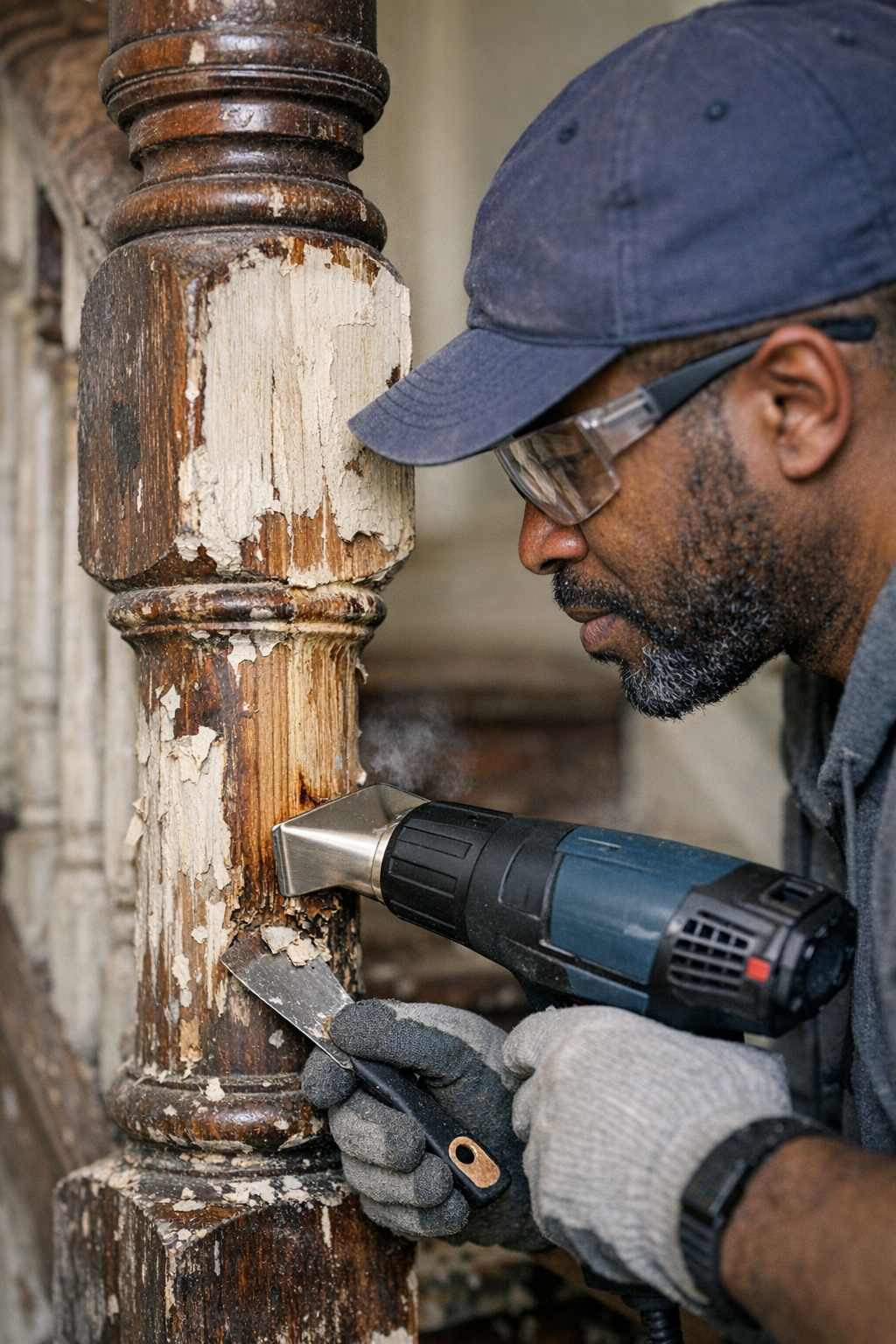
With straightforward projects, these quirks stay hidden. If you’re only stripping a hinge or two, nearly any model gives you a pass. The real test comes in the middle of a long stretch—say, an ornate Victorian banister, each spindle with curves that hold old paint in secret places.
You tire. Your hand rests for just a moment too long on the same spot. That’s when the burnt odor breaks through, when those faint brown stains announce themselves around the edges of each pause.
It feels like the heat gun’s supposed convenience is subtly working against you, amplifying mistakes you can’t fix until much later. Surface scorching accumulates. Finishes look uneven, even if your technique is careful. That’s why tradespeople sometimes talk about “matching the tool to the tempo of the job.” It sounds fussy, but by the end, you understand.
A Gentle Shift
The smallest change can make the difference. I found myself switching to a broader-surfaced nozzle—50mm wide, which doesn’t sound like much. But its effect was almost immediate. The heat spread evenly, softening the paint instead of baking it. I could pause and breathe without worrying over hidden rings or brittle, splintered wood.
Old fear faded: the sense that any moment of inattention might scar the project for good. There’s a kind of trust you regain, passing the wider nozzle over trim, watching strips of softened paint release cleanly and leave the grain intact.
It’s not about specs or numbers. It’s about preservation—a practical little lesson that only reveals itself when real-world rhythm meets stubborn surface.
Surface scorching doesn’t announce itself up front. It shows up at the end—in the hours lost to patching flaws, in the way light catches uneven finish, in the realization you could have chosen differently from the start.
Choosing a tool that goes gently makes all the difference, if not right away, then slowly, surely, over time.
These thoughts came together while working to restore a weathered bit of window trim on a quiet afternoon.