When Minimal Travel Bags Interrupt the Flow of a Journey
A minimal carry-on often fails in real use by overlapping items; separating documents and tech reduces friction at checkpoints and during travel.
There’s a quiet promise in a minimal carry-on: fewer pockets, fewer choices, less to worry about—a sense of control as you zip up before heading out the door. At first, it feels like dialing back complexity will make the trip lighter in every way. But once you’re moving—unclipping a pouch at security or sliding a passport back in mid-queue—a different reality starts to show.
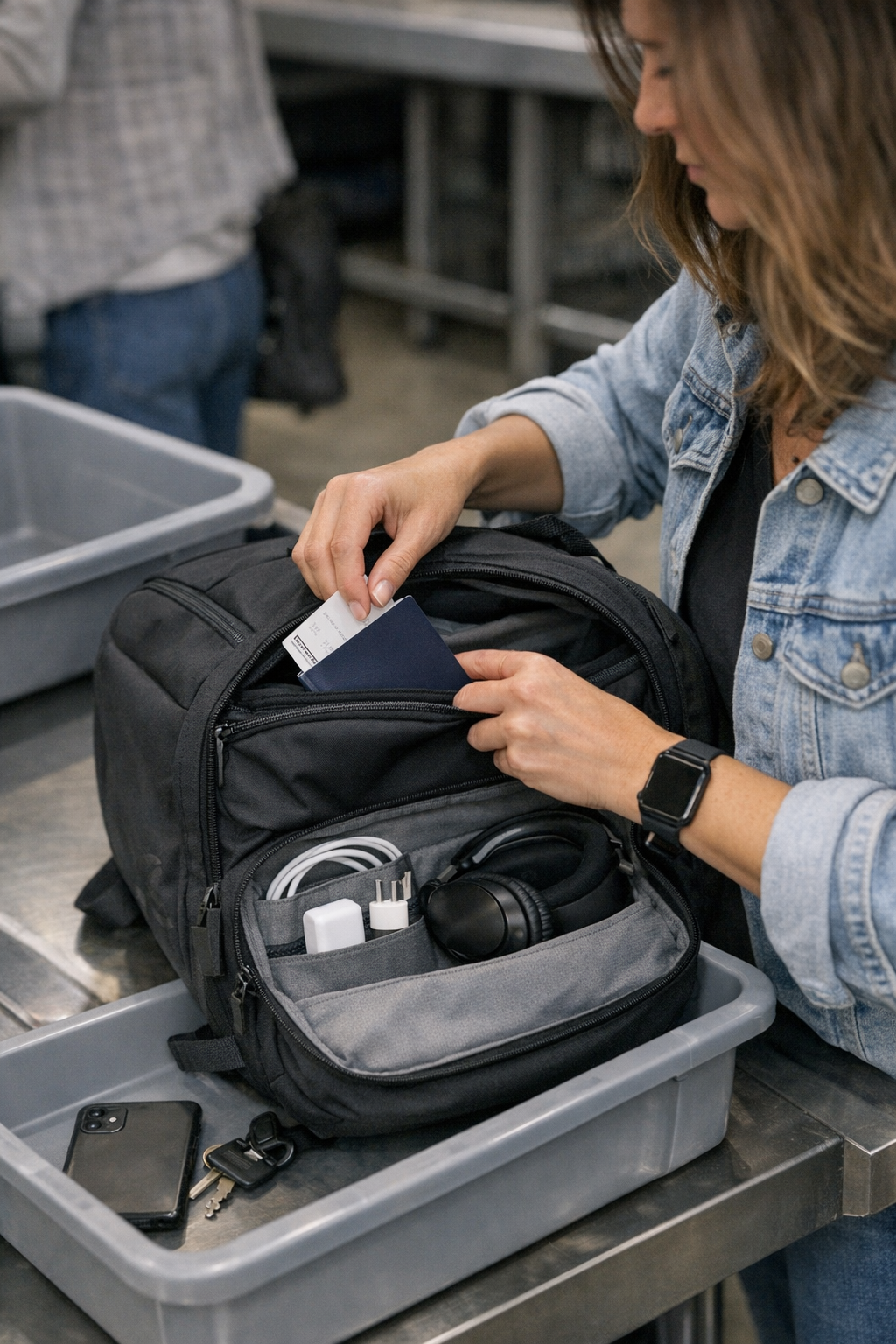
The setup that looked so streamlined at home quietly complicates things in motion. After a few transitions, you notice all-in-one pockets flattening cables against passports, documents slipping behind chargers, and every quick reach turning into a slow shuffle. It’s not the neat visual order, but the hidden friction—small hesitations and corrections while digging for one item and nudging another out of place. These moments add up exactly when time is tight, like between a checkpoint and the gate, or standing in the aisle with half your bag open and no room to repack.
At first, it seemed fine—two tidy pouches, a main zip, hardly any bulk. But that first crowded boarding moment revealed the problem: retrieving headphones slid a boarding pass across a pouch seam, and when I reached for a charger, the passport caught on the edge. The symmetry looked clever, but reach after reach, order collapsed into a series of micro-adjustments. That friction kept coming back—sometimes barely a second lost, but it grabbed my attention each time.
After a while, I split everything more intentionally: documents in a single shallow zip of their own, and all tech in a separate interior spot holding only chargers and plugs. From the outside it didn’t look very different. But in use, I stopped juggling items and repacking after every line or tray. The simplest change: a thin, dedicated pocket where my hand never had to move something out of the way to grab what I needed, even while moving. The whole routine smoothed out—not because the bag promised minimalism, but because it allowed things to stay separate when it mattered most.
Looking back, the setup that felt truly functional wasn’t always the most “minimal” on the surface. It was the one that needed fewer mid-journey corrections, where I could reach, use, and return items without worrying about what had been shifted or mixed up along the way.
If any of this feels familiar, you’ll find a set of carry-on tools here: http://www.carryonsupply.myshopify.com