When Neatness Fails: The Hidden Struggles of Organized Spaces
A storage system’s true quality shows with repeated use; surface order can hide issues like blocked movement or return friction.
There’s a quiet satisfaction in a freshly tidied workspace. Everything in its place—baskets aligned, carts parked in their corners, and the everyday clutter banished. It’s easy to feel hopeful: maybe, finally, things will stay this way. But the cracks don’t show at first. Not until routine settles back in.
The first days after a big reset are golden. Movement feels easy, surfaces stay clear, and returning tools almost feels automatic. The garage or workshop seems to hold its breath, as if order can be permanent this time. But slowly, friction creeps in. A cart sits just slightly in the way. A bin is harder to reach than expected. Small delays nudge the workspace rhythm off course.
The Sweet Spot Between Order and Use
Some kinds of mess jump right out, but others hide in plain sight.
You don’t notice it immediately, but you feel it. Resetting takes longer. Movement follows a zigzag pattern, not the smooth lines you pictured. There are blind spots—forgotten corners and overstuffed shelves—that collect odds and ends no matter how often you tidy.
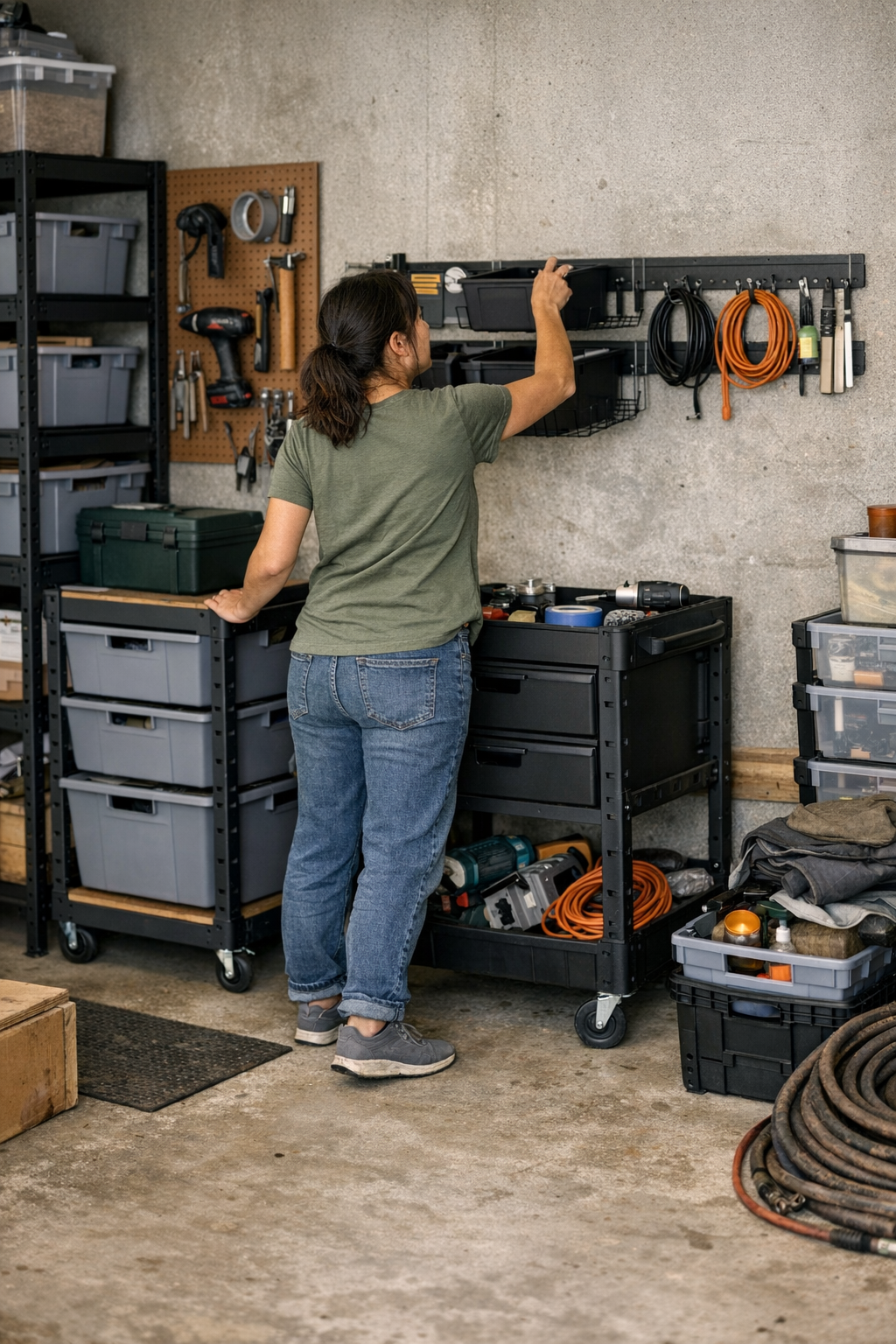
A newly organized space looks efficient. But day-to-day use quickly tests every assumption. Maybe the wall-mounted bins look perfect until a mobile cart parks in front, forcing a shuffle each time you want something. The gap between how a modular system looks and how it works grows wider with every small delay.
Where the Flow Begins to Hiccup
There’s a particular frustration when something nearly works but not quite.
I’ve seen it happen again and again: a garage or workshop setup that should be seamless ends up collecting friction in odd places. I once arranged my own garage with two slim carts and crisp wall racks—on paper, it all fit. But after a few days, I found myself pushing a cart out of the way, dodging its edge, reaching awkwardly for a single screwdriver. More time rearranging than actually working. The problem wasn’t lack of effort. It was missing space—unused, undefined, and overlooked.
These persistent trouble spots point to the real issue. If every reset means moving three things just to put one away, something subtle is off. What looks like order at first can mask daily inconvenience in real use.
The Unexpected Value of Empty Space
Not everything should be filled or finished.
It took me a while to see that the little “gaps” in a storage layout—the six inches no one uses, the strip a cart never covers—are what make the whole system breathe. One afternoon, tired of the awkward dance, I simply pulled a cart farther from the wall and left it there. The next week, the flow shifted. That extra pause-space gave me room to move and return things without extra shuffling. Over time, what seemed like wasted floor space became the key to keeping the setup light on its feet.
Sometimes the best arrangement isn’t one that fills every shelf or corner. It’s one where the flow feels easy, with just enough room to maneuver. We spend so much time chasing a picture-perfect finish that we forget lasting order grows from letting go—even if it’s just a foot of open floor near the wall.
I keep thinking about that—how real organization sneaks in where we leave space, even a little. These thoughts came into focus after long afternoons tinkering on a garage project I’ve been quietly building, balancing modular storage, mobile carts, wall-mounted racks, and open floor space for a real working rhythm.