When Outdoor Storage Fails After the Storm
A backyard storage setup seems organized at first but falls apart after storms; modular designs reduce clutter, save space, and ease use.
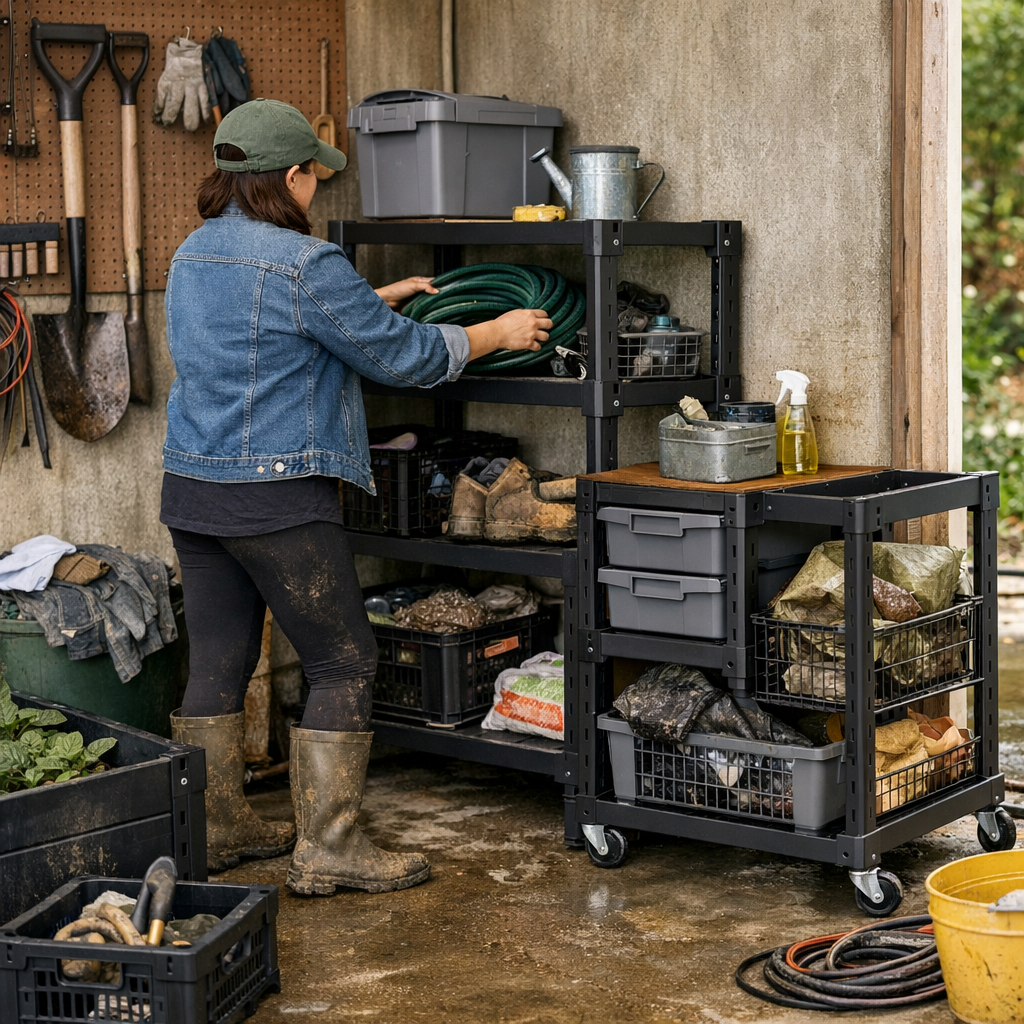
It’s easy to believe a neat lineup of bins and a watertight chest will keep the chaos at bay. At first, tidy order feels permanent—shelves flush against the wall, tools stowed side by side, footprints narrowly mapped out on the concrete. It looks like harmony, at least until real weather gets involved.
You don’t notice the cracks immediately. But you feel them.
One heavy downpour and suddenly that sense of order flickers. The waterproof chest is in the way. The bin lid bumps the wall. Boots drag mud past every carefully sorted row. What seemed solid on day one starts to unravel at the seams. The space grows heavier, more awkward—until the routine is no longer smooth, but a puzzle that doesn’t quite fit together.
What Setup Never Shows
There’s something about a clean storage setup that feels done—the satisfying symmetry of containers, the logic of shelves, the promise that everything will stay where you left it. But real life comes with motion, and motion makes demands the layout never anticipated.
A rainy week reveals details you miss in calm weather: lids that won’t open fully, bins you have to unstack, the spot you can reach only if you wedge yourself sideways. You start working around the storage itself, carving new paths that drag the outdoors straight back inside. Organization, at least the surface kind, can mask friction until you feel it in every return.
It’s surprising how quickly friction accumulates when routines don’t match the room.
Seeing the Flow Instead of the Footprint
After a few cycles of tools in and out, wet soil tracked inside, and crowded corners, the old faith in order starts to slip. I keep thinking of the day I tried returning an armful of gear after a storm, only to wedge myself sideways to reach a crate, knock loose a soggy bag, and then nudge everything around to close the lid. It’s tiring in a way that has nothing to do with effort and everything to do with broken flow.
That’s the moment things shift: order isn’t just how things look, but how easily you move. An open-sided rack with staggered shelves and a raised base makes things simpler—not by looking cleaner, but by not blocking the return path. Nothing to unstack, no lid to angle around, no wet bins pressed against the wall. Suddenly, there’s less shuffling, fewer soaked footprints, less of that creeping sense that you’re losing your grip on the space.
Sometimes, just a few inches of clearance changes the rhythm.
Letting Systems Adapt to Life
A setup that only needs to look good rarely holds up once real habits and weather take over. That’s been my quiet realization: any system that asks me to tiptoe, double-handle, or keep adjusting just builds up silent resistance.
I notice the difference most after rain. With gear rotating in and out—garden gloves, boots, forks, bags of soil—I find open racks with nothing to lift or drag out help things dry faster and routines recover more smoothly. Air flows, mud dries, baskets don’t overflow. There’s less delay, and far less clutter sneaking into corners unseen.
You don’t really design for trouble, but the right system seems to dissolve much of the mess before it happens.
I keep coming back to the feeling: when a space fits movement, resets don’t pile up; there’s just a quiet sort of ease.
These thoughts came together on a drizzly afternoon while moving things back to their place after another unforgiving spring rain.