When Perfect Lighting Still Feels Off at Home
Linear and panel ceiling lights provide steady, shadow-free lighting only when properly supported and aligned to the room’s real use.
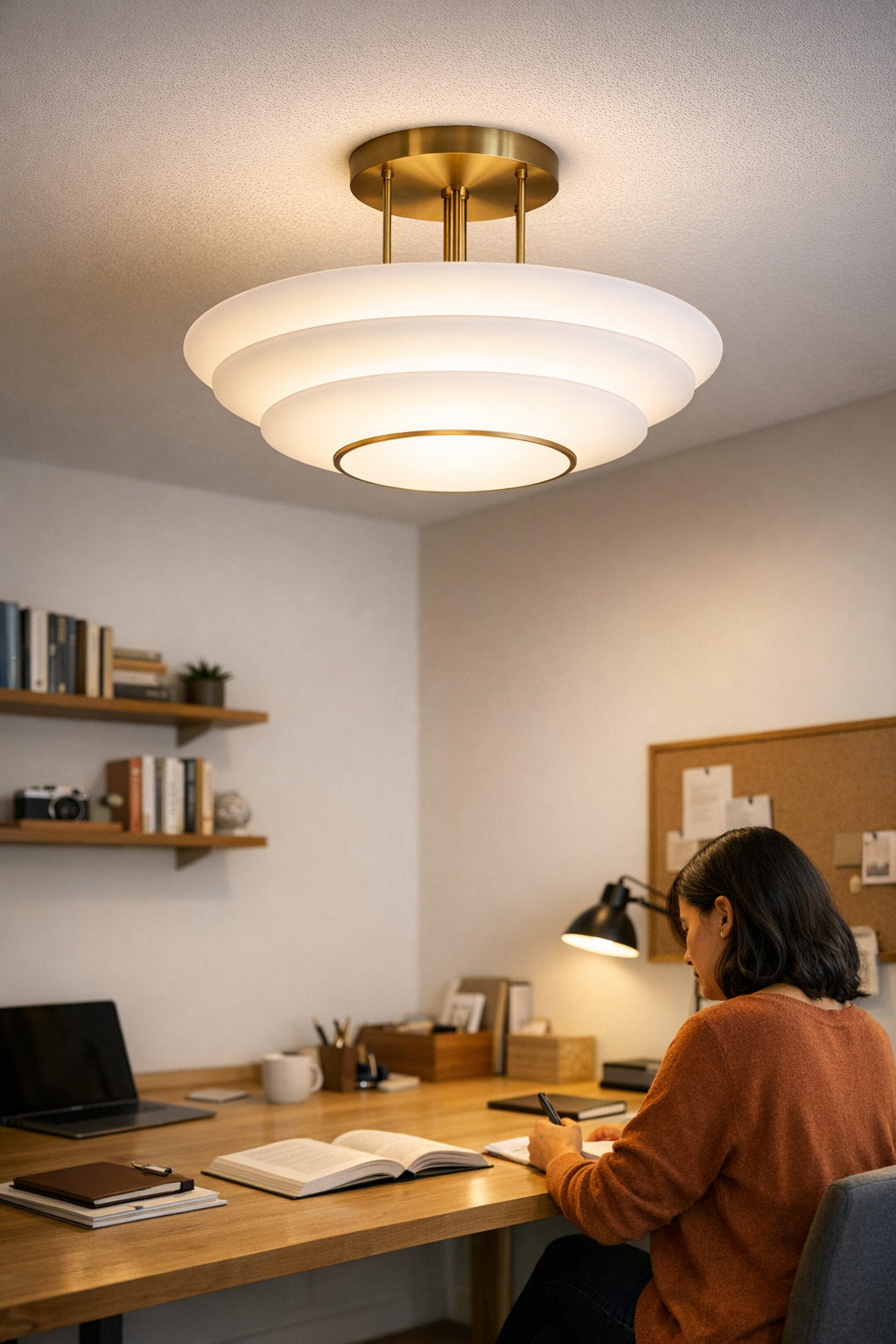
It’s curious how something as quiet as ceiling lighting can become the most insistent feature in a room. On the day you finish installing a new panel or linear fixture, there’s a quick sense of satisfaction—the lines sit flush, cables are neat, and the space feels more resolved. Yet, as days pass living under these lights, subtle issues begin to surface. A patch of shadow under your arm, a cable you notice every time you reach for a shelf, a faint glare on your screen just before evening. At first, you don’t notice these distractions. But you feel them.
The Difference Surfaces Slowly
Initially, a slim ceiling panel or a neat linear fixture seems to solve everything: delivering even, shadowless light across a desk or long table, banishing bulbs and cluttered lamps. It works—until you miss a corner while reading late at night or shift your laptop to avoid a narrow strip of glare.
I didn’t expect to keep noticing the same cable line either—always just at the edge of my peripheral vision and gradually creeping closer to the places I needed to move. The light itself remained steady and broad, but the small things—the cable’s path, a bracket that wouldn’t sit flush against the wall—became increasingly distracting with each routine use.
Minimal Is Not Always Practical
One evening, the desk looked perfect until I sat down at the side edge. The center was well-lit, but the last twenty centimeters faded into shadow, and every page outside the beam felt left out. It wasn’t dramatic, yet persistent enough to matter. The students sharing that room started bringing portable lights or hunting for new outlets. A little clutter crept back in, almost apologetic.
Cables have a way of intruding, too. Something as small as a cable refusing to run cleanly along a wall bracket can become a persistent irritant, noticed only after days of adjusting your reach or rearranging items on the surface.
The Part That Stayed With Me
What made the real difference was a quiet adjustment: shifting a linear fixture so its lit edge aligned with the desk rather than the ceiling’s center, then tucking the cable tightly along the wall. Suddenly, the dark edge wasn’t dark anymore, and the cable vanished from daily awareness.
This is the detail I kept thinking about. Fixtures perform best when they reflect how a space is actually used—not just how it looks on install day. The true measure of improvement is what you stop noticing: the fumbling, the hint of clutter, the small compromises that disappear when practical details finally match the routine.
Often, lighting feels off not because it’s faulty, but because a cable lingers where it shouldn’t, a bracket won’t fit just right, or a beam misses key work areas. The tension is less dramatic than it is quietly persistent—a reminder that spaces reveal their real needs over time.
I continue to notice these subtle clues the longer I live with each setup. If you want to explore more, you can visit http://www.lightsupport.myshopify.com.