When Storage Fights Back: The Quiet Struggle of Daily Reset
Storage that seems organized may cause daily friction; simple access and clear categories prevent clutter and make resets automatic.
It’s easy to mistake neatness for order. You line up matching bins, stand back, and feel a short-lived satisfaction at the sight of a clean, geometric shelf. For a few days, every item has its place—at least in theory. But then routine quietly intervenes.
You don’t notice the flaws immediately.
The trouble comes later, in small inconveniences that gather with use.
Storage, it turns out, isn’t just about looking organized—it’s about whether the system stands up to real, everyday rhythms.
The Quiet Creep of Clutter
At first, everything holds. Bins stay stacked; labels remain obvious; you return things dutifully. But a few days in, friction sneaks up—the kind that doesn’t announce itself.
You rummage for a belt and end up dragging an entire container down.
Shoes get mixed in with spare shirts. “Just for now” piles start growing in the corners.
It happens quietly.
After a while, it becomes easier not to bother resetting the system each time. Instead, you leave something out, just for a night.
Before long, what looked perfect at setup starts looking lived-in—slightly chaotic, a bit more complicated than you intended.
I notice it most when I’m in a hurry. My hand hovers over the bins, remembering which ones can be trusted to give back what they took last time, and which ones are due to spill everything out.
The Shift From Looks to Use
Eventually, you realize how much energy you’re spending on tidying up—repeatedly moving and restacking, always a step behind.
The difference between a functional and faltering system isn’t how it appears on Day One, but how it works after a week of rushed mornings and late nights.
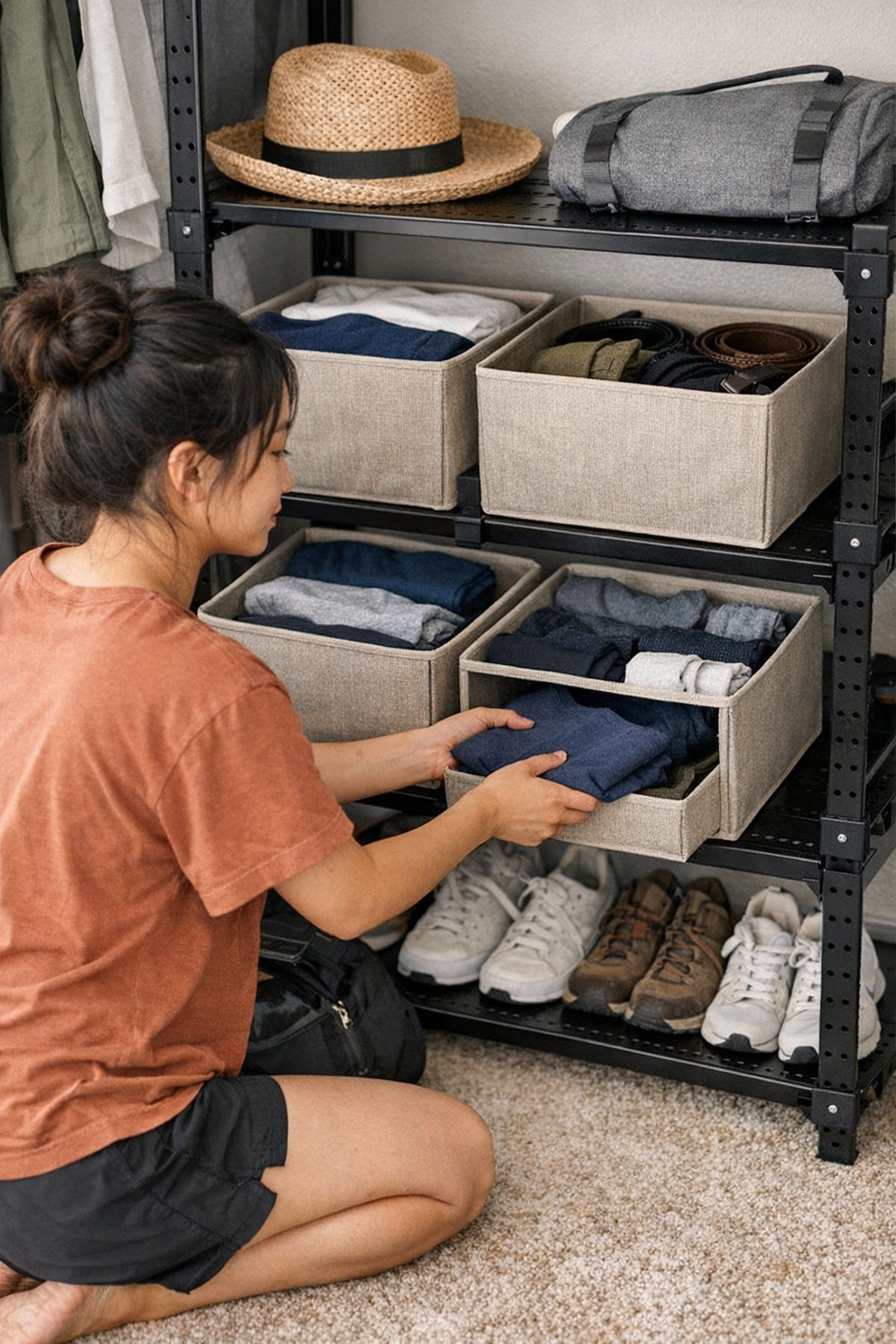
I once switched from two deep baskets to four smaller open bins, each with its own purpose.
The change wasn’t dramatic at first. But I found myself no longer hesitating at the closet. It became one smooth reach and return, not a hidden struggle every morning.
You don’t notice the lack of resistance right away.
But you feel it: the reset takes care of itself, and mess has no time to gain a foothold.
Where Clutter Gathers, Attention Drifts
Over time, areas that demand too much attention fall into neglect.
If a bin needs to be lifted, dug through, or rearranged just to find one item, it quietly trains you to avoid using it at all.
This is the subtle lesson: systems that respect your real behaviors survive. The rest, no matter how pretty, quietly unravel with routine use.
The practical beauty of good storage isn’t in its symmetry, but in the way it takes care of itself amid the rush of daily life.
When the friction drops, consistency—almost without effort—becomes possible.
Lately, I notice I’m not thinking about organizing much at all. That’s how I know something’s working, at least for now.
These thoughts came together while reorganizing my own space — in response to the rhythms I hadn’t noticed before.