When Storage Meets the Flow of Everyday Life
Switching to task-based storage clusters items by routine, speeding retrieval and reset, reducing clutter, and improving daily organization.
You don’t always notice the subtle ways a space shapes your day. Morning after morning, the closets are neat—shelves labeled, bins stacked, everything sorted by type. Yet somehow, that sense of order unravels when real life gets moving. Before long, it’s not just shoes you’re searching for, but lost minutes and untied mornings.
It starts as a quiet frustration. The routine looks good on paper, but something is off in the daily rhythm. Whether you call it “closet organization” or just “trying to keep it together,” the challenge feels all too familiar.
The Hidden Cost of ‘Sorted by Type’
It’s tempting to line things up by category—hats here, shoes there, coats in their place. The closet looks predictably organized. But as the workweek rolls on and routines repeat, a pattern emerges: each morning is a series of zigzags and backtracks, chasing after scattered essentials.
You almost don't notice this the first few times. But you feel it.
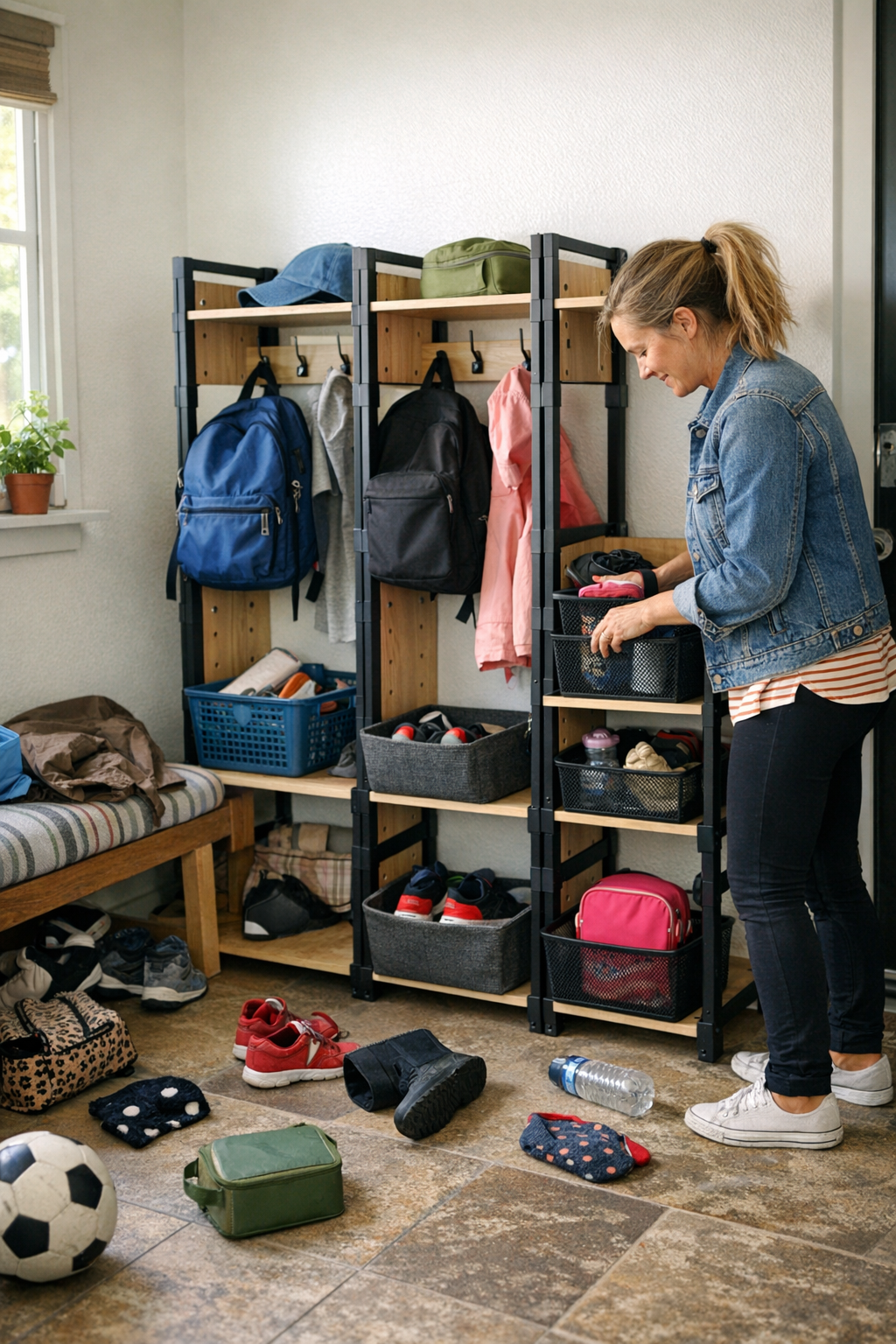
Categories make everything easy to find—until real-life, time-bound routines put pressure on the system. Shoes drift into coat piles. Lunch bags end up under jackets. The sense of control from the initial setup starts to slip away, quietly replaced by daily searching and reset fatigue.
I’ve watched this happen in my own hallway: what looks sorted by Sunday is scattered by Thursday, the effort to restore order compounding with every rush out the door.
A Subtle Shift: Organizing By Moments, Not Things
It took me a while to see that the problem wasn’t clutter, but the path I was taking through it. The real issue was pattern—the way mornings and evenings unfold, not just where things are stored.
When the space is organized around routines instead of categories—each person’s shoes, bag, and jacket kept together in their own station, right by the door—the room seems to breathe. Suddenly, each child has a simple arc, not a winding search. Retrieval becomes a single pause, not a journey across every shelf.
There’s a sort of calm that enters the room when design bends to daily life. The switch isn’t about new shelves or bins, but about noticing the rituals that repeat themselves, and setting spaces up to honor that flow.
Living with Less — and Noticing What Stays
The most surprising thing is what falls away. There are fewer lost hats, less doubling back for forgotten gloves, and a lot more floor visible at day’s end. Mornings no longer start with the tired refrain of “Where’s my…?” Instead, it’s often just one reach, one reset.
It’s not perfectly tidy. Grouping by task has a different look—items gathered by function, a little less symmetrical, but unmistakably lived in. Yet the order lasts longer, and the time saved is real, especially during the hectic hours.
Maybe the real insight is this: when storage fits the shape of your days, not just the shape of your things, the space feels less like another task to maintain—and more like a place that gives something back.
Somewhere between the zigzags and the resets, small improvements began to feel like a kind of quiet support. These thoughts came together while reorganizing my own entryway, on a morning that finally started out calm.