When Your Closet Finally Feels Effortless to Use
When your closet system is right, you reach for what you need without extra effort or reshuffling, making daily routines smoother.
It’s easy to think a tidy closet will set you free. All those neat stacks and lined-up bins offer a sense of calm—at least at first. But sometimes, what looks like perfect order still echoes with small frustrations. The real difference isn’t the container or the shelf. It’s how many times you have to touch something just to use it.
You don’t notice it immediately.
But over time, the rhythm of your space starts to trip you up.
The Subtle Cost of Every Extra Move
At a glance, most organized closets look about the same. Shirts folded, baskets squared, shoes stacked below. The trouble shows up later. Moments when grabbing one thing means shifting three others—when putting something back takes both hands and a little exhale. Each minor interruption adds up. Sometimes it’s a shelf that asks you to move a basket just to reach yesterday’s shoes, or a folded pile that topples with the tug of a single sleeve.
You feel it, even if you can’t name exactly what’s off.
What’s really at stake is flow—the small, nearly invisible friction of storage not quite built for everyday life. If things require more handling than they should, the system quietly asks for more of your time. Over the days, this builds from a minor test of patience to a reason the closet looks right, but never quite works.
How Overlap Turns Order Into Chaos
A closet can hold two people’s routines, holiday sweaters, and guest towels all at once. For a while, it manages. Then, towels drift into boots, a mitten falls out while the linens shift, and suddenly the design unravels. A hallway closet designed for everyone soon favors nobody. What began as a shared space starts to feel like constant maintenance. Categories cross over; stacks have to be rebuilt, not just straightened. That’s the moment you realize the system isn’t holding you, you’re holding the system together.
There’s a kind of quiet fatigue in having to fix things, not for the sake of tidiness, but just to keep basic access. One shelf. Two purposes. And a daily urge to redo what should already work.
Small Boundaries, Big Shifts
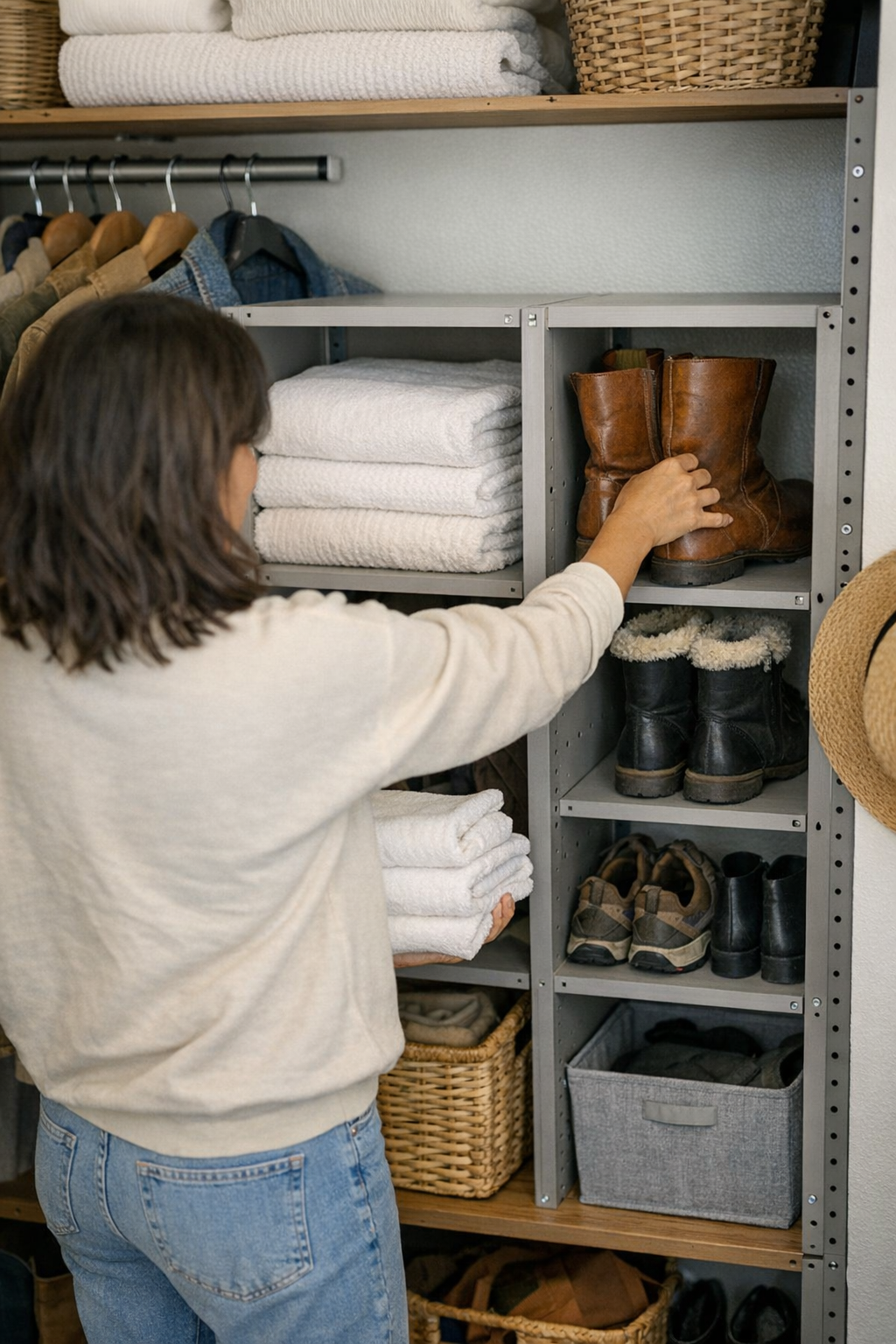
I watched this happen in my own hallway. Two weeks after organizing, what started as crisp folded stacks and ordered boots blurred into a mix of lint, toppled piles, and the occasional rogue glove. A single change—adding a slim divider panel—transformed the shelf. Suddenly, towels stayed neat, boots moved easily, and nothing crossed the line. Each group had space to be itself.
The number of touches halved. Reaching in became a single motion, not a chore. There was no need to bend down, to restack, or to hope the top towel wouldn’t catch on a boot. It was a small fix, but it changed everything about how the space felt to use.
These kinds of adjustments aren’t always dramatic. Sometimes, all it takes is a gentle boundary—a bin, a divider, even a different kind of basket—to keep things flowing with less effort.
Which is worth noticing: if putting things away feels like step after step, your closet doesn’t need more storage. It needs more ease.
It’s strange how order and rest can hinge on something as simple as the path your hand follows, day after day.
These thoughts came together while standing in a quiet hallway, noticing which things stayed put and which ones strayed. (More musings, here.)