Finding Calm Beneath the Desk Amid Everyday Cable Chaos
Hiding desk outlet mess with the right cable management removes visual irritation but only works long-term if it supports your cable change routine.
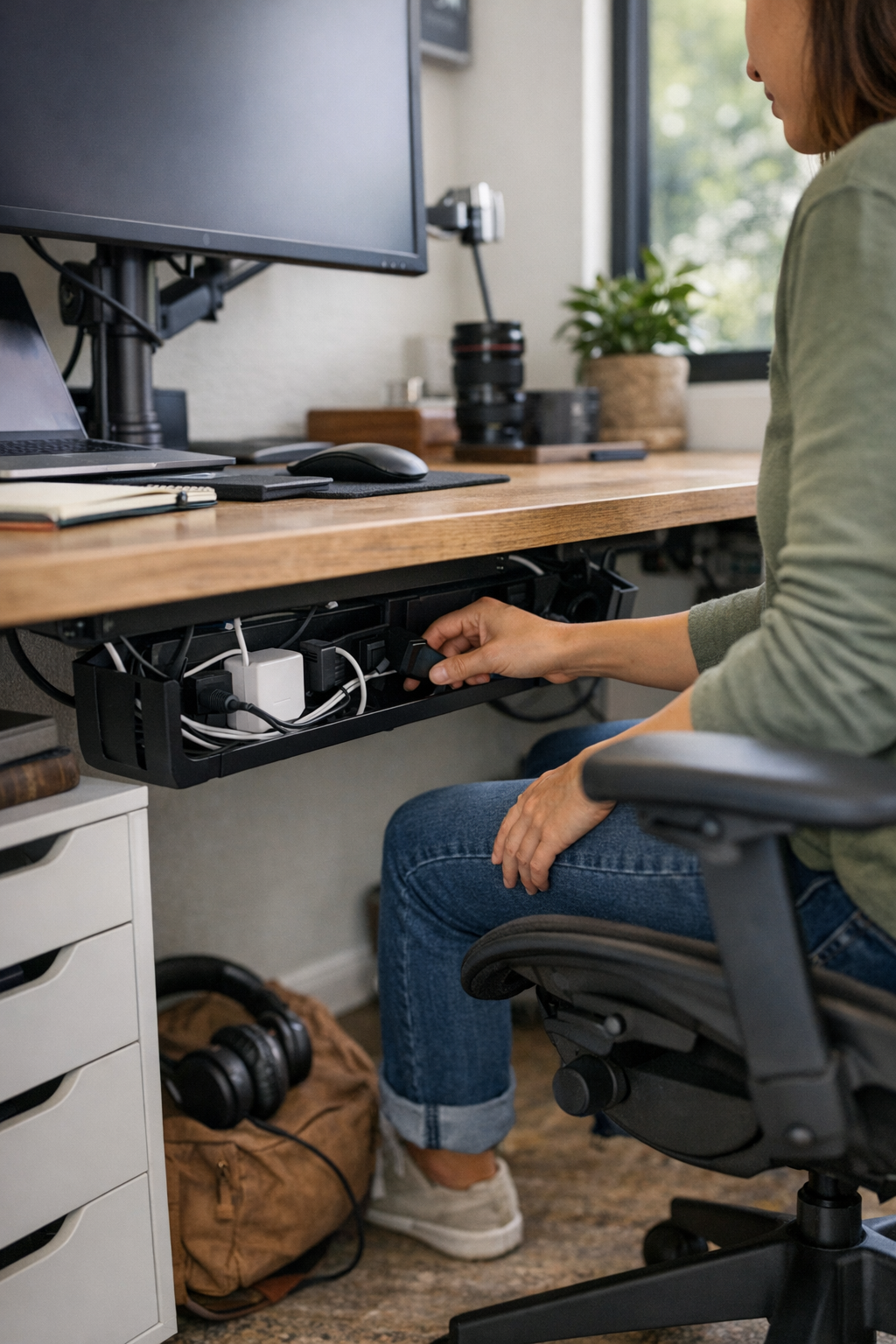
When Hiding Cables Solves One Problem and Quietly Creates Another
At first, the tangle of cables beneath my desk seemed tolerable—background clutter, nothing urgent. It only drew attention when my foot snagged a line or when a charger had to snake across open space on a busy morning. For a while, I let it be. But these interruptions added up, small delays multiplying whenever I needed to switch a monitor or hunt down an open outlet. That’s when I started considering the real role of cable management—not as a styling choice but as a practical fix for the rhythm of real work.
The Surface Is Not the Whole Story
Fitting a cable box under the desk felt decisive—tidy, invisible, done. You notice the change after a few days. There’s calm where there had been a mess, a clearer line for your feet, nothing to catch your eye or trip you up. The desk feels newly intentional. But that was only half the story. The box did its job too well: every time I had to plug something in or swap a charger, the cover became a little obstacle, breaking the flow of small tasks with extra moves and awkward hand angles.
It looked fine at first. But the difference kept showing up.
The barrier between calm and convenience isn’t always visible until you need to reach through it.
Practical Order and Real Friction
I learned the deeper effect once desk routines started overlapping—meeting on one screen, jumping to a different call, plugging in a power adapter for a quick charge. The neat cable box under the desk, fixed closed and meant to soothe, turned the simplest cable change into a small project. Sometimes it meant shuffling the chair or crouching lower, pausing work to dig out the right plug. For setups that rarely change, this cost may hardly exist. But for anyone tweaking a layout even once or twice a week, every extra step becomes its own source of drag.
That was the part that stayed with me: how fast a tool for order could start shaping little moments of friction. The structure was finally neat, but each routine change now surfaced its own kind of interruption. The tradeoff lingered—neatness paid for with lost momentum.
An Uncovered Path Forward
Switching from a tightly sealed cable box to an open cable tray, tucked just out of sight, changed things more than expected. The workspace stayed clean to the eye, but now swapping a device or pulling a new cord was as easy as reaching sideways. A pause, and then work could continue. Less drama, fewer resets before starting again. It wasn’t about hiding everything so much as finding a blend—just enough cover to feel settled, open enough to fit the pattern of my days.
The practical upside became obvious after a week: more time spent in flow, fewer minor interruptions, less resentment at the tools that were supposed to help. Routine became a touch easier to maintain. The structure that fit best was always the one that matched how often things actually moved.
Sometimes the answer isn’t more cover or less clutter, but a small shift in access—a pathway that makes sense for how you really work.
If you want to see a few structures I tried along the way, they’re here: http://www.workbasic.myshopify.com



