Finding Quiet Corners for Calmer Cat Moments
A protected, corner-placed box reduces startled exits and messes, making upkeep lighter and shared space calmer.
Some things only become clear after they’ve quietly worn you down. It’s easy to think you’ve found the right place for your cat’s box—a soft square in a corner, a neat mat pulled straight, the quiet hope that this time, you’ve cracked the setup. But the real meaning of a “working” spot only reveals itself through repeated daily use. I noticed it in small, repeated details: the same toy fetched from under the chair again, the mat edging out of line, that thin trail of fur building up by the baseboard each evening.
At first, you believe the setup is finished, as if it’s a fixed part of the room. But living with it tells a different story.
When a Tidy Spot Still Multiplies the Mess
You start to see it after a few resets. The box looks tidy beside the entryway, or tucked along a kitchen archway—visible and easy enough for your cat to reach. Yet it only takes one quick pass through the room, a dropped spoon, or a rush to open the door for things to fall apart. The cat startles and bolts, and the disruption expands: bowls shift, toys scatter, the mat wrinkles under a quick paw.
It looked fine at first. The problem isn’t loud or dramatic—just the steady return of small upsets that quietly demand more frequent attention. For me, it was the third time that week bending down to pick up another runaway mouse, or running my hand over fur winding along the baseboard. Patterns embedded themselves into the nightly routine: a bit of fixing, a bit of gathering, one more small wipe.
The Subtle Win of a Protected Corner
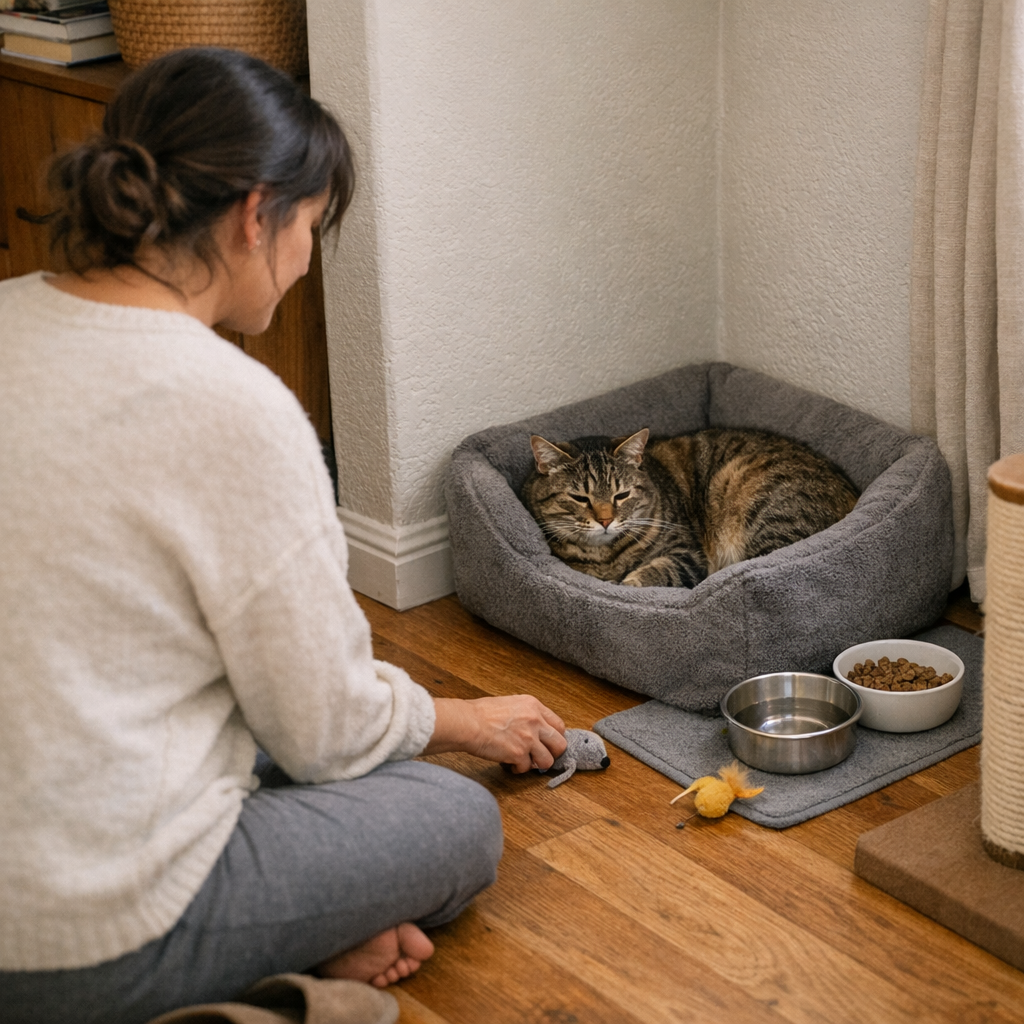
Eventually, the “finished” setup couldn’t keep up with the ongoing churn. That part kept coming back. Changing the location felt overdue, if only to carve out a calmer stretch between cleanups. I moved the box away from the busiest pathway and into a real corner—two walls behind it, with only one opening facing the quieter part of the room. I didn’t expect much at first, but the difference grew over the next week.
It became quieter. The cat curled up instead of springing away when someone walked by. The mat stayed in place and only one toy needed rescuing from behind the radiator. Cleanups became gentler, less urgent. There was one less collision between routine noise and the resting animal, and everything seemed to settle into place with less fuss.
You don’t always see the impact when you adjust for your cat’s sense of safety, but the chance to do a little less reshuffling each night is proof enough.
Real Life Means Real Adjustment
Every home shapes itself around comfort and practicality in its own way. It’s easy to mistake a calm-looking box for a settled plan—but repeated use reveals the tension between setup and upkeep. If you’re often nudging mats, tidying up toys, or finding fur trails after another startled dash, sometimes the fix is more about location than what you’ve placed there.
It’s a small reshuffle—not a big investment. But the difference shows itself quietly, night after night.
Sometimes noticing what really reset itself is the only way to see what actually works. For a closer look at StillWhisker’s world, you can wander over here: http://www.stillwhisker.myshopify.com