How Divided Entryway Benches Change Daily Routines
Entryway benches with separated cubbies prevent clutter by keeping belongings separated, easing daily routines if capacity matches use.
You don’t really notice it in the first couple of days. The bench I placed by the door stood empty, open—an easy landing spot for shoes coming off, bags dropped between errands. For a little while, there was a sense of just enough order. But by the end of the week, as my own quick routines mixed with everyone else’s, that ease fell apart. The jumble crept in quietly, turning the entryway into the kind of mess that makes mornings noisier and more frustrating than necessary. It never feels urgent—the slide into pile-up just happens.
Where the Mess Actually Begins
There’s something about a single open storage space, like a bench or floor system without divisions, that allows belongings to blur together. You toss in two pairs of sneakers on Monday, a stray scarf by Wednesday, then someone’s work bag wedges in on Thursday. The surface doesn’t look too bad at first—no big mountain, nothing catastrophic.
But then, suddenly, a shoe is missing. Someone else’s bag covers it, or a kid’s jacket slips in between and hides the matching boot. It’s surprising how quickly a neat space turns into a shared heap once multiple hands put things back their own way. Retrieval doesn’t just slow down—it sometimes stops altogether as you stoop and dig. At first, you don’t notice it immediately. But you certainly feel it during those rushed mornings.
The Small Boundary That Changes Everything
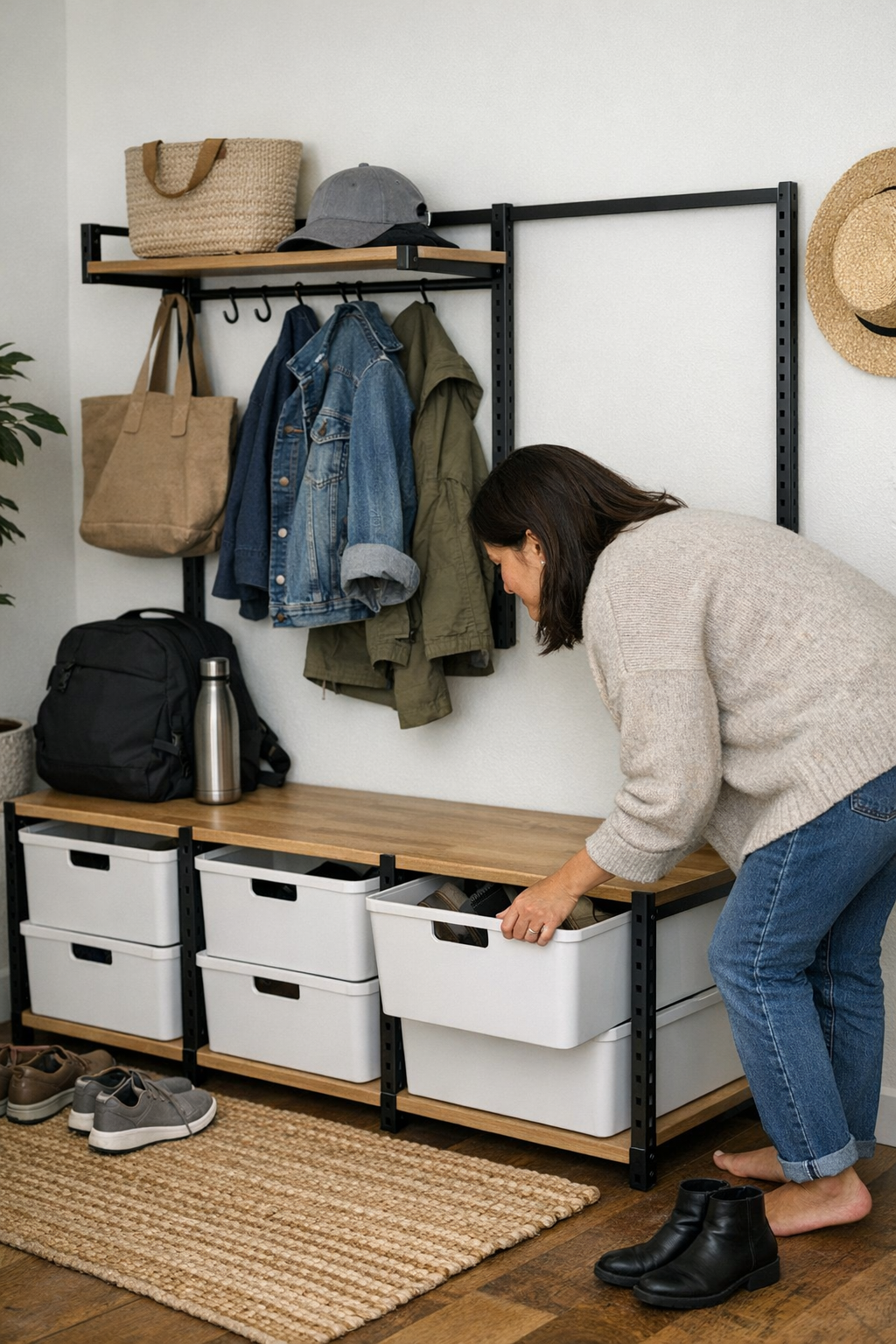
I swapped the wide open bench for one with a row of square cubbies—each just big enough for a single pair of shoes, with clear divisions between every slot. The difference wasn’t dramatic at first, more a quiet tightening. Shoes didn’t lean on each other as much, and bags stopped invading shoe territory. The order wasn’t perfect. But the mess always had a defined shape, and jumble could only grow to the edge of a cubby before demanding attention.
The crucial improvement was that neglect didn’t have as much room to hide. If a pair didn’t fit, or if someone tried to cram an extra bag into a slot, it became immediately obvious. There was no slow creep of stuff drifting together—just a small, recognizable overflow that pushed back. The problem didn’t vanish, but the boundaries held firm against the daily push and pull.
That was the part I kept coming back to. With defined spaces, you get a built-in limit—things only fit until they don’t, and when they stop, it’s time to decide what stays or moves on. The system gently nudges you to rotate or reset before chaos boils over. One set of everyday shoes per person, maybe a bag or two, and little else. Enough to handle the weekday churn, not enough to encourage a backlog.
The Quiet Trade of Daily Upkeep
Cleaning feels different, too. A divided bench collects less mud and dust overall; dirt tends to settle in one slot instead of spreading everywhere. Mess stays contained for longer, but the lines between cubbies make it easy to spot what needs attention. A quick swipe is enough most days, so upkeep never piles up.
It isn’t perfection, just resilience. Over time, I noticed a small relief—a less frantic search as we leave the house, fewer trips over abandoned sneakers. It felt like the space itself was quietly doing the sorting and reminding. There’s a comfort in knowing the entryway resets, a little, each time we come home.
Small changes like this don’t solve every storage challenge, but they soften the hard edges of daily routines around mixed-use entry spaces. For a clear example of practical, repeated-use storage systems that respond to real household pressure, there’s more to see at http://www.gridry.myshopify.com.