How One Quiet Corner Changed Our Daily Flow
Building one firm “quiet corner” boundary contains indoor-cat mess, reduces cleanups, and keeps feeding and play routines from overtaking shared space.
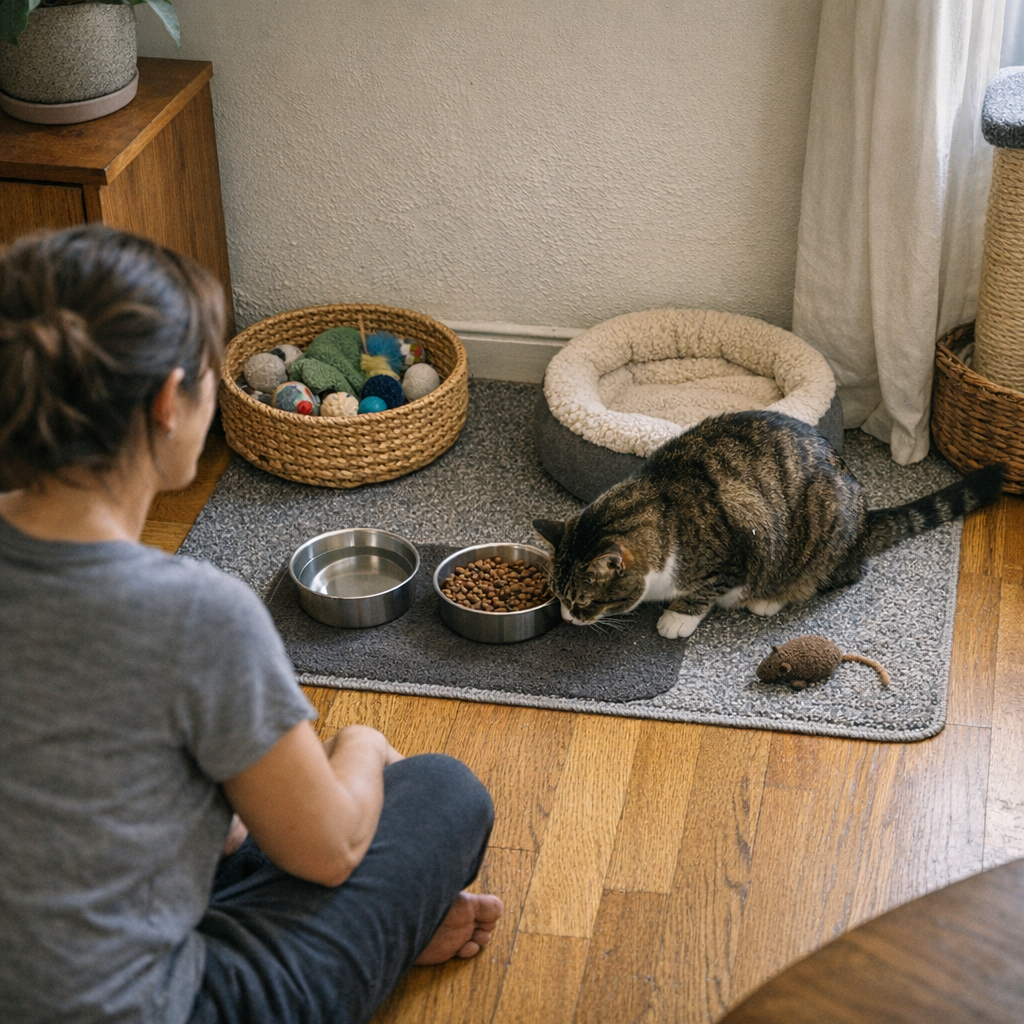
There’s a moment, usually in the late afternoon, when the house looks slightly off, though it’s hard to say why at first. At first, it feels like ordinary fatigue: the food bowl isn’t quite where I left it, a soft toy peeks out from under the rug, and the usual sense of order drifts just beyond reach. That’s when I start noticing the small shifts—how the feeding area, water setup, toys, and blankets quietly rearrange the flow of the shared space with my indoor cat, slowly and almost invisibly.
It looked fine initially. I thought I’d drawn clear boundaries—feeding just over here, toys and blankets over there, water bowls tucked neatly by the wall. But the subtle bleed between her area and mine became a quiet background hum to daily life. One bowl nudged out of place after a meal, toys scattered a little wider during play, a blanket inching further into the walkway. It wasn’t messy, exactly. More like a constant, slow drift.
When the Visual Reset Isn’t Enough
You notice it after a few resets. Lining up the mat, stacking toys in the bin—these felt right at first, a system that worked. But by noon, the bowl had already shifted from its spot, and another crinkly ball was under the chair again. I’d sweep up stray kibble, nudge everything back, congratulate myself for having a process—and by evening, I was doing it all over again.
This rhythm became routine: sweeping up bits of litter and kibble, moving the bowl a few inches back, pulling fluff from underfoot. It was easy to think of this as basic upkeep—a natural part of life with a cat. But the real issue wasn’t the effort itself. It was the creeping feeling that nothing stayed where I set it, that every surface order dissolved into constant small corrections.
That feeling stayed with me.
The Small Edge That Changes the Room
It didn’t happen overnight. But eventually, I set a firmer edge—a physical line, not just one in my head. The mat’s corner aligned exactly with the floorboard seam. The toy bin pressed firmly against the table leg, always returning to that spot, always within easy reach.
It was a small daily effort. Each night, I restored everything within that boundary—nothing sliding past, nothing left to vague “neatness” or visual cues alone. Over a week, the difference showed quietly: toys stopped turning up in odd places, the floor was easier to navigate without leftover hazards, and the cat’s corner stayed inviting yet undisturbed. Most importantly, the daily resets shrank to a manageable rhythm that let both of us move through the room with less effort.
Those extra seconds spent marking that edge saved minutes I hadn’t realized I was losing.
Living with the Low-Grade Drift
By the end of each day, there are still reminders—a blanket bunched slightly past its place, a toy half-hidden, a stray bit of litter edging the mat. The line isn’t perfect. But once the space accommodates both of us, I find myself doing fewer repeat cleanups. Her world and mine feel easier to share, even if it doesn’t look perfectly tidy all the time.
Some boundaries settle quietly, becoming clearer over time as patterns emerge from repeated feeding resets, water refills that slow down the flow, litter-adjacent cleanup that reveals lingering traces, toys that stray between play sessions, and blankets or mats that creep into walkways. These small but steady shifts make it obvious why a feeding setup, water area, litter corner, resting spot, or grooming-adjacent storage behaves differently after repeated use.
The subtle line between my world and hers is one I keep redrawing—practical, tangible, and built to last through real indoor-cat life.



