Lighting That Changes How You Feel Under Low Ceilings
Slim low-profile lighting makes low ceilings feel higher if cable paths, mounting, and shadows are well managed to reduce visual clutter.
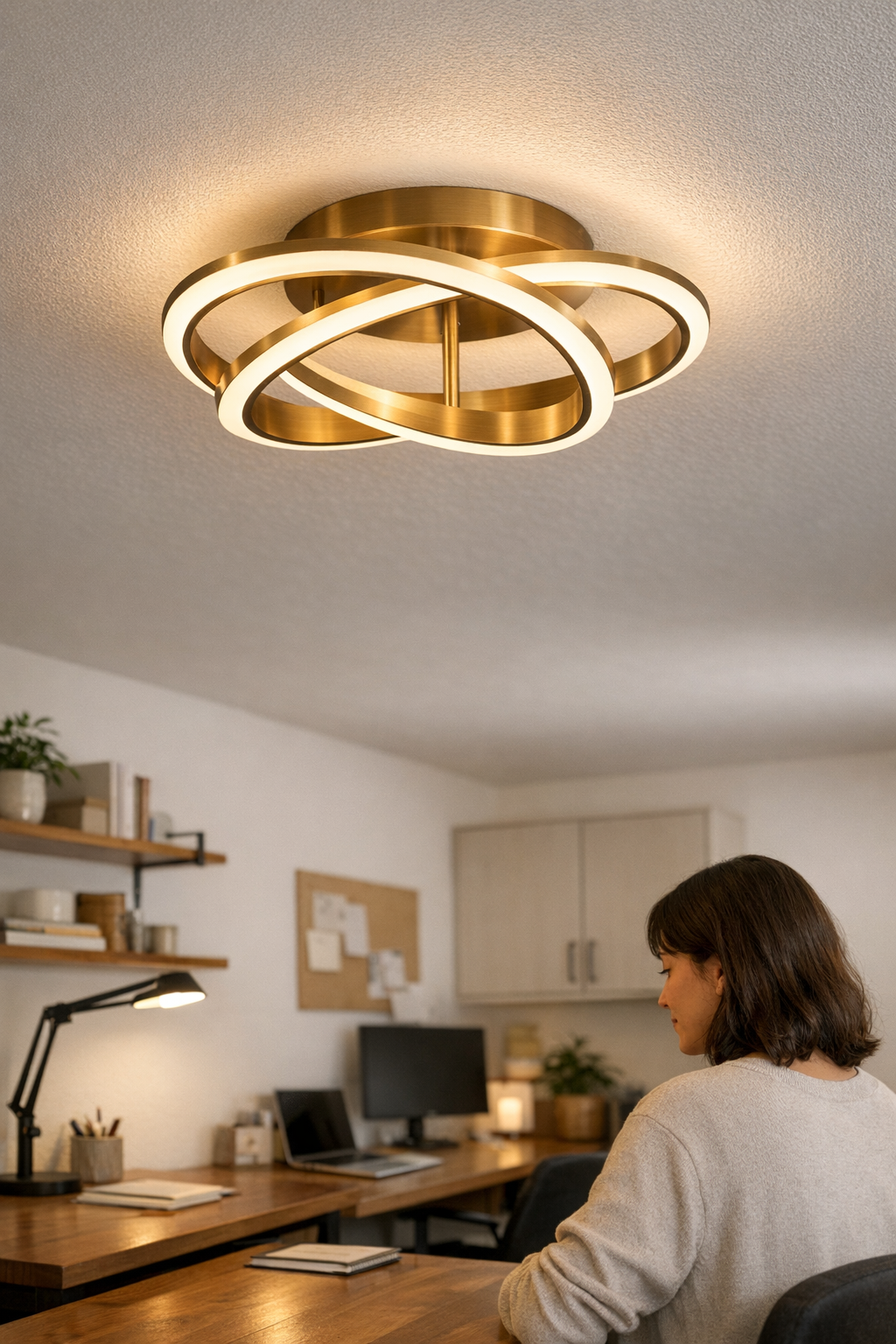
There’s a particular weight to a low ceiling, the kind you don’t so much notice when you first move in, but feel every day living beneath it. The promise is always there—a slim LED panel, a low-profile fixture nearly flush with the paint, maybe even a little more breathing room. Yet it never takes long for cables, misplaced brackets, or slivers of glare to creep into your sightlines. It’s a quiet irritation, a shrinking measured in centimeters and shadows. You look up, and the ceiling feels just a little too close. What I kept returning to was this: it’s not just how things look, but how the whole room feels and moves around you once the lighting and its supports settle in.
When Slim Isn’t Enough
You don’t notice it right away. Replacing a bulky fixture with a slimmer LED panel or linear light quickly clears overhead space, and for a while, it’s easy to believe the room feels taller.
But then, over time, arriving and leaving, lifting a box, or sitting at the desk in the evening, your eyes catch on the small details. Cable lines running unevenly across the ceiling, a bracket inching into your direct line of sight, a plug dangling where it shouldn’t. The difference between “less clutter” and “no clutter” is subtle, but you feel it. It’s an ambient awareness of where the fixture ends and your personal space begins. When supports or cables are visible or off-center, the ceiling edge creeps back into view, becoming an unnecessary visual boundary.
Shadows, Angles, Movement
Rooms—especially work areas like home offices or shared benches—are constantly in use and flux. A slim-panel or linear LED fixture can seem like the entire solution at first. But after a few days of shifting chairs or moving around the table, life near the edges becomes more difficult.
Shadows form bands across the workspace; someone shifts position, and glare returns. Despite looking cleaner, the lighting can’t fully keep up. Even a cable slightly off its channel or a bracket misaligned by a few centimeters can undo the sense of openness. Any visible support pulls your eyes toward the ceiling, breaking the clarity on your task surfaces in small but cumulative ways.
You don’t want to be watching the fixture’s cables and supports every time you cross the room.
What Actually Made It Easier
Eventually, I stopped trying to push or lower the fixture and focused on adjusting the mounting channel itself—just by a few centimeters, enough to move cable runs and brackets out of sightlines. The cable ended up aligned with existing ceiling shadows, hiding it in plain sight. The clutter didn’t just move; it receded.
This wasn’t about going thinner again. It was about understanding that even the neatest, slim LED lighting only keeps the ceiling feeling open when every line—bracket, cable, plug—stays just out of view, even as people and furniture move around the room. It’s a detail that doesn’t always get planned for, but once it falls into place, the space changes. Maybe not larger, exactly, but definitely less fraught.
There’s always another cable to route, another small shift to make the room feel more honest. That’s worth thinking about—how the best lighting is the kind you almost forget until it quietly works.
If you want to see where some of these solutions start, I ended up wandering over here: http://www.lightsupport.myshopify.com