Living with Cats: When Order Meets Everyday Chaos
A consistent, well-anchored indoor-cat setup reduces impulse buys and lowers maintenance by containing daily scatter and fitting routines.
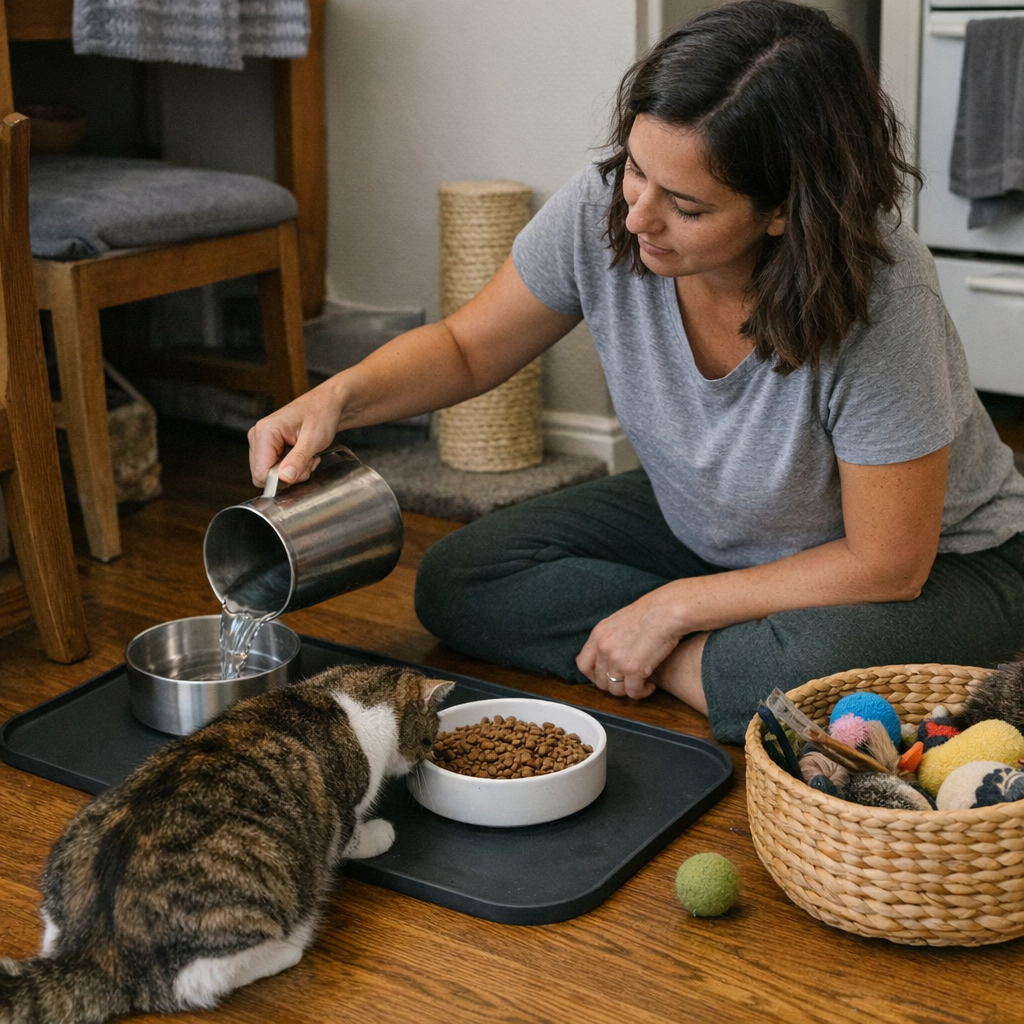
If you live with an indoor cat, you probably know how quickly a tidy cat corner can unravel. It often starts calm—a couple of bowls, a toy basket, maybe a mat underfoot. But after a few daily uses, things begin to slip out of place. By the second day, stray bits of kibble appear near the fridge. Toys that once stayed put end up scattered where you want to put your feet. What seemed like a solved space turns out to demand constant upkeep.
You notice the pattern after a few resets. Feeding, water, and play areas each gather their own mess. At first, it looks fine. But as I refilled bowls, scooped toys, and wiped down the mat (often later than planned), I kept encountering small interruptions: dishes drifting apart, crumbs edging the mat no matter how often I swept, and awkward reaches for scattered items. Every quick “fix” I tried—another container, a splash tray—quietly became part of the problem, adding its own cleanup loop.
The Part That Doesn’t Stay Fixed
Arranging everything in neat rows feels like progress, at least for a moment. For a while, the setup looks settled. But daily routines break through any order you impose. Bowls nudge apart, toys wander back into shared walkways. Sometimes you step on a stray catnip mouse before your first coffee. I started to realize the maintenance wasn’t shrinking—it was spreading out. Small interruptions piled up: fetching a water bowl pushed behind a chair, sweeping food from under the table, bending down repeatedly to return plush fish to the bin.
This was the pattern that quietly expanded the work, even as things seemed contained on the surface.
The Hidden Cost of Scattered Routines
Sharing space with a cat raises its own challenges. The line between the cat’s area and the rest of the home is thinner than it looks, held in place only by constant small resets: wipe here, nudge there, relocate the tunnel, scoop up that toy. The cost isn’t just time—it’s all the moments your attention drifts back just as you’re moving on. Barefoot crumbs, strings tangled by the stove, a litter-adjacent splay on an otherwise clean floor—all of it slowly negotiates the arrangement, while cat routines quietly resist being contained.
You can maintain surface order, but the slow sprawl keeps demanding new temporary fixes—fresh trays, extra wipes, better bins. The real difference isn’t in how much you organize, but in what stays put through repeated use.
A Small Layout That Finally Held
What changed things was almost simple. I put a single, low-lipped silicone mat under both food and water bowls, holding scattered kibble in one fixed spot. Instead of chasing unpredictable trails or fishing toys from under the fridge, I could quickly circle the mat and bin—no strays hiding in corners, no bowls straying into awkward places. The boundary between cat space and shared space felt clearer without extra thought.
After a few weeks, it was clear: most of the temporary fixes I’d stacked up were answers to layout problems, not storage ones. The daily maintenance felt smaller and more predictable. I stopped searching for more organizers to patch over what the setup really needed—a structure that holds together under real routines, real use.
These changes stand out after living through repeated cycles of use, disruption, and reset. If you want to see what that kind of everyday setup looks like, there’s a soft landing here: StillWhisker.



