Living with Shadows: The Quiet Struggle of Home Lighting
Reliable, shadow-free lighting in stairs and laundry beats brightness alone, ensuring safe, easy movement by covering weak spots daily.
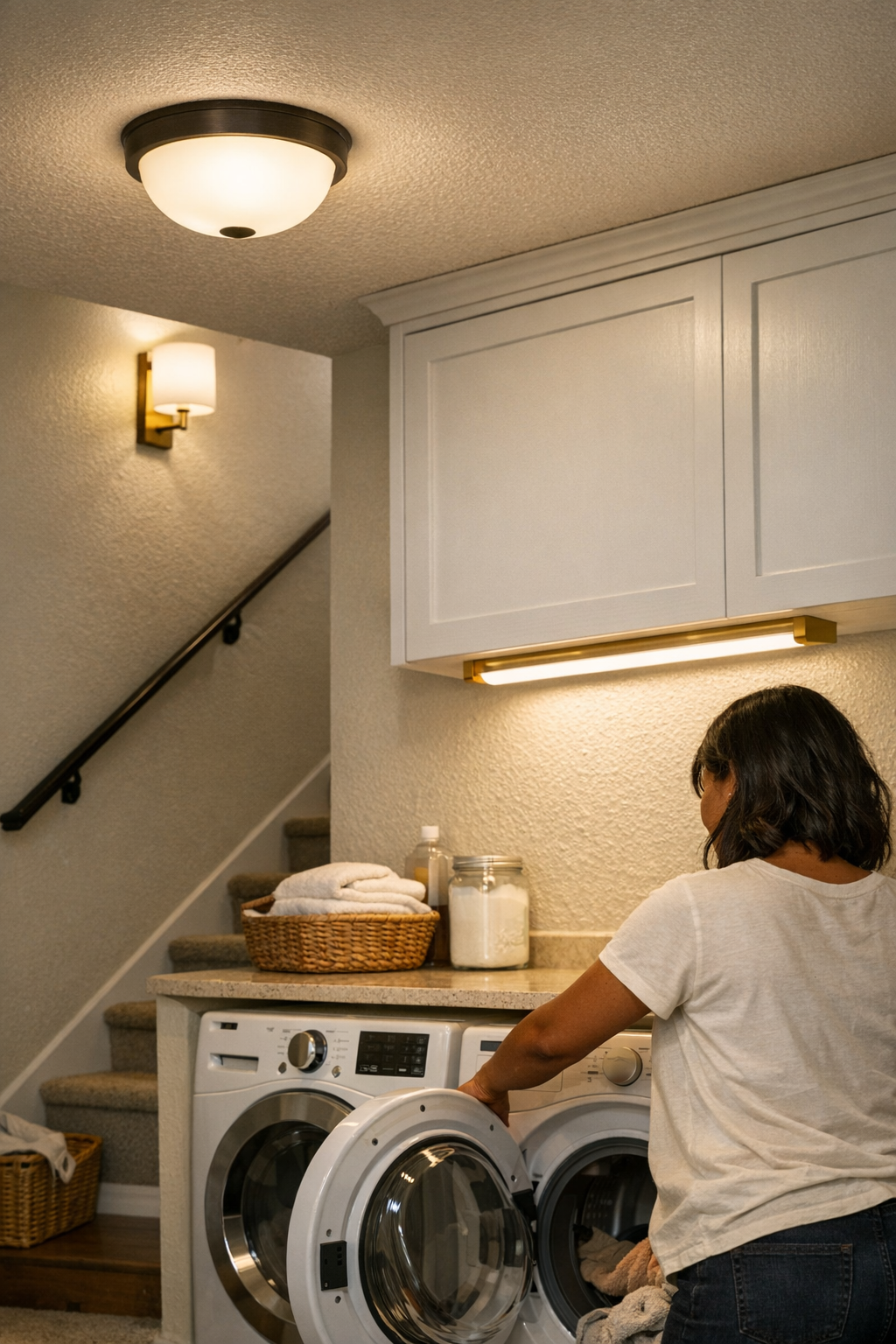
The stairs looked bright enough at first. The laundry corner, too—a single new ceiling fixture, pale but confident, casting a clean sweep of light. For a few evenings, I thought maybe that was enough. But underneath, I kept feeling around for socks lost behind the dryer, and moving slower on the steps—noticed only in small glances, never urgent, always there.
You don’t notice it immediately.
But you feel it.
It’s not about the number of lights, or even wattage, really. In those practical hallways and corners, a room that seems “lit” becomes something else entirely once you settle into your routines.
The Edges Where Light Doesn’t Quite Reach
Shadow lines know where to gather. At the edge of a staircase or behind a machine, they collect and linger—too subtle to be obvious from the middle of the room but unmistakable once you return at night or with your arms full. A flush mount or semi-flush ceiling light has its spread, but it can’t erase every darkness. Corners stay dim, the far side of a cabinet remains a guessing game.
You learn this by living there. Each time you hesitate at the turn of the stairs or slow down to see where the floor meets the wall, it presses in—a quiet warning that the fixture chosen for “brightness” can still leave you unsure where your feet will land. A room that appears fine in a showroom diagram feels different when you’re climbing up in low, uneven light.
That was the part I kept coming back to.
When Familiar Spaces Demand More Than “Bright Enough”
It’s never on the first day when you discover the problem. It comes after a week, or maybe two. The move from one circle of light to the next, that hidden sock never reappearing, a shadow that somehow always sits at the halfway point of the steps just as you’re carrying a laundry basket. The points that should feel safe begin to invite second-guesses.
In practical spaces—stairs, corridors, laundry corners—it’s not about lighting “style.” It’s whether every surface you use is actually visible and reliable. Oddly enough, putting in a brighter bulb rarely changes the experience. It’s the wrong shadow that matters, not the total glow.
Adding a second ceiling fixture at the stair turn, or mounting another damp-rated light above the laundry cabinets, changes the room’s dynamic. The corners start to reveal themselves again. Shadows dissolve just enough to speed up daily movement, and you find yourself skipping the step where you used to slow and look twice. Targeted light, thoughtfully placed, nudges everything back to effortless.
The Subtle Shift That Comes With Routine
There’s comfort in the change, and it arrives quietly. Suddenly the familiar hesitation is gone. The floor under a cabinet or the midpoint of a stair is simply there—visible, ready. I found the missing sock easily the first time light reached behind the machine; I crossed the stairs faster, no longer bothered by the old strip of darkness.
It reframed the difference between a room being bright and actually being easy to move through. The spread and overlap of the light mattered more than the fixture’s wattage or shape. Trouble disappeared not from more lumens, but from light angles covering the work and walk zones that routines make necessary.
Most days, it’s just background. But every so often, I notice how those corners now welcome me, instead of holding me back.
If this sounds familiar, I came across a few more thoughts at LightHelper. You will receive a blog body draft.



