Living with Shadows: The Quiet Struggle of Kitchen Lighting
Uneven diffusion in under-cabinet lighting causes shadows and glare, while wide, even coverage ensures safe, fast, and clear kitchen tasks.
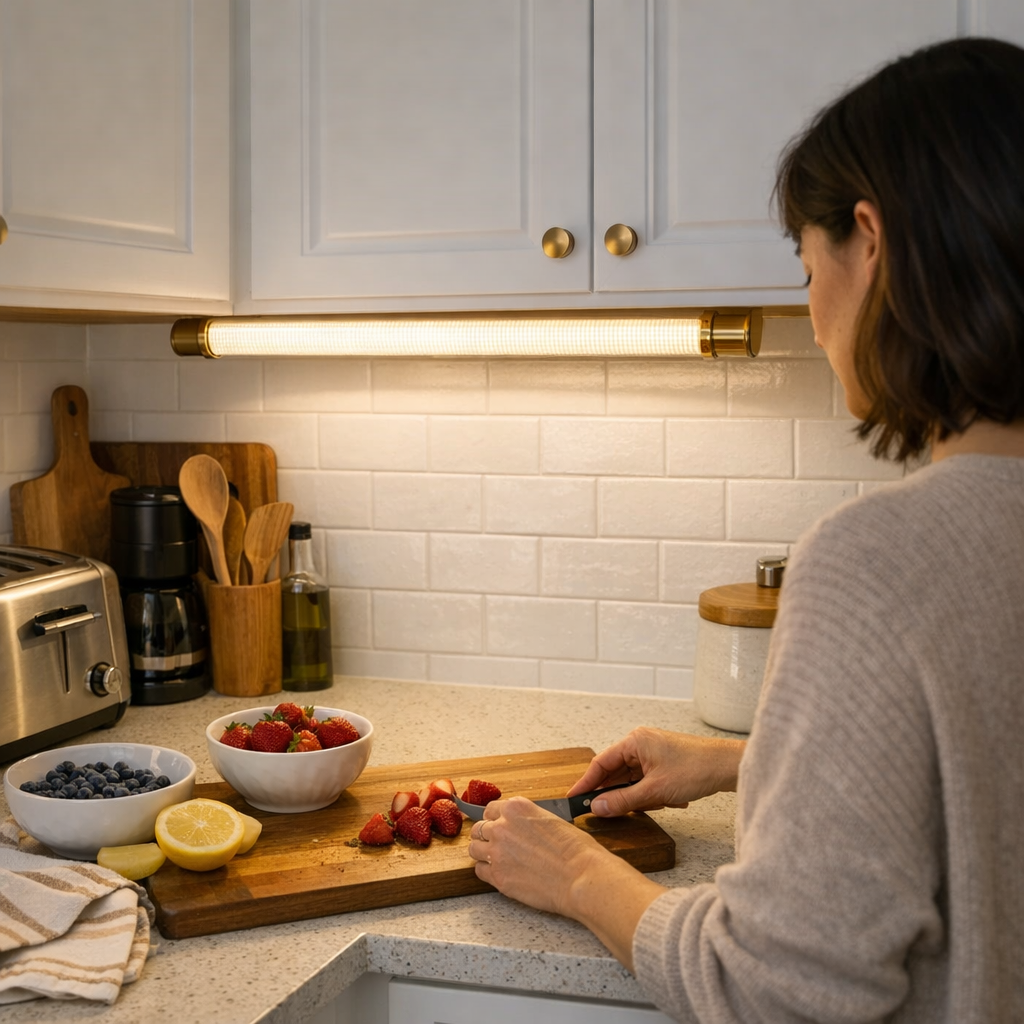
In the first days after installing new under-cabinet lighting, I kept waiting for the moment when the change would feel complete. At first glance, everything seemed brighter, as if the kitchen finally had its act together. But it’s in the days after—the rushed mornings, the return trips at night, the regular flow of tasks—when the lighting’s quirks started showing up. Shadow bands crept in where the bread gets sliced, edges near the stove dulled out, and glare bounced off the backsplash in a way that made coffee spoons almost vanish in a puddle of light. Brightness alone wasn’t enough. The real issue showed quietly in how the light actually landed on surfaces and zones I use most.
You don’t notice it immediately. But you feel it.
The Corners Tell On You
From across the room, most lighting looks like it’s doing enough. Puck lights and neatly aligned spots cast bright pools along the counter, and the space seems to glow. But step closer, cutting board in hand, and something shifts. There’s always a corner or a run along the wall where the light weakens. I found myself angling plates or shifting slices just to see into those shadow gaps. Over time, these half-lit spots became part of my kitchen routine. The back edge by appliances, shadows lurking under upper cabinets—all became patterns I navigated by habit. It’s subtle, but it lingers, affecting tasks every day.
What surprised me was how quickly my eyes adapted to working around these failings. Over weeks, I started placing things in the brightest spots, keeping most prep away from edges where the illumination faded.
The Everyday Correction
The real change came with a simple run of LED bar lighting—just one fixture, nothing fancy—with a broad diffuser stretching from one end of the counter to the other. Almost overnight, the counter stopped dictating where I had to stand. The light didn’t just reach further; it softened into previously blurred or darkened corners. Tasks I barely registered before—sponging crumbs near the backsplash or lining up a measuring cup for late-night baking—felt easier and less awkward. I don’t remember the last time I noticed glare in the sink or shadows by the coffee maker. Those old irritations simply faded, no longer shaping how I moved through the space.
That’s what kept drawing me back to the lighting: how an even, gentle spread didn’t just change how the kitchen looked, but how quietly and reliably it worked during daily use.
More Than Just Numbers
It’s tempting to focus on specs—brightness, color temperature, beam sharpness. But none of those details fully explain why this setup mattered in repeated use. What mattered was the absence of problems: no sudden shifts between glare and gloom, no missed crumbs hiding in shadow bands. It felt as if the kitchen itself was relieved of a few small burdens. The space became less about working around leftover darkness and more about moving, prepping, and cleaning without fuss.
There’s a reliability that comes from lighting you don’t have to think about every evening. If I were doing this again, I’d pay closer attention not to raw output on the box, but to how softly and evenly the light spreads across the work surfaces, cabinet runs, and zones I use most. That includes consideration for how flush mount ceiling lights, semi-flush mounts, wall sconces, hardwired wall lights, vanity or mirror lighting, bathroom-rated and damp-rated fixtures behave in these repeated routines—how they handle shadow control, glare, and circulation through areas like narrow hallways, stair turns, or utility rooms.
Some evenings, I still notice the quiet difference after dusk, moving through a kitchen that finally lets every detail settle clearly into view.
There’s a little more about that kind of lighting simplicity, if you want it, over here: lighthelper.myshopify.com