Living with Shadows: When Ceiling Light Fails Everyday Comfort
The real fix for tired eyes and uneven light is often mounting hardware and cable management—not just moving the fixture itself.
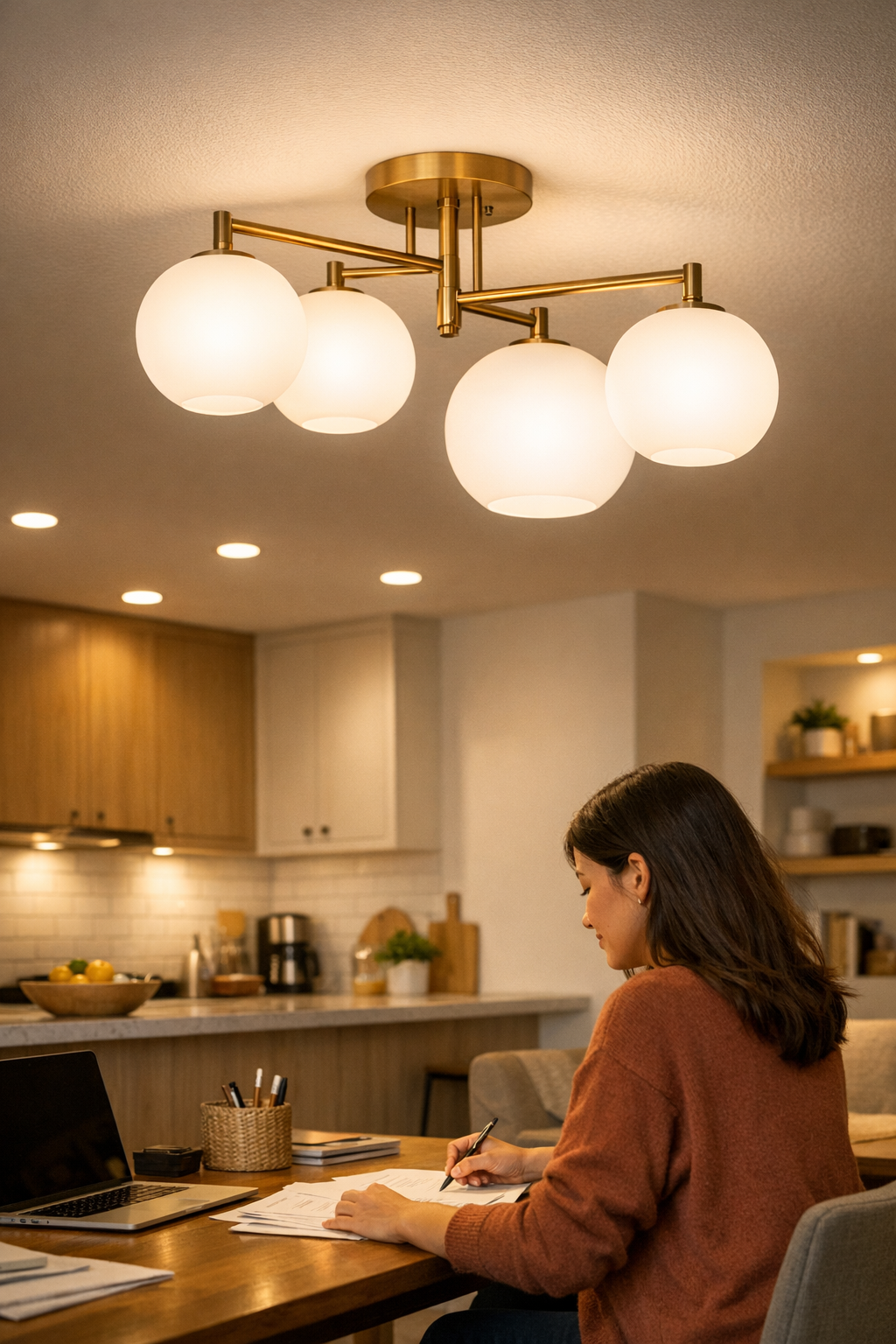
It’s strange how quickly you become aware of where the light falls—and just as importantly, where it doesn’t. The first few days with a new fixture usually pass with a quiet optimism. Everything seems finished, in that way neat cable lines and brushed metal can look on a ceiling at sunset.
Then you start noticing what’s missing. For me, it showed up as a persistent dimness at the edge of my desk—just enough to make late tasks irritating. The central spot was almost aggressively lit, but my reading pile sat in shadow. I thought maybe it was the angle or my eyes being tired. But after a while, it became clear: the support, not the fixture itself, wasn’t quite right.
How Light Slips Away From the Edges
You don’t notice it immediately. But you feel it.
There’s a strange reluctance to settle into the darker side of a workspace or the far end of a table. Even a slim LED panel, perfectly flush, can leave a spot in shadow if the drop or bracket isn’t aligned with how you move through the room. Sometimes the effort spent pulling a desk lamp back and forth isn’t just about brightness—it’s about the frustration of light that doesn’t quite reach.
One afternoon, I caught myself using only half my desk. The rest stayed in the periphery, lifted out of daily use by a shadow cast—not by design. That was the part I kept coming back to.
When Clean Looks Meet Real Use
It’s easy to believe a ceiling light is “done” when all the cables are invisible and the mount looks simple from across the room.
But the difference between a visually clean setup and a truly livable one becomes obvious over time. I’ve tried hiding every cord, smoothing down every hardware edge—only to find my hands drifting back to the same corner lamp, just to fill in what the main light misses.
It’s ironic. Sometimes the neatest solution isn’t the most comfortable. An exposed cable guide or an awkward extension bracket can seem like a compromise for appearance, but if it lets the light reach evenly across both sides of the workspace, the space feels more right.
The Quiet Weight of Support
Glare and dimness aren’t usually fixed by swapping bulbs.
For me, the change was less about fixtures and more about rethinking where and how the support was set. A single bracket, placed with a little more honesty about where I really sit, plus a cable adjusted for logic rather than just elegance, made more difference than any high-output spec sheet.
Now the desk is evenly bright long into the evening, and I rarely have to shift position or squint at the wrong moment. The look may not be perfect, but the sense of ease is impossible to miss after a few weeks. The underlying structure is what made living with the light work—not just looking at it.
Somehow, that feels more finished than anything else.
If these details are quietly familiar, there are more subtle solutions over at LightSupport.



