The Quiet Comfort of a Well-Known Walk
Repeating a familiar walking route reduces a dog’s scanning, leading to smoother walks, quicker settling, and less daily tension.
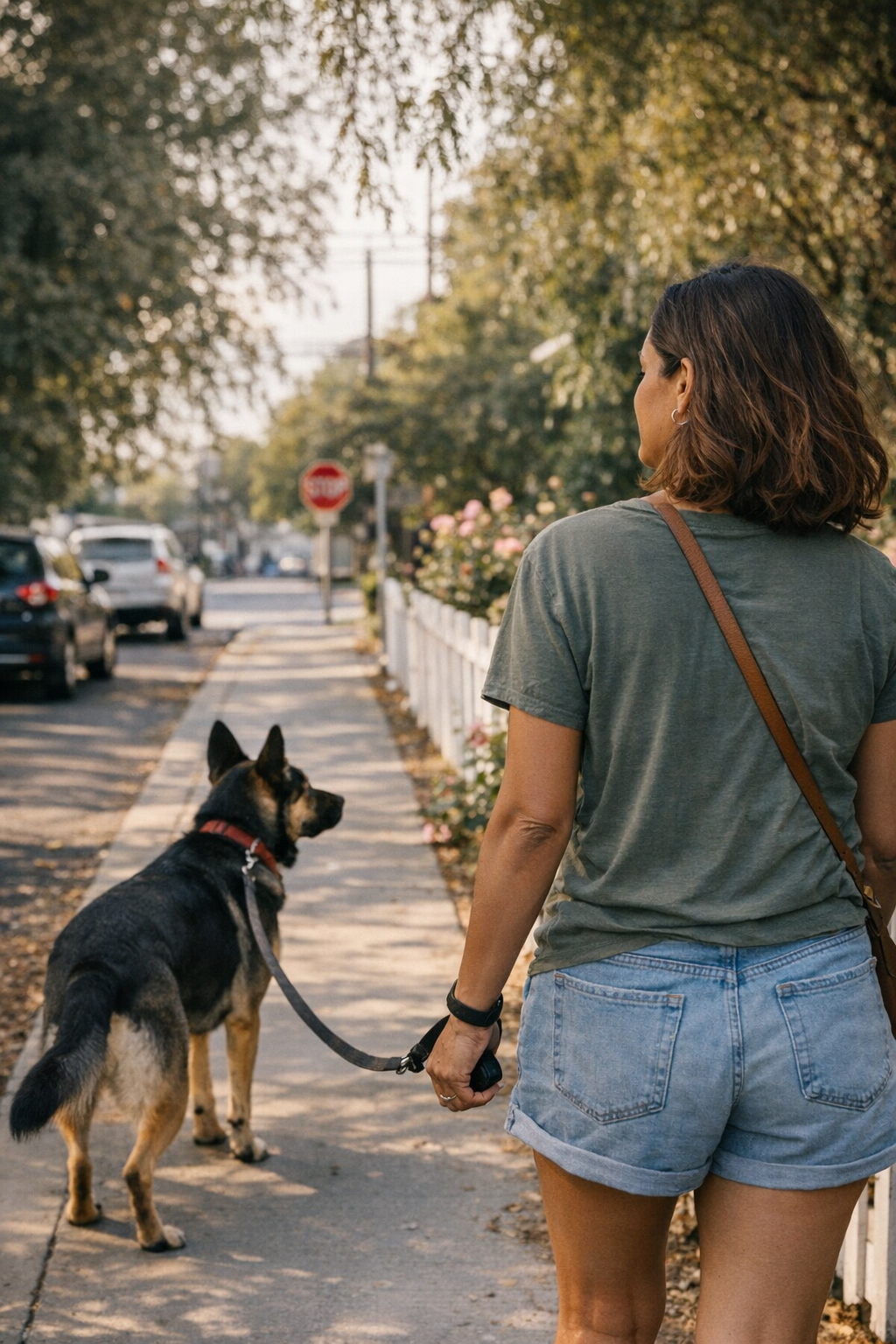
Most of the time, a walk is just a walk—leash on, out the door, quick loop around the block. But when you live with a dog who scans—pausing to check each side street, watching windows, halting for every movement—routine starts to feel different. What should be a simple, mind-clearing stroll becomes a series of interruptions: a long standstill at the hedge, another stop at the corner where someone once left recycling out, one more for a squirrel two houses ahead.
You notice it after a few mornings. The usual fifteen-minute autopilot walk drags past twenty, sometimes twenty-five minutes. The leash grows tenser in your hand, though you don’t catch exactly when it started. Most days, it’s not dramatic, just slow and chiseling away at calm. Each return home carries less ease—your dog still alert, you already thinking about shifting dinner plans, while small irritations stack up by the time you reach the stoop.
A Pattern in the Pause
Curiosity alone doesn’t explain it, even when you want to chalk it up to that. Patterns settle in quietly: the same pauses, the same look-backs, step for step. The world feels fresh and alert to your dog every time, even though nothing’s changed for you. The route is safe, familiar, nothing obviously wrong—but tension lingers.
Sometimes it’s easy to blame the day, the weather, or a neighbor’s car. But the effect repeats: the dog gets jumpy on the same street corners, checks the same driveways, hesitates at the same lamppost every walk. You start to feel like you’re locked in a choreography of stops that aren’t yours.
A smooth walk never really happens; there’s always a stutter. The settling moment—the part where you both let your guard down and just walk—never quite comes.
Narrowing the World
After trying longer loops, new routes, even more distractions, nothing changed much. The halt-and-scan routine held firm. The nudge came from the opposite direction: what if novelty isn’t the answer?
Returning to the same exact street, day after day, I noticed the tension ease a little with each repeat. Fewer new variables. The row of yards, doors, and parked cars stayed constant. My dog stopped mapping every sound like it was new. There were still pauses, but only at known spots—places that sent a steady signal rather than a mystery.
It’s subtle, but by the third or fourth walk back, there were fewer sudden stops, less leash stiffening, more steady grip instead of constant adjusting. The noise settled. The distraction didn’t vanish, but the walk regained something of its usual routine.
It’s never instant. Rough days still happen. But with a familiar route passed often enough to feel almost boring, the world gets a little smaller. That was the repeating lesson: walks may look the same, but predictability slowly does its work.
Reset Starts at the Door
What’s harder to spot is how the walk’s aftereffects creep into everything else. I’d get my dog back inside, unclipped from the leash, then move straight into the evening shuffle. She’d pace near the window, still scanning, not fully settling.
One night I shifted her water bowl to the entryway—just beside the path we cross coming home. Something about ending the walk routine at the same physical spot every time seemed to help interrupt her alertness. She made a beeline for water, drank, then settled into her bed faster than usual. Cleanup happened before dinner, not after.
Resetting became easier not just for her but for me too. The edge faded. The end of the walk wasn’t just the door closing—it was both of us settling into the day’s quieter rhythm: her on the mat, me sorting through leftovers and laundry.
After a week, the difference was clear: fewer small messes waiting on the margins—no spilled water, no tripping over toys on the return, a calmer atmosphere from then on. The walk ended instead of carrying over into the rest of the evening.
Small Routines, Less Negotiation
There’s no one-size-fits-all, not with dogs. But a quiet relief comes from closing the small gaps that make a day trickier: same street, same sequence of steps, same bowl clicked on tile at the end. Predictable, almost boring. Still, the reset became smoother.
I noticed my grip on the leash softened, the anticipation at the curb eased. The dog’s scanning didn’t vanish, but it lessened at the places we’d rehearsed dullness. And in a way, mine did too.
Some days you have to break routine because life pulls you elsewhere. Still, what stuck was the understated balm of sameness—a feeling that we both could stop negotiating every corner for a little while.
If you want to see more about how everyday setups can shift the routine, there’s a place I keep returning to: http://www.dogpile.myshopify.com



