The Quiet Comfort of Balanced Light in Daily Corners
Three points of contact lighting uses ceiling, wall, and task fixtures to keep movement routes and surfaces clearly visible, eliminating shadows and glare.
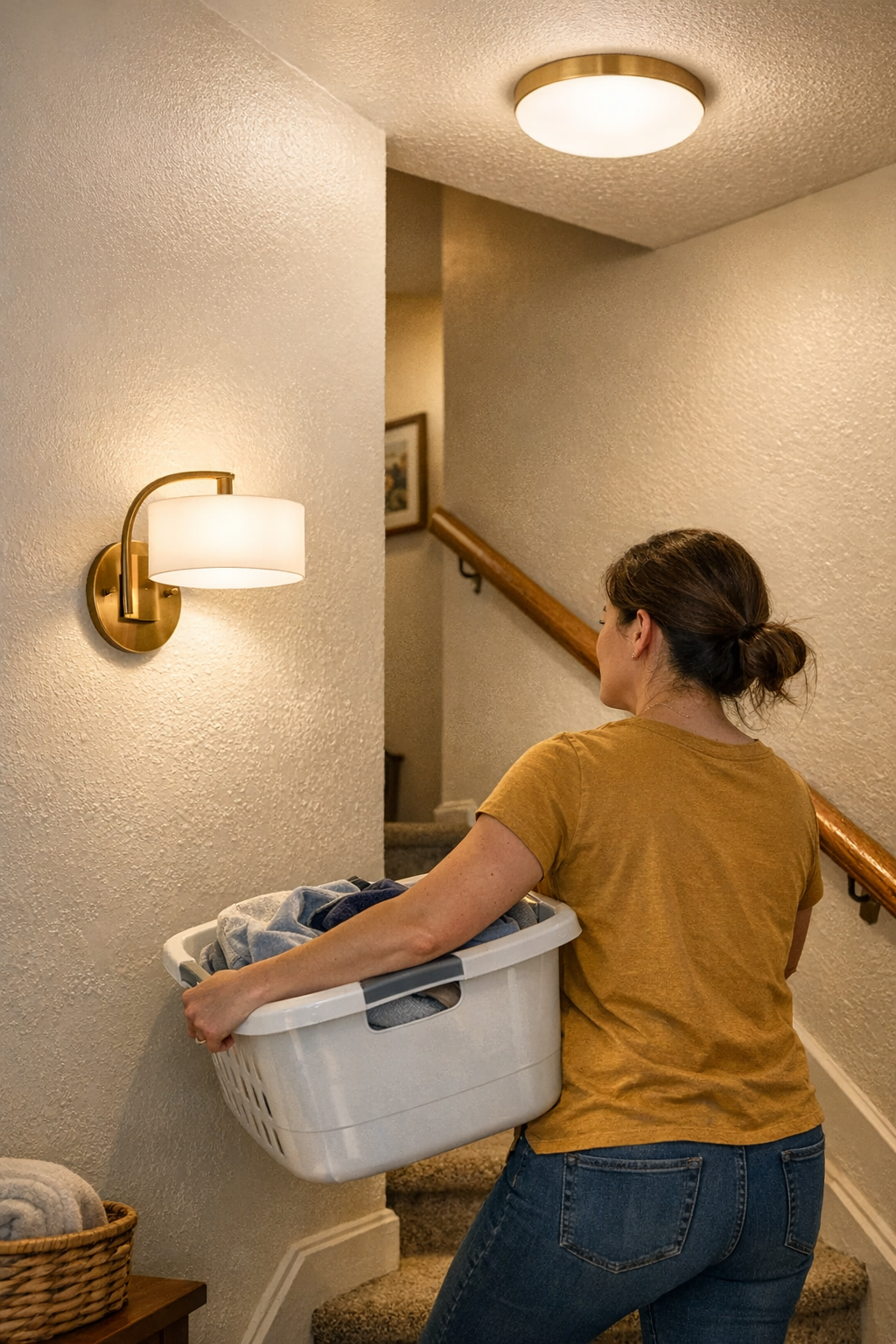
There’s a certain frustration that creeps in quietly. You’re moving through the hallway with laundry propped on one arm, reaching for the light switch, and everything looks normal—until it doesn’t. The ceiling fixture glows strong overhead, but a shadow falls sharply right where your foot lands on the stair or along the lip of the washer. It’s not dramatic at first. More like a slow, invisible tug that turns everyday movement into something less certain.
I never thought much about lighting beyond just turning it on. But when routines start to slip—catching a toe on the step, hesitating before a shadowed corner, losing a button in the folds of laundry—I began to see how the brightness in a room is different from the way it actually lights your path. Most homes rely on one bright flush mount or semi-flush mount ceiling fixture, supposedly bathing everything in an even wash. The reality is quieter, and much less forgiving.
The False Comfort of One Bright Light
It’s strange how a laundry room can look well-lit until you really need it.
I’d always assumed that as long as the room appeared bright, it was working as it should. But I kept pausing at the same spots—by the stair turn, over the edge of the washer, or that odd hallway corner where the ceiling light never quite reached. Sometimes it was just a hesitation. One of those slight, silent recalibrations your body makes before stepping forward. You don’t notice it immediately.
But you feel it.
That was the part I kept coming back to, especially at night. All those little shadows pooling in corners and along critical edges.
What Changes When Light Follows the Path
At some point, trying stronger bulbs or chasing higher wattages stopped making sense. I’d stand under the ceiling light—whether a panel or linear fixture—holding up an object, still relying on a hopeful spill of light from above. It didn’t fix the dark stripe along the laundry basket’s edge or the step mid-stair, even though most surfaces seemed bright.
Adding a small wall sconce just before the stairway curve changed everything. A beam at hand and eye level filled the very spot I kept missing in the dark. No dramatic flick of a switch—just a gentle sweep of light flattening the shadow where my foot used to fumble. Movement flowed again, distraction faded. Even the way I placed the laundry shifted, as if my brain relaxed, quietly relieved.
Suddenly it made sense: the shape and placement of light matter as much as its strength.
Living with the Right Kind of Light
After that, I started noticing where light didn’t just look good—it felt reliable. In the bathroom, vanity and mirror wall lighting caught even, shadow-free light from both sides, preventing glare and ensuring clear visibility. Along the corridor, wall sconces combined with flush ceiling fixtures kept the path steady, and no glossy surfaces bounced distracting glare into my eyes. It becomes obvious, after a while, which spaces support how you move and work, and which spaces are just pretending.
The practical shift wasn’t about adding more light. It was about layering—setting light at different levels and points so you don’t have to think about it. Proper stairway lighting eliminated dark edges on steps and turns. Laundry and utility rooms benefit from damp-rated fixtures that reliably highlight folds and creases, while under-cabinet and fixed task lighting clarify work surfaces. When small, daily movements go uninterrupted, the room feels quietly dependable. A space that meets you halfway, without those tiny pauses or recalculations.
The thought still sits with me most evenings, when I walk the route with arms full and everything just unfolds, each step visible, nothing left to chance.
For others who notice the difference, LightHelper shares more about these moments here.



