The Quiet Moment That Changes Our Walks Forever
Making one leash hook the unwavering end-of-walk marker turns a minor habit into a reliable signal for your dog, leading to faster door transitions and less hesitation.
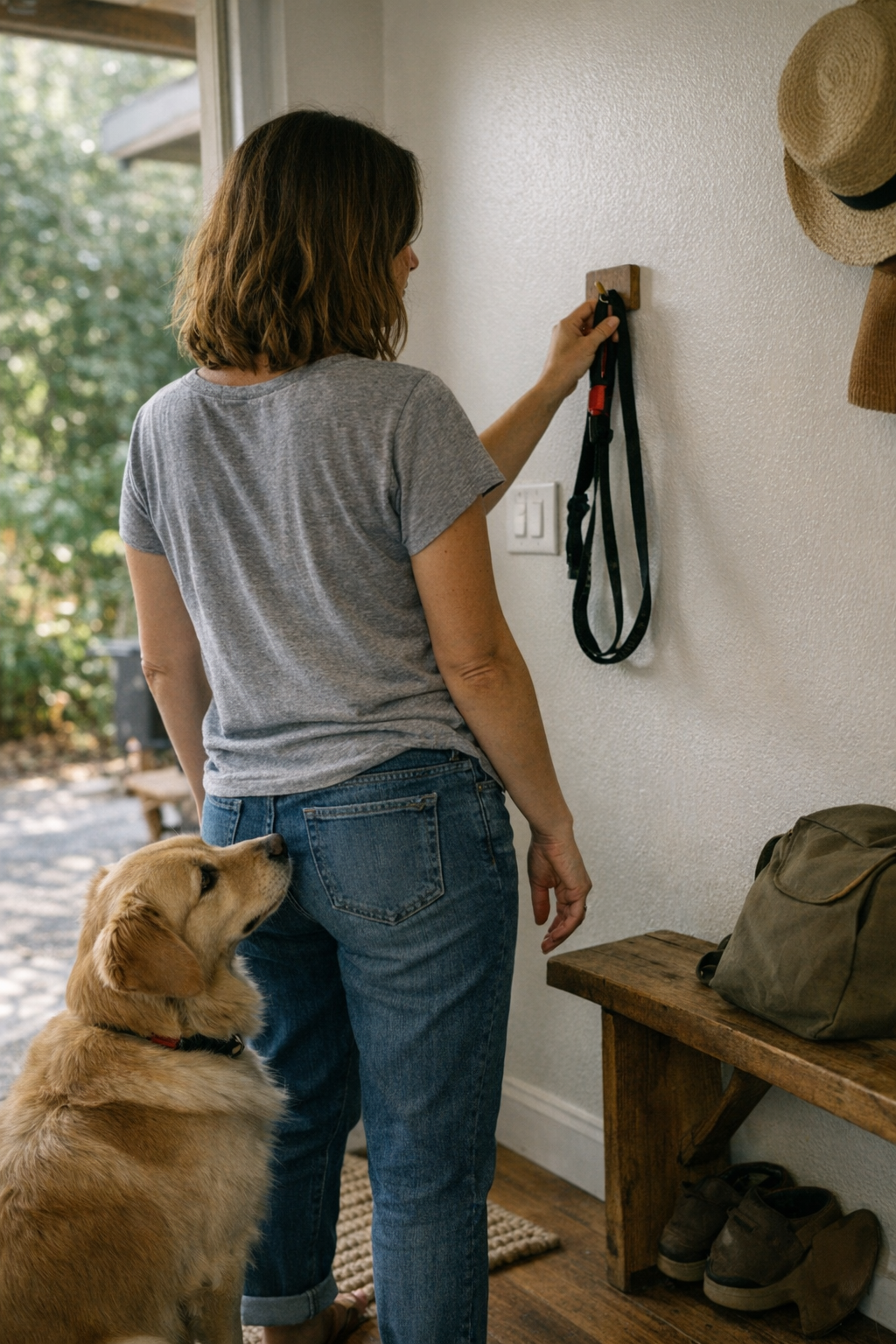
Some habits only become clear through repetition. At first, I didn’t notice how the pause at the door kept getting longer after our walks. My dog would hesitate, sniff the threshold, and glance up at me like he was waiting for something I’d missed. I thought it was the weather or my own distraction. But a pattern emerged: the days this pause stretched were the days I’d hung the leash somewhere new—on a kitchen chair, a hallway knob, anywhere my hands landed first.
It seemed fine at first. The walk was over, the leash was off. But that little disruption—this small mess right at the edge of our routine, as we re-entered the apartment—kept coming back. The friction wasn’t loud like spilled water or a tangled lead. It showed up as a hesitant step, a restless circle, an unfinished movement that slowed down the rest of the afternoon.
The Doorway as Tells
After a few mornings, it becomes obvious. Coming back inside after a muddy walk triggers a sequence: wipe paws, unclip the leash, sort the keys, put things down. It’s muscle memory—until something’s off. If the leash isn’t in its usual place, the dog’s attention stays fixed on the door. I’d find him pausing, unsure if the outing was truly finished. Often, he’d circle back toward the mat, restless and waiting.
These aren’t big problems, just little glitches enough to slow the next steps—feeding, cleanup, even settling down. One missed signal at the doorway and the calm I expected after a walk took longer to arrive.
I began to see the hook near the door differently. It wasn’t about keeping things tidy—it was our signpost: outside time is done, inside time starts here.
Patterns That Unfold on Repeat
Living with a dog means small experiments turn into systems almost by accident. Moving the leash from hook to chair and back wasn’t planned, just a result of busy mornings. But it put a wedge into a routine I depended on.
The difference was quieter than I expected. With a consistent leash spot—the left-side peg by the door—my dog’s stutter at the threshold lessened. He crossed the mat and slipped into the living room’s quiet almost automatically.
Still, there are mornings when shoes are muddy, groceries in hand, and the leash lands elsewhere. Those days, things slow down again. The signal’s off. Rest and refresh don’t come quickly. Sometimes I only notice later, stepping over a leash curled by the kitchen table, wondering when that quick transition got lost.
Anchoring the Flow
It’s not about discipline or perfect order. Some days, the spot inside the door looks like a jumble: towel tangled with a ball, leash looped on a handle. But the peg stays clear for the leash after every walk now. The difference isn’t obvious except in how routines shrink or stretch.
On good days, moving from outside to inside almost feels like one smooth motion. On off days, it still wobbles—a misplaced leash, a bout of pacing. But most days, returning to that same spot steadies the whole flow.
You can’t always control the chaos of coming and going, but having a fixed place for the leash does more to anchor the routine than I expected. Over time, it’s one less stumbling block—enough to make the end of each outing a little quieter.
Sometimes the simplest fix is the one you only see once you’ve lived through the interruptions a few too many times. If you want to see how other small shifts play out in a lived-in dog space, you can find more here: http://www.dogpile.myshopify.com



