The Quiet Relief of a Drawer That Breathes
Leaving slack space in drawers keeps categories distinct, speeds retrieval, and makes routine resets easier, preventing hidden daily chores.
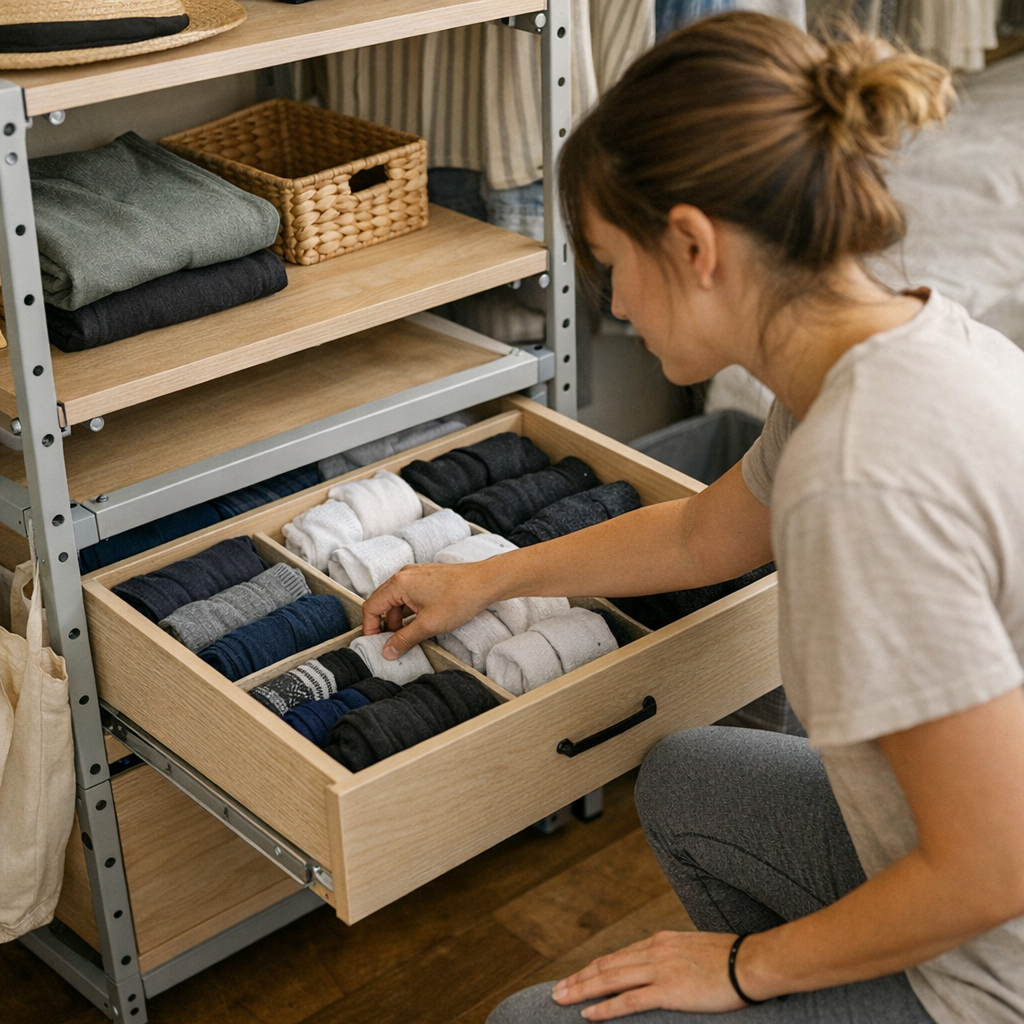
There’s a restless satisfaction that comes when every inch of a drawer is perfectly filled. Socks lined up, t-shirts folded tight, the surface immaculate—at least for a day or two. We don’t usually think about organization until something small begins to drag at us. A stuck drawer, a cluttered corner, the slow undoing of tidy intentions.
That’s when slack space—the bit of empty room left in a shelf or drawer—begins to matter. It isn’t something you notice right away.
But you feel it.
The Illusion of Fullness
It’s tempting to cram as much as possible into our daily spaces. A packed drawer looks sharp in the beginning, every edge flush with possibility. The illusion holds for a few mornings.
Then the edges slip. T-shirts drift into the wrong stack. Reaching for something familiar means shifting things around or smoothing a jumble. I’ve watched a solid line of black socks quietly tumble into bright colors by week’s end, the original order barely a memory.
You don’t notice the change at first. But it’s there in the extra second you spend searching, or the subtle frustration of things just out of reach.
Routine and the Invisible Cost
The true impact of slack space appears with repeated habits. Set up a drawer to be full, and it rewards you with a crisp first impression. Give it a few laundry cycles and the friction builds—a sock gone missing, a favorite t-shirt dug from the back, categories starting to blur.
One morning, I found myself late for work, kneeling by the closet, nudging overstuffed rows of clothing apart just to get to a single pair. That’s when it struck me: the real work wasn’t getting dressed, but constantly resetting the order I thought I’d created.
Removing just a few items—leaving a thumb’s width of space—shifted everything. Suddenly, each stack held its shape, morning after morning, and the reset button faded from my routine.
Less Fills More
It’s easy to confuse efficiency with capacity. But a subtle margin—the bit of empty space—acts as a buffer against entropy. Categories keep to themselves, socks stay grouped, and laundry day isn’t a test of patience.
A drawer isn’t empty just because it isn’t maxed out. That little visible gap between rows quietly keeps the whole system intact. It’s a small surrender to space, but one that returns itself every time you reach in without pause.
Sometimes, the simplest comforts come from what’s left untouched.
These small reflections took shape while rethinking the drawers in my closet.