The Quiet Relief of Marked Wires in Everyday Spaces
Labeling wires during indoor lighting work prevents confusion and guesswork, making future repairs faster, safer, and more reliable.
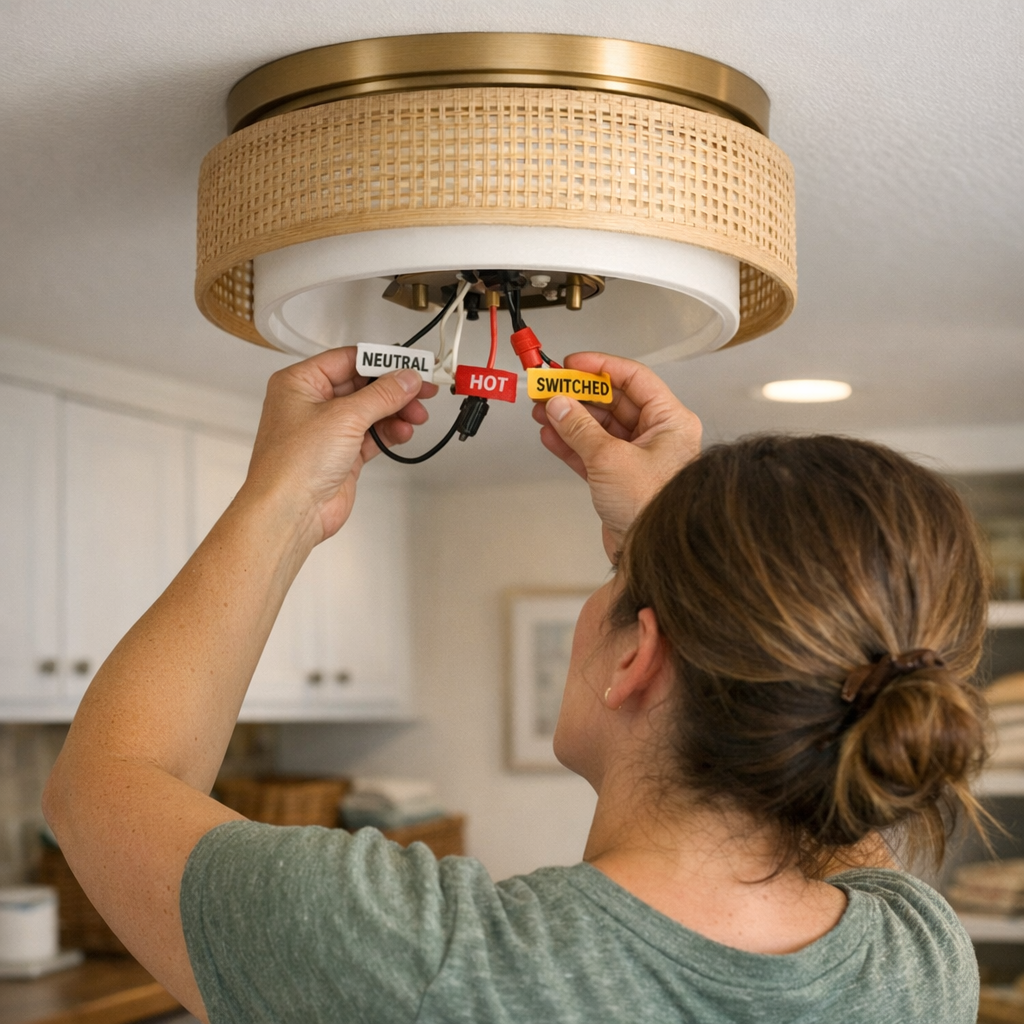
It’s usually quiet when I first notice. Just a flicker, or the slow fade of a bulb that used to shine cleanly down on a well-used hallway, stairway, or the laundry table. No big deal at first—until it is. Because hidden behind every flush mount ceiling plate, wall sconce, or damp-rated laundry fixture, there’s a tangle of wires, unmarked and less obvious than the light they power. It feels harmless, right up until I have to act in a hurry.
One evening, with the house dimming all around me and a ladder propped under the stairwell fixture, the gentle confidence of “I’ll just swap this out” disappeared. Instead, I found myself staring at the same black, red, and white wires as always—except it was anyone’s guess which was hot, which neutral, and which one zigzagged off to the switch on the landing. I had done this before, but each time, a little less certain, trying to remember old decisions made in better light.
What Looks Simple, Isn’t Always Simple
With flush mounts, semi-flush ceiling lights, or the damp-rated panels in laundry and utility rooms, the surface routines barely change. Remove, test, swap, restore. It’s the kind of maintenance that feels straightforward because—at first—it usually works. The laundry corner stays bright, the stair landing safe, the narrow hallway unshadowed.
But, as I’ve found, the feeling changes when something stops working late on a busy weeknight. I remember a twisted cluster of wires from weeks ago, hastily reconnected and quickly forgotten. Now, with a new fixture in one hand and uncertainty in the other, the old ten-minute task sprawls out longer than planned. You don’t notice it immediately. But you feel it each time you hesitate before flipping a breaker back on.
That was the part I kept coming back to: confidence slowly replaced by second-guessing, as if the room was quietly keeping score.
The Small Pause That Changes Everything
Light has a way of making a space feel certain. Yet, behind the switch, a small pause—just a moment to mark the wires with a strip of tape and a few clear words—turns confusion into calm the next time around. I realized after finally labeling the lines behind a bathroom vanity and vanity mirror fixture that repairs no longer carried the same undertone of worry. Later, when updating a ceiling panel light after nearly three years, the labels quietly solved a puzzle before it ever began.
The shift wasn’t dramatic. It was subtle, like the way perfect under-cabinet lighting chases out the last shadows from a kitchen work surface. I can trace a circuit in seconds now, instead of minutes, and I don’t have to wonder if a hallway zone will accidentally go dark while fixing the laundry ceiling fixture.
Over time, that small step kept the routine stable, so the work area lighting stayed evenly lit and late-night fixes finally felt simple again.
When the Light Isn’t Just About the Light
Most rooms stay in the background—until they don’t. Easy access, clear stairs, a soft pool of light in the right spot. When I look back, the days tangled in mismatched, unlabeled wiring start to blur together, but the relief of a faster, steadier repair always stands out.
It’s a kind of comfort that settles in around everyday routines, subtle but necessary. Fewer surprises. Fewer regrets. Rooms that simply work as expected behind the scenes.
Sometimes the smallest pauses end up making all the difference. That realization has changed the way I move through these spaces now.



