The Quiet Struggle Behind Every Rivet’s Perfect Fit
Rivet gun stroke mistakes grow after material changes; a 0.4mm tweak cuts vibration, improves finish, and prevents flaws from compounding.
You don’t really notice battery life — until it interrupts your rhythm. The same is true for rivet guns. At first, every tool feels solid in your hand; every seam lines up nice and clean. There’s a certain flow, an ease, as the work begins.
But as the project stretches on, small choices quietly gather weight. Stroke adjustment — the simple habit of tweaking the gun’s throw — makes itself known, not with a bang, but with a growing sense that something is either going right or slipping out of control.
It’s the kind of detail you might only recognize just after it matters most.
Invisible Until It Isn’t
Mistakes in stroke often slip by unnoticed at first. The first handful of rivets usually settle in place, almost indistinguishable in their uniformity.
You don’t notice it immediately.
But you feel it.
Maybe it’s when you shift to a denser panel, or run your finger down the line and find a single proud rivet head catching your glove. Maybe the handle suddenly feels heavier, the recoil sharper. This is the point where the material pushes back, and the subtle, cumulative cost of not adjusting your stroke begins to show up — edge burrs, uneven seams, the frustration of a sequence interrupted.
It’s usually not a single error, but a series of faint signs that build with each pull.
The Accumulation of Small Differences
There’s something about working through sixty, seventy, or a hundred rivets that makes the small things louder. What worked at the start may not work fifty rivets in, especially when the sheet flexes or the metal thickens.
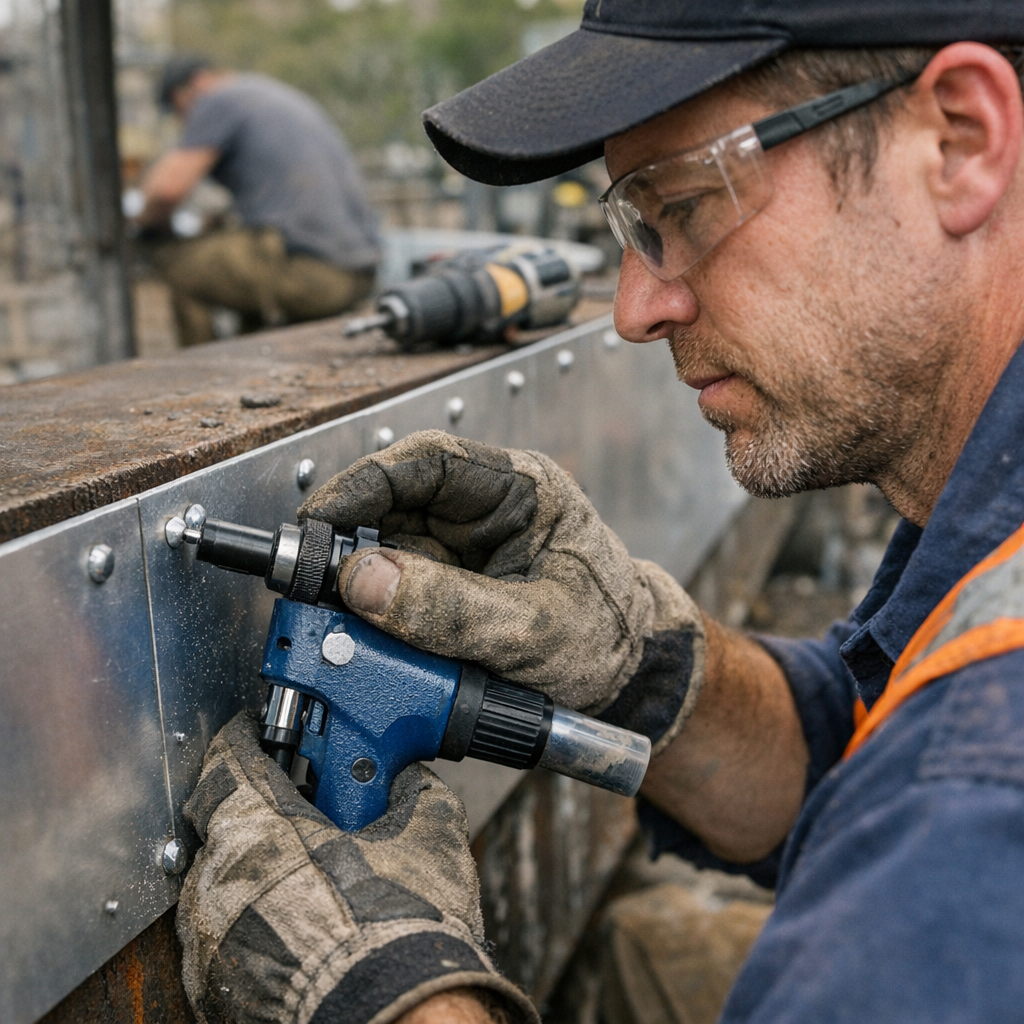
Sometimes, when both a tuned and a barely-touched rivet gun are at work, the difference doesn’t surface until you pick up speed — that’s when the short-stroke gun needs extra force, passes along a pulse of vibration, and leaves a trail of heads sitting just askew. Over time, those alignments start stacking up: mandrels stick, the finish roughens, and you’re left feeling like you’re chasing consistency that keeps just out of reach.
I once watched a row of aluminum rail come together on a rigid steel frame, every few feet revealing the gentle consequence of a stroke just slightly out of sync with the changing material. It wasn’t catastrophic. Just quietly less satisfying.
The Quiet Value of a Tiny Tweak
There’s a refresh — a small sense of ease — that comes from pausing to adjust. It’s usually after a few problem rivets, that moment when you realize it’s time for a change.
A single 0.4mm stroke shift can feel almost trivial. But on a demanding section, that little move steadies the gun, settles the heads flush, and brings back the rhythm that lets the work flow. Vibration through the grip fades, and the line straightens itself out.
It’s hard to put into words how small comfort becomes large when you’re knee-deep in repetition. The hand aches less; the work takes on a satisfying, unremarkable steadiness. Sometimes the best fix in the shop is also the quietest: a small, practical switch made at just the right moment, before trouble has the chance to multiply.
I’ve come to think of stroke adjustment like a habit of paying attention — not a grand fix, but a way of noticing when the job is asking for something just a little different.
The first few dozen rivets rarely teach you this. It’s only over the hours, through the weight of small, steady choices, that it becomes clear — sometimes, control isn’t about force, but about a pause, a modest change, and letting rhythm return.
I found most of these thoughts after a late evening in the workshop, looking over a stubborn repair. Here’s where I wrote more about small habits that keep surprising me.