When a Cart’s Drift Disrupts Your Daily Entry Routine
Unlocked carts on sloped floors drift with use, causing clutter and reset work; adding a wheel stop helps maintain order and clear entryways.
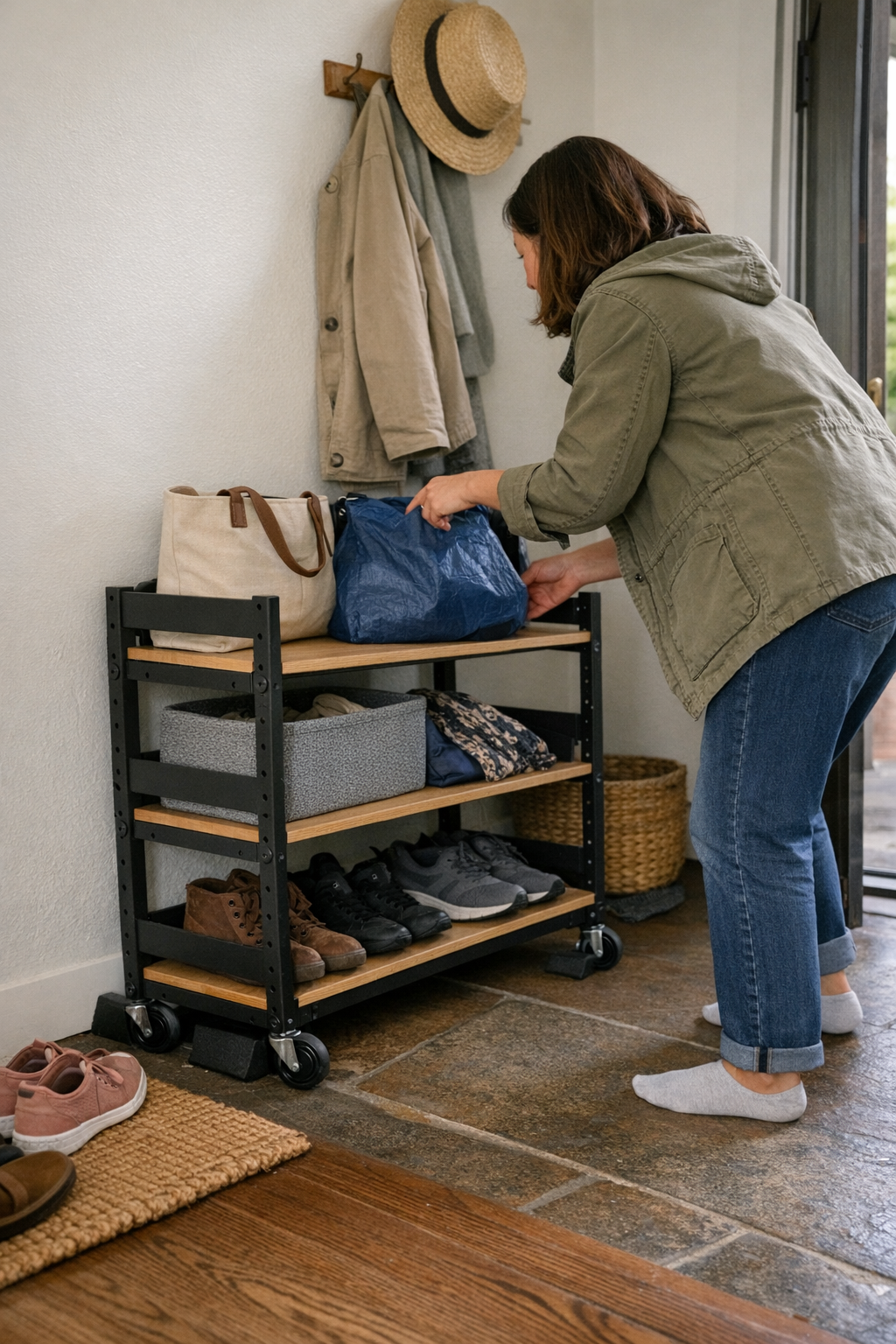
Some problems in a transition space reveal themselves slowly—in the soft drag of a door or the subtle bunching of shoes underfoot. At first, a mobile cart along the entry wall feels like a permission slip—moveable, adaptable, ready to catch the overflow of bags and boots that follow a busy evening. But a floor with the gentlest tilt can quietly undo your plan. Over a few days, movement you barely notice starts to redraw the lines between storage and walkway, shifting the threshold in ways that leave the space feeling unsettled, even when everything still looks almost right.
Unanchored Storage in Motion
The first week with an unlocked cart, I didn’t think much about its wheels. Shoes went into place, bags leaned against the frame, and the cart lined up as intended. You don’t notice it immediately. Then, by midweek, a corner lurched a little closer to the door after someone nudged it on the way in—just enough to crowd the walkway and scatter smaller shoes further across the tiles.
It’s a slow drift at first—rarely a sudden slide, more a fitful migration with each return home, creating small bottlenecks at the edge of the mat. There’s a difference between a setup that absorbs daily mess and one that amplifies it after every pass. That was the part I kept coming back to.
How the Flow Shifts
Late afternoon always revealed what the morning had started. A couple of arrivals in quick succession—arms loaded, backpacks half-zipped, someone veering sideways for balance—and the cart edged away from the wall again, stretching the row of shoes further into the path. You feel it even before you see it: the pause as people angle around, the swing of a bag catching on a cart handle. Even guests, pausing in the threshold, notice the blocked passage.
That wedge of open space you meant to keep clear narrows day by day, reshaped by the sum of tiny, repeated collisions. It’s an odd thing—how something designed for flexibility becomes, little by little, an obstacle for those who need extra room most. I found it oddly reassuring to recognize this as a rhythm, not just a flaw: an adaptive arrangement quietly asking to be anchored.
A Small Change, a Different Return
The turning point was seeing how little was needed to restore calm. A simple block—pressed behind the rear wheels, barely the thickness of a finger—held the cart where it was meant to be. After that, instead of drifting out with every door slam or kid-tumble, the whole entry zone kept its shape. The benefit wasn’t so much about fitting more gear; it was about returning to a space that wasn’t quietly scrambling itself after every hurried arrival.
It’s curious how much less the space asks of you when storage can hold still, even as everything else keeps moving. Some evenings, I just pause at the doorway and appreciate that.
On days when I wonder about other ways to stabilize the transition—modular pieces, wall-mounted units, smaller utility cabinets—I sometimes follow the thread a little further here: http://www.betweenry.myshopify.com



