When a Desk Corner Stops Feeling Like a Temporary Spot
True workstation stability comes from structures keeping cables clear and out of the way, making work transitions faster and seamless.
Sometimes, it's the smallest snag that breaks your flow—a cable catching on a drawer handle, the inch of slack you didn’t notice until your foot taps against it under the desk. At first, these little interruptions blur into the background, easy enough to ignore. But after a few days at the same corner workstation, the details start to repeat. The routines, along with their interruptions, have a subtle way of echoing—cable friction, misplaced chargers, the rhythm breaking each time you reach for something and find the path blocked.
In the morning, it looks tidy—everything pushed to the edges. But function reveals itself differently—on busy afternoons or when the desk resets after calls and device swaps. That’s when corners seem unfinished, no matter how much you clean: cables crossing zones they shouldn’t, small stutters interrupting what should be seamless work. The neat appearance holds for a while, but the daily experience shows its cracks.
Where Order Breaks Down
You notice it after a few days. Hidden cables, tucked neatly behind a monitor or inside a cable box, seem like a fix—until you reach for one mid-task. Now, a stiff cable cover blocks the drawer from opening fully, or a bundle of adapters turns plugging a device into a minor excavation.
The difference isn’t about looks. It’s how often you find yourself adjusting things. Wires get bumped by a chair leg or hold your laptop off-center with the slightest nudge. That stayed with me: how these details shifted from invisible to impossible to ignore, session after session.
The Patterns That Show Up
Work didn’t slow down all at once. The setbacks came as pauses—a hand tracing the same tangled line, an extra second spent lining up a plug, or a brief break needed just to re-align the screen after shifting in the chair. Each one alone barely mattered.
But the differences kept showing up. Routines stacked with interruptions, and the desk started to feel like something to work around, not with. The design didn’t fail loudly; it just nudged itself into every transition—after a meeting, between tasks, right when you want to settle in quickly.
A More Lived-In Flow
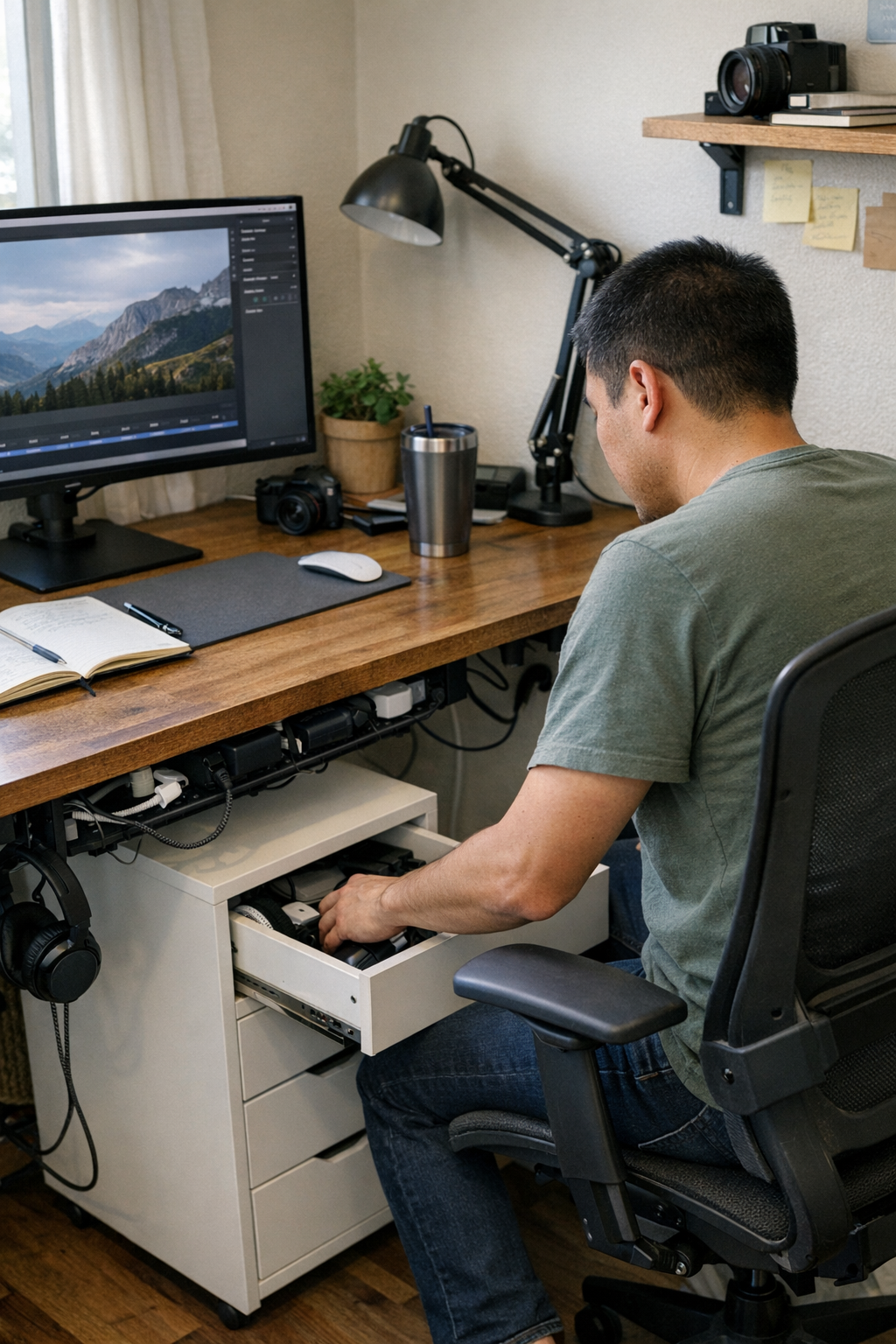
Changing the cable path made a subtle difference. I traded the cable box on the surface for a tray under the desk—barely a hand’s width from the edge. The result wasn’t dramatic, but daily patterns shifted: drawers opened fully, cables stopped drifting, and nothing flexed out of place when the chair shifted back. There was still one visible cable loop, just enough for quick device swaps, but most of the mess stayed out of the way.
This wasn’t a big transformation. The quiet change was in not thinking about it all the time. Missing cables faded into routine; plugging in a laptop or resetting after a tough hour became simple again because nothing blocked the next move. The desk wasn’t just organized—it let the work reset itself without a pause.
If you’re curious about setups made for actual desk time, this is where I keep looking: http://www.workbasic.myshopify.com