When a Donate Bin Becomes the Quiet Source of Clutter
A “donate” bin prevents clutter drift only if emptied regularly and discourages retrieval, keeping the entryway clear and reset effort low.
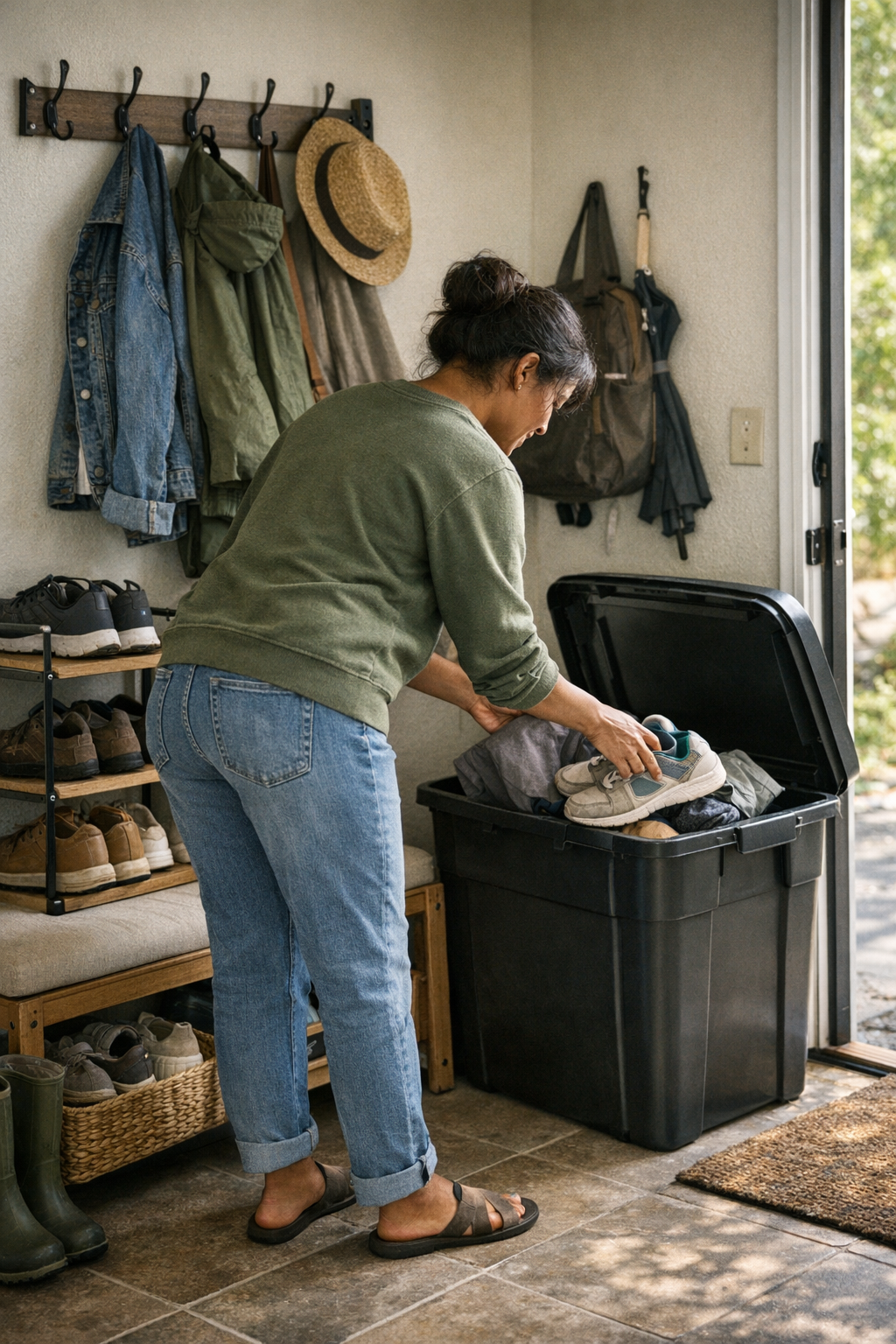
It’s surprising how quickly a so-called “donate” bin can fade into the background of a busy household entryway. At first, it brings relief—finally, a designated spot for old shoes, jackets with broken zippers, and kid gear that’s been outgrown. But as days pass, it shifts. The pile near the door becomes familiar, almost invisible, like the light switch you tap without thought. What began as a transition tool slowly becomes a quiet blockage—never fully empty, rarely overflowing, subtly squeezing the space at those first and last steps inside.
The Difference Between Outflow and Drift
Whenever the weather changed, I noticed a pattern: boots and sneakers rotated in and out, hats moved from one pile to another. In a true transition space—where shoes line up or nestle neatly beneath the bench—items meant to leave tend to drift back, almost as if they want one more pass in the lineup. It’s not obvious at first.
But you feel it.
This was the piece I kept circling back to—why did the space feel so tight, why did the donation bag keep showing up again (and again), perched on the utility bench? It wasn’t about volume alone; it was about flow. When bins or cubbies are too easy to reach—or become hard to access—the drop zone turns from a quick pass-through into a pause.
Where the Threshold Blurs
An under-bench bin seems unassuming—until you try to move through quickly. The test comes with one foot catching on a stray edge, a rogue water bottle stacked too high, or someone pausing mid-threshold to find a weather-resistant jacket they almost forgot. Over days, the path narrows imperceptibly, and that once-low-profile bin becomes a low-slung blockade.
The real shift came when we swapped that lidded, blend-in box for a slim, wall-mounted unit just off the main walkway. Suddenly, it took a bit more effort to drop items “just for now.” Overflow stopped bubbling up in weekly rings on the bench. The change was subtle—but the threshold felt lighter, airier, even when little had actually left the space.
Steady Movement Feels Like Relief
The best transition storage in these in-between spaces doesn’t just hold items—it nudges them forward. Anything too easy to retrieve invites hesitation, while any system that resists buildup keeps the passageway open, even if the stored gear isn’t glamorous. Emptying the bin when it’s half full—not only when it’s crammed—lets the zone stay ready for what comes next: muddy boots from a wet field or shoes tossed off after a weekend hike.
It may seem minor, but the relief is real. Small design choices around mobility, clear boundaries, and just-visible signals quietly decide whether an entryway supports letting go or encourages lingering. That’s the lesson I keep coming back to.
Sometimes I try new ways to tune habits in these transition zones—and lately, I’ve explored a few concepts over here: http://www.betweenry.myshopify.com



