When a Hallway Bench Shapes Everyday Flow and Calm
The depth, alignment, and compartment style of a hallway storage bench impact ease and clutter control in narrow passageways.
You don’t really notice how narrow a hallway feels until you add a bench that almost fits. At first, it’s just another piece intended to tidy things up—a place to sit, a close-at-hand spot for shoes and bags. It looks organized, at least for the first few days.
But as you cycle through mornings and evenings, something small shifts. The space narrows in a way that’s hard to put your finger on. Eventually, every sidestep and pivot becomes sharper, especially when the bench edges into the path. Shoes pile up by the side. There’s a bit more squeezing, a subtle pause you didn’t have before.
This is where storage turns into friction—for everyone.
Where the Structure Breaks Down
In the calm of an empty hallway, the bench seems harmless.
But once routines kick in, the pinch points reveal themselves. A deep storage bench with a heavy lid promises neatness, but with every crouch and two-handed lift, less actually makes it inside. Shoes, bags, and stray gloves start living on top. Retrieval slows, and step by step, the passage becomes a lineup of obstacles.
The whole space is still technically organized. But real use tells a different story.
That was the part I kept coming back to. When the bench stuck out, even just a few centimeters, everyone compensated around it. Not enough to change the world—just enough to change the feel of the room.
Finding a Fit That Fades
There’s something steady about a bench that aligns flush with the wall.
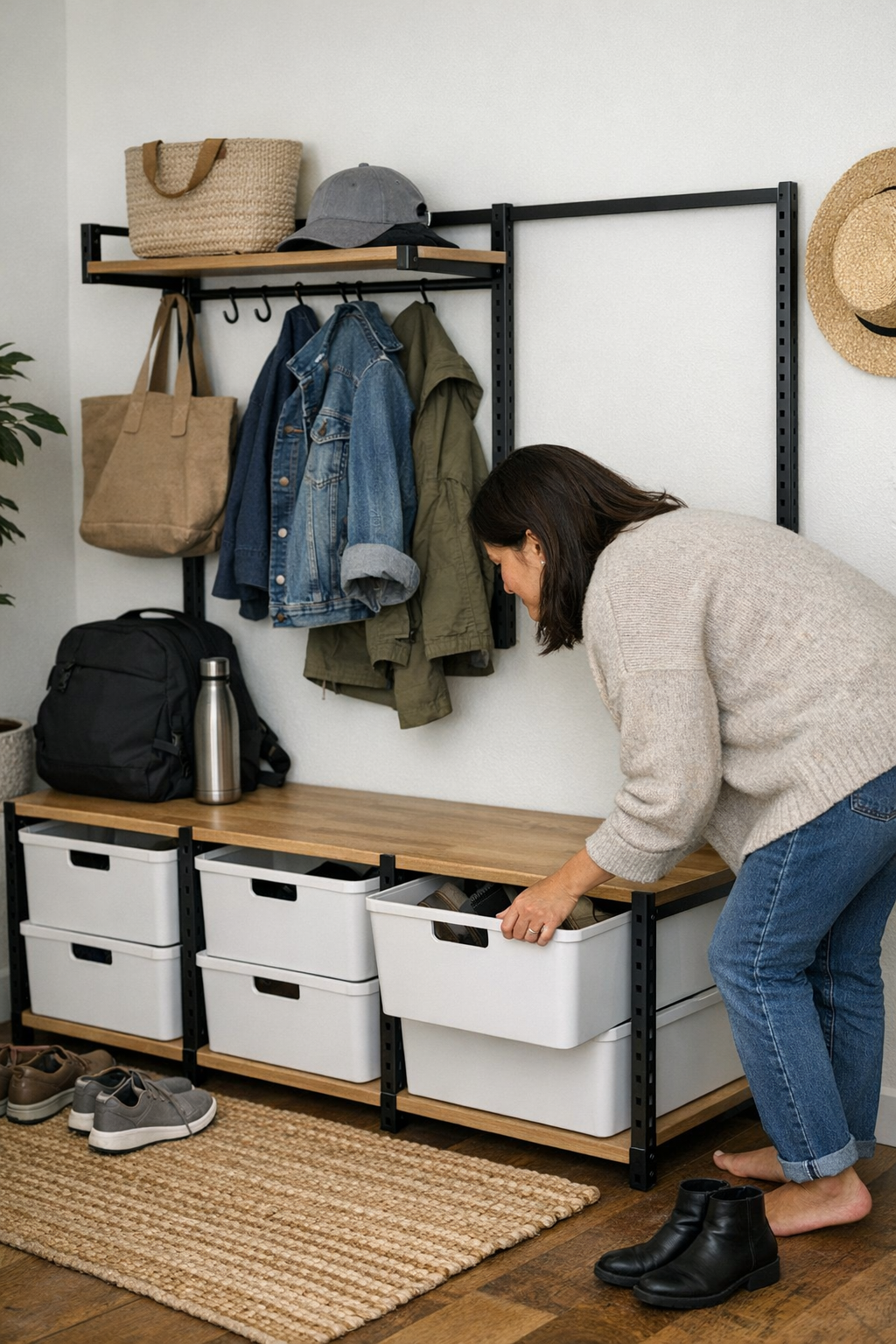
After switching to a slimmer model—one with an open shelf high enough to slot shoes in side by side—the hallway started to breathe again. Shoes went under instead of beside. Nothing blocked the walking line. The daily scatter of backpacks sliding off the edge disappeared.
It wasn’t a dramatic shift. Just a gradually easier flow. Pull-out baskets inside the shelf made sense—things went in or out without fuss—and when a reset was needed, it didn’t feel like a chore.
Open shelving did leave everything visible, a little busier to the eye, but the simpler structure outlasted the initial mess.
Storage That Holds Up to Habit
It’s interesting: a bench can feel like just furniture until its proportions subtly nudge your whole routine off course. A difference of just a few centimeters in depth moved us from half-blocked passage to free flow, and made returning to order a habit, not a reset.
That clarity didn’t come from matching finishes or clever categories. It was the way the structure didn’t interrupt movement, didn’t collect overflow at the edges, and didn’t demand extra effort to stay usable.
You don’t notice it immediately. But over time, you feel it.
If you’re exploring how these kinds of proportions add up in modular systems, slim cabinets, floor and wall storage, or integrated benches, you can look here: http://www.gridry.myshopify.com