When a Quiet Edge Changes Everyday Cat Care
Choosing the right physical boundary—like a mat with a raised edge—prevents stray mess, making daily routines smoother and shared living easier.
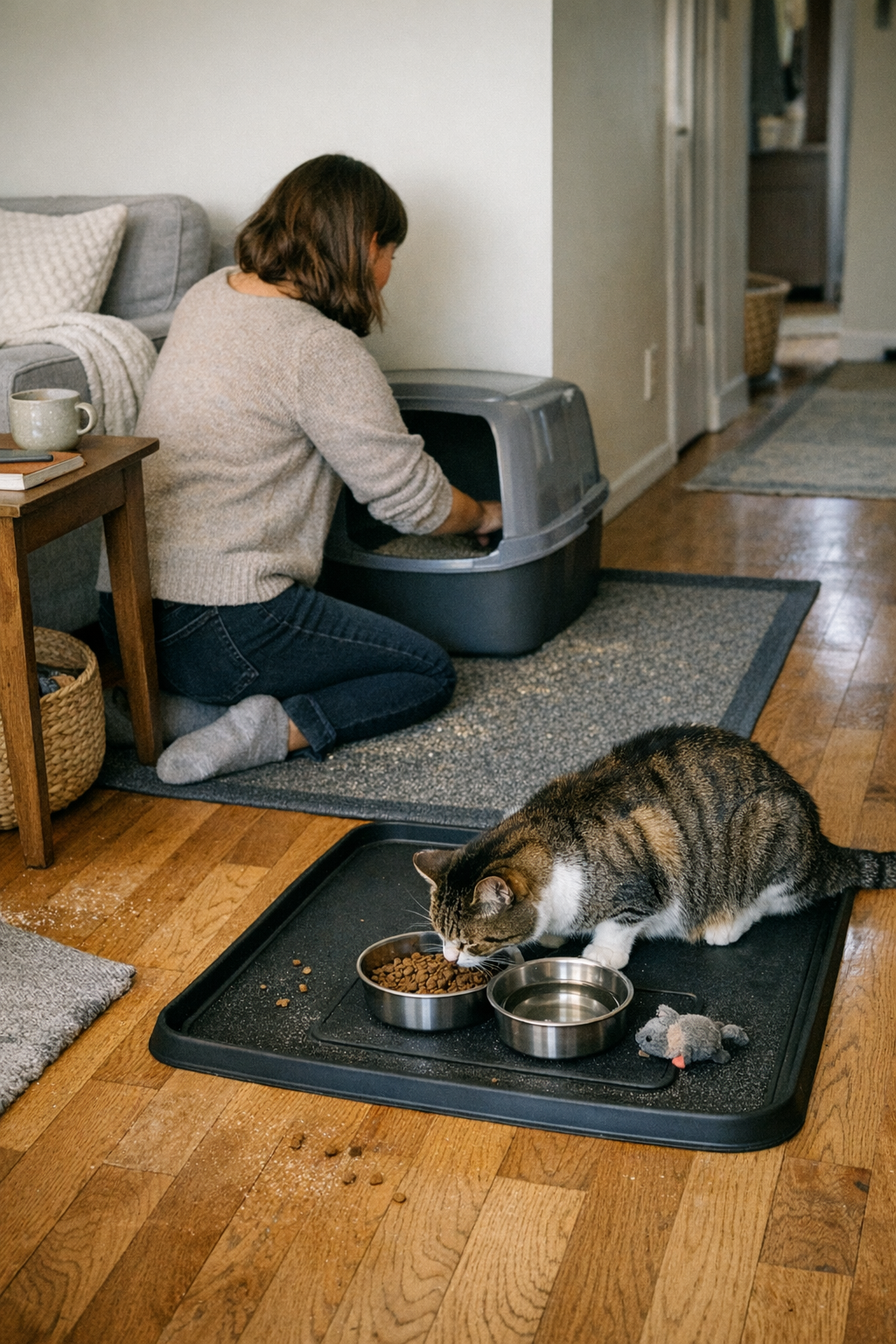
I didn’t notice the slow drift at first. The food bowls stayed lined up, the mats looked just fine, and that little corner by the litter box seemed organized enough to pass for tidy. But after a few weeks—feeding, refilling, cleaning, again and again—subtle shifts started to show. Kibble skittered past the edge. Water left faint rings on the floor. Stray litter dust inched beyond where it should have stayed. It quietly moved the “cat zone” further into the rest of the room. The sense of order faded almost without warning, replaced by a running catch-up in the shared space around it.
You notice it after a few resets. The mat under the bowls seems meant to contain everything, right up until it doesn’t. Each refill or wipe redraws the same invisible line: which part belongs to the cat, and which part is yours. I found myself pausing—shouldn’t that one small rug be enough? Yet the routine kept nudging beyond it, so that mat felt more like wishful thinking than an actual boundary. That was the part that kept coming back: the more lived-in the setup became, the more it demanded reconsideration.
There’s something disappointing about a space that looks collected but always calls for another sweep. On paper, a slim rug promises easy containment. In use, it just buys a few days before another scatter appears underfoot. Every time dry food rolled beneath the sofa or a faint water ring crept toward the hallway, it felt less like a dedicated pet corner and more like a moving target. I’d spot a forgotten toy under a side table, kneel to fetch it, and catch the fine dust from litter tracked in on my palm. That’s when it hit me: the boundaries felt decorative, not real.
Eventually, the change was quiet and practical. The thin mat went out, replaced by a thicker, rubber-backed mat with a raised lip—a small detail, but suddenly stray food stopped escaping and water pooled safely inside the edge. Cleanup started shrinking, and nothing migrated under furniture anymore. The relief wasn’t dramatic; the area simply stayed within its footprint, day after day. It’s easy to underestimate how much daily upkeep comes down to the difference between what looks contained and what truly holds its ground during repeated use.
Sometimes the smallest physical edge is what lets the rest fade into the background. If cleanup creeps further every week, it’s worth seeing whether the old boundary is a boundary at all. It took living through the cycle a few times to realize that’s where most of the friction hides—in feeding resets, water refills that dribble over the edge, litter-adjacent dust that lingers, and toys that don’t quite return to their spots.
If this feels familiar, you might find a few quietly waiting options over here: http://www.stillwhisker.myshopify.com