When Boundaries Shape Everyday Workshop Flow
Defining boundaries like wall-mounted rails and fixed zones keep return flow smooth, routine resets fast, and floors clear, preventing clutter and friction.
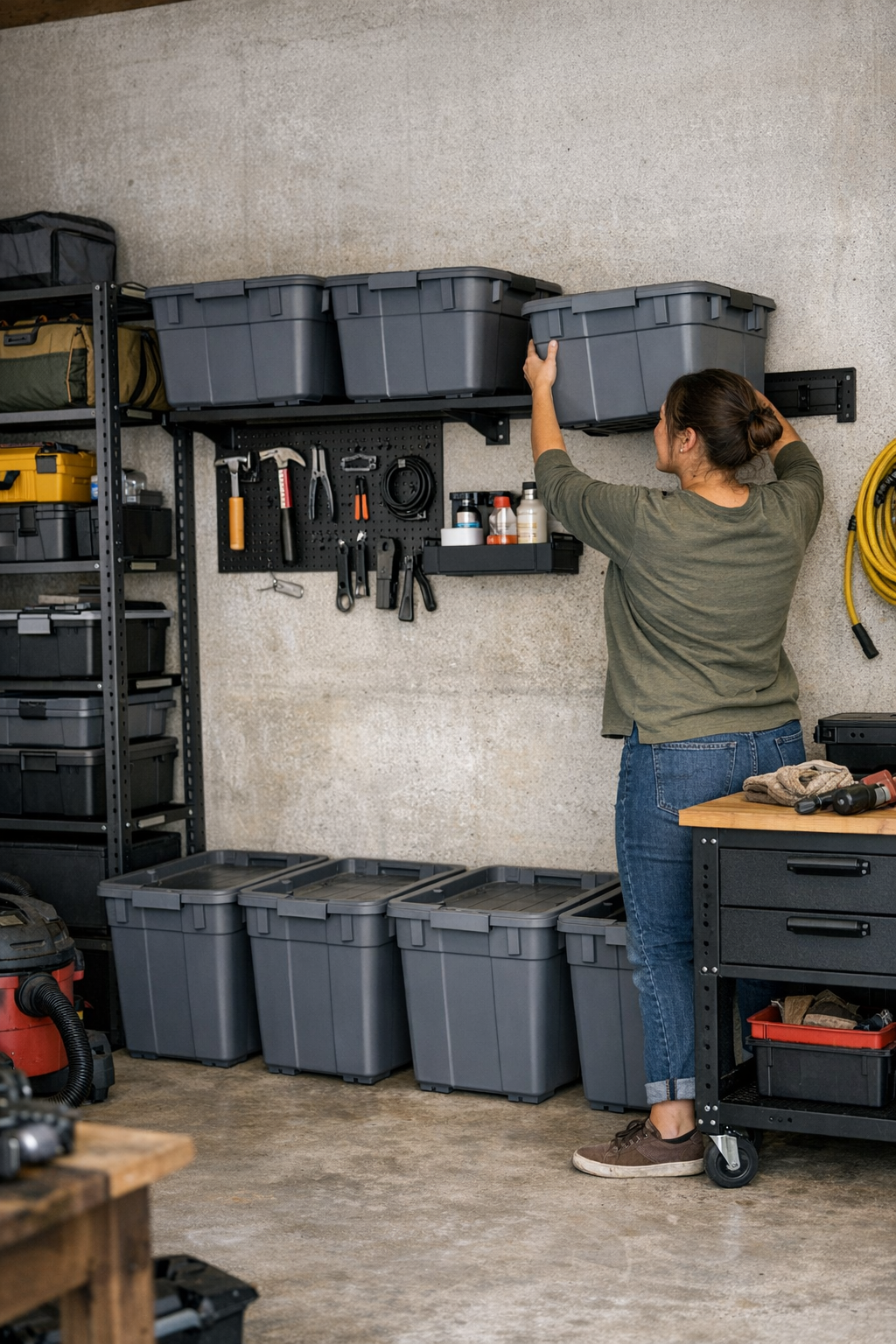
Sometimes it’s the smallest details in a space that shape how we work. Organization feels like a puzzle—one that, for a while, seems solved. Stacks of bins, carefully labeled and arranged, convince us the problem is managed. But time has a way of testing those choices.
Storage in a garage or workshop isn’t really about how many containers you can line up or how tall you can stack them. It’s something more subtle: the idea of boundaries, and the difference they quietly make. When things move easily, we hardly notice. It’s only when flow is interrupted—when the shuffle slows down—that we start to feel the real consequences.
You don’t notice it immediately. But you feel it.
The Pull of Open Space
A row of matching storage bins on a concrete floor looks orderly at first. But the routine of daily life—grabbing tools in a rush, returning a crate with hands full—softly erodes that order. Bins edge out to clear a blocked outlet; a coil of hose snakes behind them until you have to shift everything just to plug something in.
Real-life movement reveals this: containers without true boundaries start wandering.
You might not think much of it at first. A small drift. A bag propped atop a bin “just for a day or two.” Yet over a few weeks, the space doesn’t feel as open as it once did. Walking paths close up. Suddenly, simple tasks feel like chores—just grabbing one box means nudging two more aside.
It’s a subtle shift, almost invisible until your rhythm stutters.
When Boundaries Quietly Do Their Work
I noticed the difference almost by accident, after lifting half a dozen bins off the floor and onto a wall-mounted rail. The change wasn’t just visual. With fewer containers on the ground, there was space to breathe—and to move.
Overflow stopped sneaking across the workshop. Accessing tools and parts was easier, and even the act of putting something back took only a single step. No more gentle shoves to make space. No more resetting piles each week just to keep the door clear.
It struck me: it wasn’t about having more containers. It was about where each began and ended.
Physical boundaries—fixed rails, assigned shelving, defined cabinet zones—quietly hold shape. They don’t just organize; they guide. Items anchored to specific places return more naturally, with less effort.
The Natural Order of Things
Over time, even the most organized setups fall apart when limits are vague. More bins can only do so much if they keep finding new homes in corners or creeping into pathways. Shape-shifting piles and shifting footprints are signs of a system under strain.
True order isn’t about surface neatness—it’s about the ongoing ability to keep things in motion. That gentle feeling of putting something back in one step, finding walking space always open, and not having to shuffle five things to find one.
We tend to focus on “how much will fit,” but the peace comes from how reliably things return.
There’s a relief in discovering that boundaries, not just containers, keep our spaces gentle on the routines that matter.
These thoughts came together while rearranging my own workshop, bins in hand and a quiet appreciation for the way walls hold our habits.



