When Cat Spaces Disrupt the Flow of Home Life
Systems anchoring cat areas and containing mess reduce cleanup, making indoor cat care easier than improvised setups.
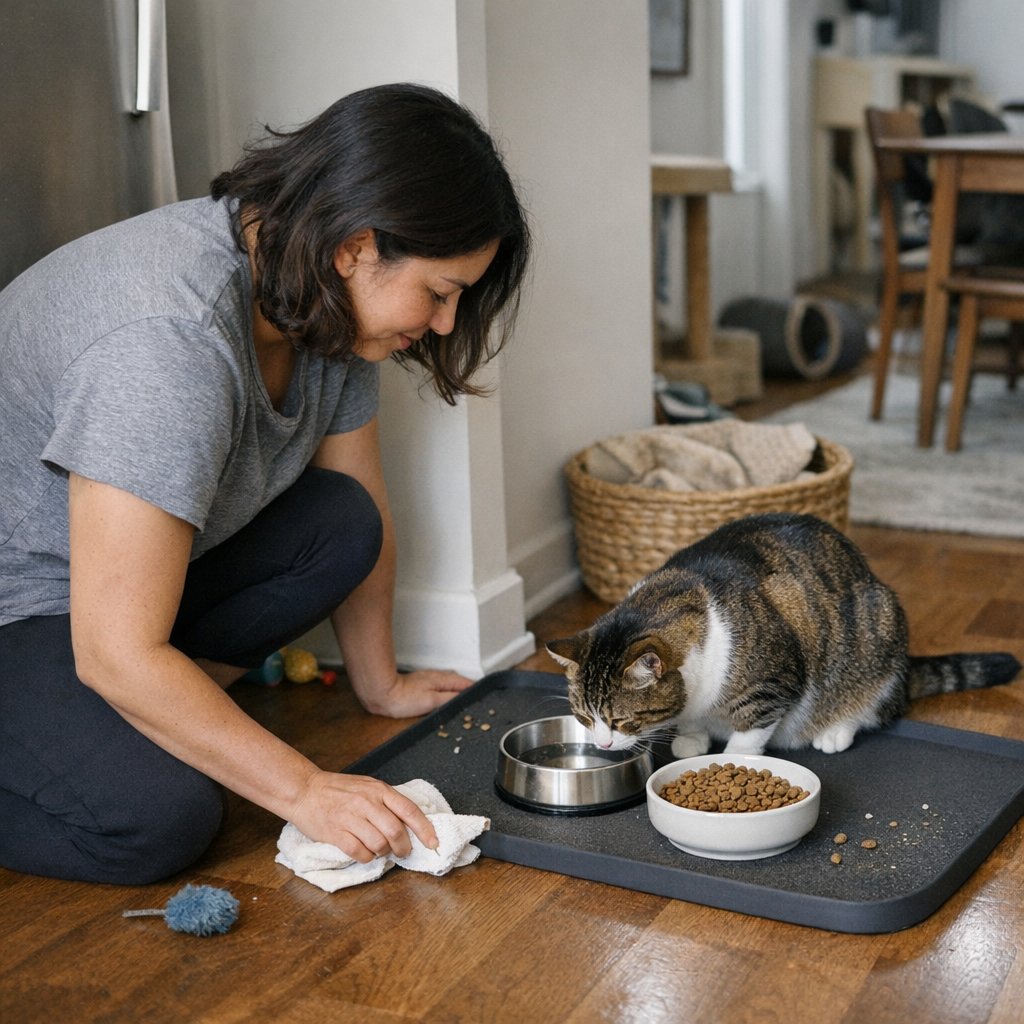
There’s a quiet moment when you start to notice patterns repeating around your cat’s feeding space. The mat under the food bowls might be clean enough at breakfast, but by evening, hidden grit collects under the edge, kibble scatters several inches away, and there’s often a slow ring of water forming beneath the bowl. Picking up stray pieces and wiping damp patches becomes a familiar, unplanned rhythm. In these small resets, the difference between a setup that holds up in everyday life and one that just looks finished quickly becomes clear.
Mess is easy to forgive at first. Even a slim, neat feeding mat seemed clever—a minimal solution that I hoped would keep the room orderly. But the edges of routines tend to fray fast: kibble sneaks past the mat every day, water shifts off target, and the mat itself slowly migrates a few inches at a time. Eventually, cleaning behind it becomes necessary, then the cycle repeats. What looked fine initially doesn’t absorb the everyday scatter of living with a roaming cat and an ordinary household schedule.
A Feeding Zone in the Never-Quiet Part of the House
It’s not just the bowls or mats alone; it’s how their territory overlaps with daily life. The kitchen is rarely empty, especially before coffee or during the afternoon rush. Each trip to refill food or water usually steps over crumbs or a stray toy left from recent play. Sometimes, a bit of litter ends up hitching a ride and settles quietly along the seam between mat and floor. You start noticing these after a few daily resets. What felt like a sharp, tidy line between “cat zone” and the rest of the room slowly blurs, especially when you find yourself sidestepping toys or nudging the water bowl back to its corner repeatedly.
Some cats seem to sense the disruption, pausing near damp spots or lingering by their bowls longer than usual. Over a few weeks, I found that a little order does more than just please the eye—it changes the routine. A setup that quietly contains mess reduces the extra rounds of stepping back, picking up, and resetting. The difference is subtle but builds steadily.
Finding What Actually Stays Put
After many habitual wipe-ups and bowl repositionings, I switched to a heavier mat with a small raised lip—a detail I had earlier dismissed as unnecessary. The practical impact was clear: food and water stopped leaking into the open, stray pieces collected where I could easily see and gather them, and importantly, the mat stayed anchored despite repeated use from morning feeding to evening reset. That repeatability was key: a setup only feels truly easy if by day three it demands less attention, not more.
Often the breakthrough comes from containing scatter in one place. Having just one mat to check and clean, one spot to intercept stray toys, felt lighter than battling the daily spread that earlier, neater-looking setups allowed. Since then, daily resets have taken less time, and I no longer rush to clean after every little mess. Living alongside my indoor cat’s regular habits quickly highlights which parts of the setup need constant attention—and which start to slip quietly into the background.
Small adjustments make a difference: mat edges, bowl weight, surface grip—all contribute to what stays put. I still find the occasional noodle-shaped toy under the table, but mostly the feeding and water area feels quieter now—less demanding, more settled.
If you’re curious about other feeding and water setups or related spaces like litter-adjacent arrangements and play zones, you can explore more here: http://www.stillwhisker.myshopify.com



