When Ceiling Lights Don’t Reach Every Corner of Home Life
Ceiling lighting keeps rooms open only if fixture spread and placement match activity, preventing dim edges, extra lamps, and cable clutter.
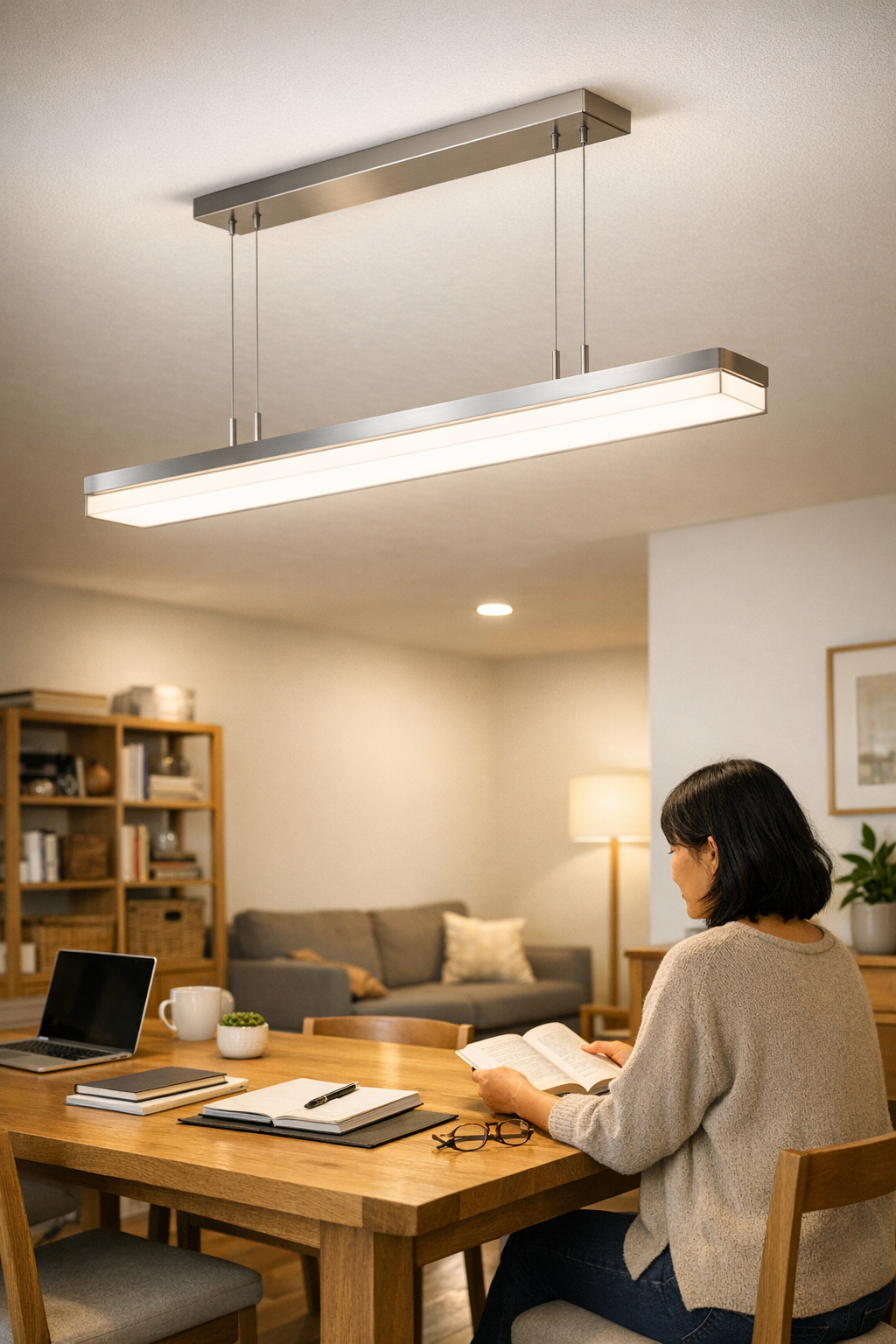
It’s easy to mistake a tidy room for a room that works. I noticed this especially when the ceiling light switched on at sunset, its even glow brushing over surfaces and wiping away any sense of clutter. At first, the space appeared organized and clear. But once a few extra people settled in, or someone tried to work at the far edge of the table, old habits—scattered desk lamps, trailing power strips—crept right back in. Clean lines on the ceiling didn’t always translate to usable corners or comfortable movement. That was the part I kept returning to.
What the Eye Misses, the Routine Finds
You don’t notice it immediately. The cable that keeps returning beside a chair, or the dull shadow hugging a wall shelf where notebooks slide just out of reach. In photos, the room reads as neat; in use, it tells its own story—glare off monitor glass, reading arms hovering in twilight, another lamp nudging its cord into view.
Day by day, there’s a quiet negotiation happening behind the scenes. The hanging ceiling fixture grants the illusion of order, but any routine—shifting papers around, working late, following kids to the floor—finds its limits. Most of the time, the gap shows up as a persistent dimness at the edge of a desk or an awkward lean toward a portable light just to finish a task. But you feel it.
The Pattern Beneath the Calm
It’s strange how a room can look solved while quietly holding small frictions. For me, this was clear at the long table near the window: the main ceiling panel covered the middle, but every shared project drifted toward the well-lit zone, leaving the far edge in partial shadow. There’s an odd choreography—swapping ends, nudging chairs, trading clear surfaces for clustered corners—whenever the lighting only halfway matches real habits.
Eventually, the original neatness broke down. A desk lamp would land on the table, its cord trailing across the seat. The hope that a ceiling fixture alone would erase visual and physical clutter never quite played out. Sometimes the simplest fix wasn’t adding another lamp, but shifting the ceiling mount a little closer to where people actually gathered. When the panel reached that missing stretch, the constant improvising faded.
The Slow Reveal
Most days, it’s not about how a setup looks at noon but how it moves through evenings, guests, or those times when everyone’s working from the same surface. Lights that seemed to simplify things quietly expose their limits—dim zones, awkward bracket angles, cords creeping back into view. Living with that, I began to notice how a practical shift in placement could quietly resolve old sticking points, leaving the room feeling more open, not just orderly.
The biggest changes were subtle enough that I nearly missed them—until I stopped reaching for backup lamps each night.
Sometimes I look for quiet examples like this one: http://www.lightsupport.myshopify.com You will receive a blog body draft.



