When Ceiling Lights Shape the Rhythm of Shared Rooms
Linear and panel ceiling lights seem similar but diverge quickly in use: only a well-directed linear light with proper support and cable management avoids dim edges and clutter.
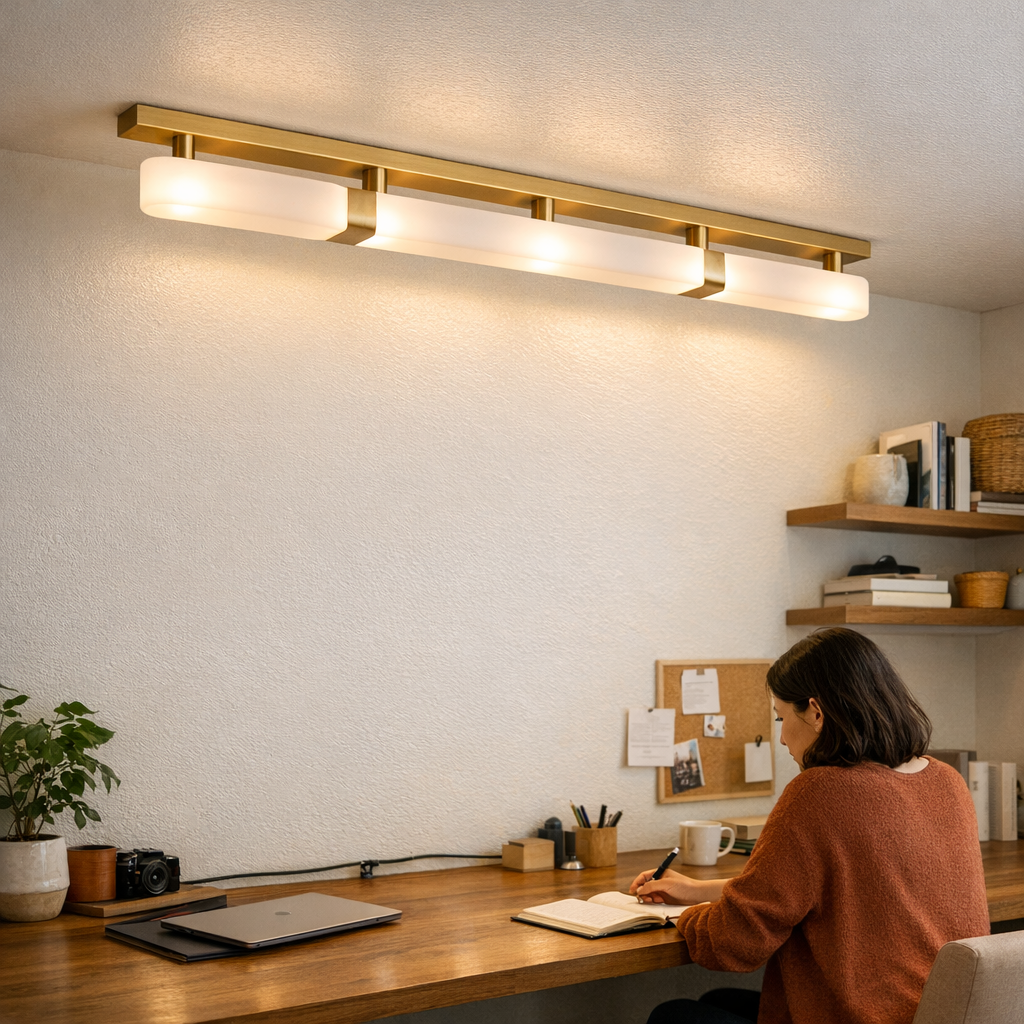
It’s strange how some rooms look completely resolved, almost seamless, until you actually live with them. The right overhead light can feel invisible at first—just another line on the ceiling, another square flush against the surface. But every evening at my usual desk, something small kept nagging for attention. Not urgent—just the way one side always seemed better to work at, an edge left in dimness no matter where I sat, and a line of cables tracing the wall more than I’d expected.
Lighting feels final until it doesn’t. And that was the flaw I kept circling back to.
The Edges That Fade Out
Flush ceiling panels have their own quiet charm. The room feels calm, uniform, even a little smarter. But there’s a difference between what looks finished and what quietly works.
I only started to notice this after a few weeks. The middle of the desk glowed, as intended, but by late afternoon, the far edge faded. Papers left along the wall sat in a comfortable half-shadow; cables and chargers stayed as visible as ever—no matter how many times I tried shifting them aside.
You don’t notice it immediately. But you feel it.
It’s not just a question of brightness—more a slow, accumulating sense of compromise. A fixture can feel resolved right up to the point you need the light somewhere else.
Lines That Actually Belong
Everything shifted the day a linear fixture went in, running lengthwise with the desk and pushed twelve inches out from the wall. It didn’t look dramatic—just a slim line in a tidy slot, easy to forget. But for the first time, the whole desk felt possible.
The change wasn’t loud. But it was easy to trace. Light carried evenly, the dim strip vanished. Both sides became equally usable: from the nearest shelf to the last laptop charger, everything sat out in plain sight, no extra lamp needed. There was less negotiating for the “good” side, less fiddling with adapters or moving piles to catch a better angle.
That was the part I kept coming back to. Less workarounds meant more quiet, and the cables finally fell out of mind.
Just because a space looks minimal doesn’t mean it will feel simple to use.
When Support Actually Supports
Over time, I started to see the effect in other shared corners. Not just at the desk, but any place two people sat together—where a ceiling panel left the outermost area fading, and lamps crept back, bringing their cables with them. It wasn’t about having more light. It was about getting the right light to the right place, from the ceiling down—not just shining on the center, but following the real surface where things happen.
Support matters just as much as the fixture itself. A linear light, set at the edge, became a quiet partner for both people at the desk. There was less to explain, less to dodge or rearrange. Lighting that works from experience outwards, not just from design inwards.
You live with it, and the difference lingers.
If you ever want to see some examples, they’re quietly collected here.