When Closet Choices Meet Everyday Life’s Mess
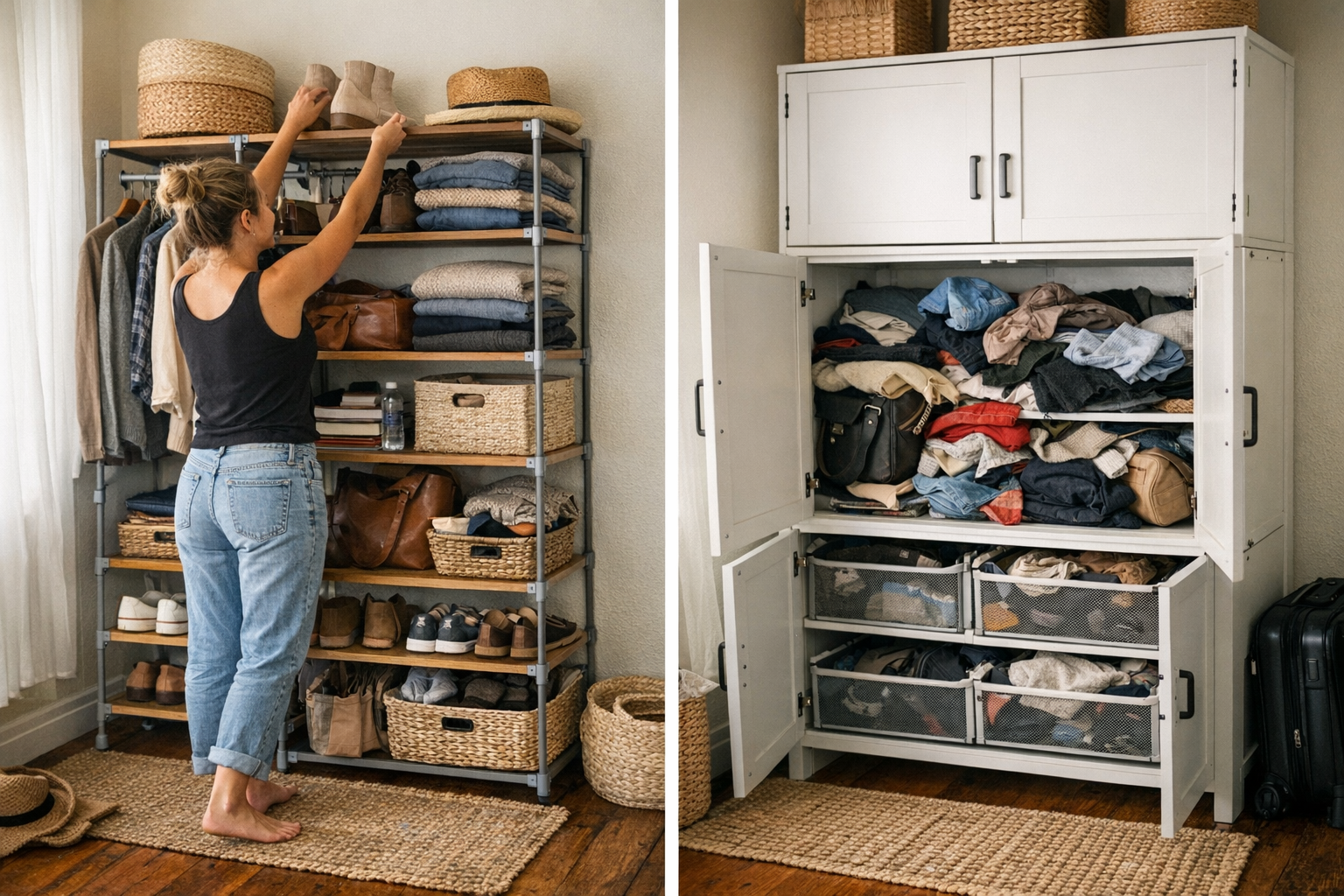
Open shelves offer quick access but reveal mess fast; closed cabinets hide clutter but can hide disorder. Combining both improves closet use.
There’s something strangely comforting about a tidy closet—the promise of order, the hope that every morning we’ll reach for what we need and find it right where it belongs.
But as days go by, the story shifts.
Somewhere between Monday’s rush and Friday’s fatigue, the system—open or closed storage—begins to show its true nature. Open shelves quietly invite us to drop things wherever; closed doors give cover to laundry-day compromises. We rarely realize when the rhythm breaks. We just feel it: a little more hesitation in the morning, a few extra seconds lost searching for that favorite scarf.
Visibility and the Quiet Creep of Clutter
Open shelves feel honest. They display everything, promises and clutter alike. At first, it’s reassuring to see folded shirts, bags lined up, each item accessible with a glance.
You don’t notice it immediately.
But day by day, the open layout starts to reveal every shortcut—a stray tote set down in haste, yesterday’s mail parked atop a shoe box. The visual reminders multiply. Each lapse nudges a boundary, stacking until the shelf loses its shape and resets become a chore.
Yet, the story is different behind closed doors. Here, surfaces stay clean. For a while.
Until one morning you tug at a cabinet and realize the things inside have become unsettled. Socks mingle with scarves, tees and sweaters compress into a mound. Outward calm masks quiet backlog, sometimes until you need something in a hurry.
The Real Life Reveal
I remember once trying to keep everything “visible.” Every shelf within reach, categories open and ready. At first, it made sense. But I’d find a favorite sweater wedged between things that didn’t belong, and soon enough, a line of shoes kept sliding further out of place.
One small shift brought peace: I reserved a single open shelf above eye level for off-season shoes. Just that. The rest—frequently used, everyday things—stayed close at hand. Everything else, tucked behind doors. The mixing stopped, and resets became less frequent. For a few weeks, it felt as if my mornings exhaled.
A Subtle Balance Emerges
There’s a gentle irony to all this.
Open storage brings disorder into the light, giving us a chance to course-correct before chaos sets in. Closed storage delays the message—peace outside, mess seething quietly inside—until a reset can no longer be postponed.
Some mornings need the speed of grabbing what you need from a shelf in plain view. Other days, the calm of a smooth cabinet front is more important, even if it means a longer search inside.
Neither system is perfect on its own. The trick is subtle: keeping daily essentials in easy sight, tucking away the rest, and letting zones shift gently with real life instead of against it.
We don’t really notice when our systems start to slip. But we can always recalibrate, a little at a time.
These thoughts found their shape as I reworked the storage in my own small entry closet.