When Closet Order Fades Into Everyday Frustration
Closet shelving towers work best when shelf spacing fits your routine, preventing overcrowding and making retrieval and resets easier.
The closet looked organized enough at first. I remember that moment opening the door in the morning and everything still being in its place. But after a few days, the rhythm shifted—a slow pressure, not dramatic, just a sense that the order wasn’t quite holding up against my routine.
I started noticing the details. Shoes never seemed to settle where I meant them to, and baskets drifted out of formation without warning. That was the part I kept coming back to: not mess, exactly, but quiet friction that snuck into every return and retrieval.
It’s strange how adjustable shelf spacing makes such a difference, but you don’t really feel it until you’ve lived through a week or so of using the space.
Small Shifts, Subtle Trouble
Much of the trouble hides in the in-betweens. Closets and wall systems always look calm the first day after rearranging—rows of folded shirts, shoes lined in pairs, every stack freshly mapped.
But real life settles in quickly. In towers with tightly spaced shelves, the neatness slowly comes undone. You reach for something in the middle and nudge two other things aside; bins pushed back behind a lip, shoes drifting out past the edge. The surface stays calm for a while, but underneath, categories start to blend and overflow.
You don’t notice it immediately. But you feel it, especially near the end of the week, when just getting your shoes means shuffling a pile of extras out of the way.
The Rhythm of Retrieval
What stood out most was how easily a closet organization unit could lose its pattern—not from clutter, just from a structure that asks you to move things more than you should.
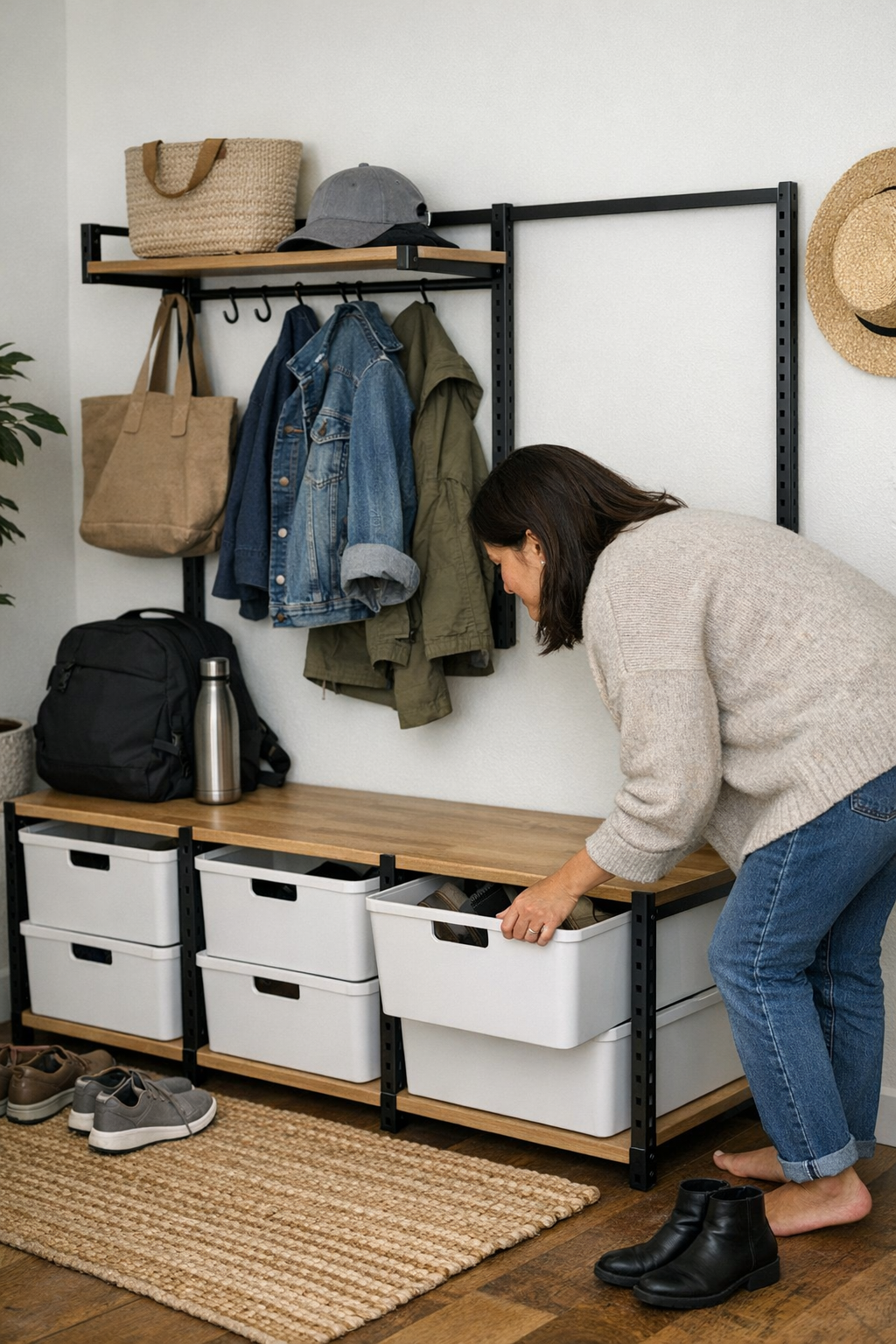
In a shared or busy closet, returns become tiny negotiations. Put one bag back, and the stack slumps. Slide out a pair of shoes, and the row collapses, every “quick fix” adding up by Friday. You invent workarounds—put this here, tuck that there—but the modular shelving system starts asking for maintenance when it’s meant to save you time.
I realized that shelves set just a finger-width above what lives on them changed just about everything. There was room to move things in and out without resetting the whole row, and less hiding of items at the back where I’d forget them. The reset at the end of the day felt less like a chore and more like a simple pause.
How Things Hold (or Don’t)
Stacking more shelves or squeezing in slimmer towers doesn’t always work out the way it sounds. Efficiency can start to cost hidden minutes. Deep shelves, for all their promise of space, let categories blur together, and overstacking becomes hard to avoid.
What helped most wasn’t necessarily fitting in more storage—but making sure each area could handle coming and going without merging categories or hiding overflow. When the edges stay clear and the rows stay upright, the “organized” look lasts longer, but more importantly, so does the feeling that everything returns easily to its place.
I found myself moving less, reaching less, resetting less. It added up gently, in ways that were hard to see but easy to feel.
I came across a few more thoughts along these lines, in case you’re curious: http://www.gridry.myshopify.com