When Closet Order Fades: The Quiet Battle of Shelves and Baskets
Open shelves give quick visuals but let small items drift; baskets keep categories clearer but hide contents. Balance containment and visibility.
There’s something satisfying about a tidy closet. Rows of folded shirts, neatly stacked sweaters, everything in its place—a silent promise of order. But that sense of control fades quickly, almost without warning, especially when daily life seeps into the space. You might not notice the unraveling at first, but you feel it.
Most of us don’t spend much time weighing the merits of open shelves versus baskets for storing the little things: scarves, socks, gloves, all those daily necessities. Yet, behind the closet door, this small design decision holds more sway over our peace of mind than we might admit. It isn’t about Pinterest-worthy minimalism. It’s about how easily an ordered space unravels into hassle and frustration if the tools that keep things separate aren’t right for the rhythm of our lives.
The False Comfort of Perfect Stacks
In the beginning, those open shelves feel like a quiet triumph. Everything visible. Everything easy to grab. For a few days, maybe a week, the system holds. The morning rush doesn’t leave much trace.
But then there’s that moment—when you reach for a pair of gloves and a pile of scarves slumps sideways. Or a lean stack of socks topples, disappearing behind heavier layers. What was once crisp and reassuring becomes a tangle of edges, categories blurring together in silent protest.
Pause, and you might see it: a trail of small frustrations, like a drawer that never quite shuts or a light that flickers just enough to bother without being noticed right away. The shift happens quietly, building up until the original order is a memory.
Where Baskets Quiet the Chaos
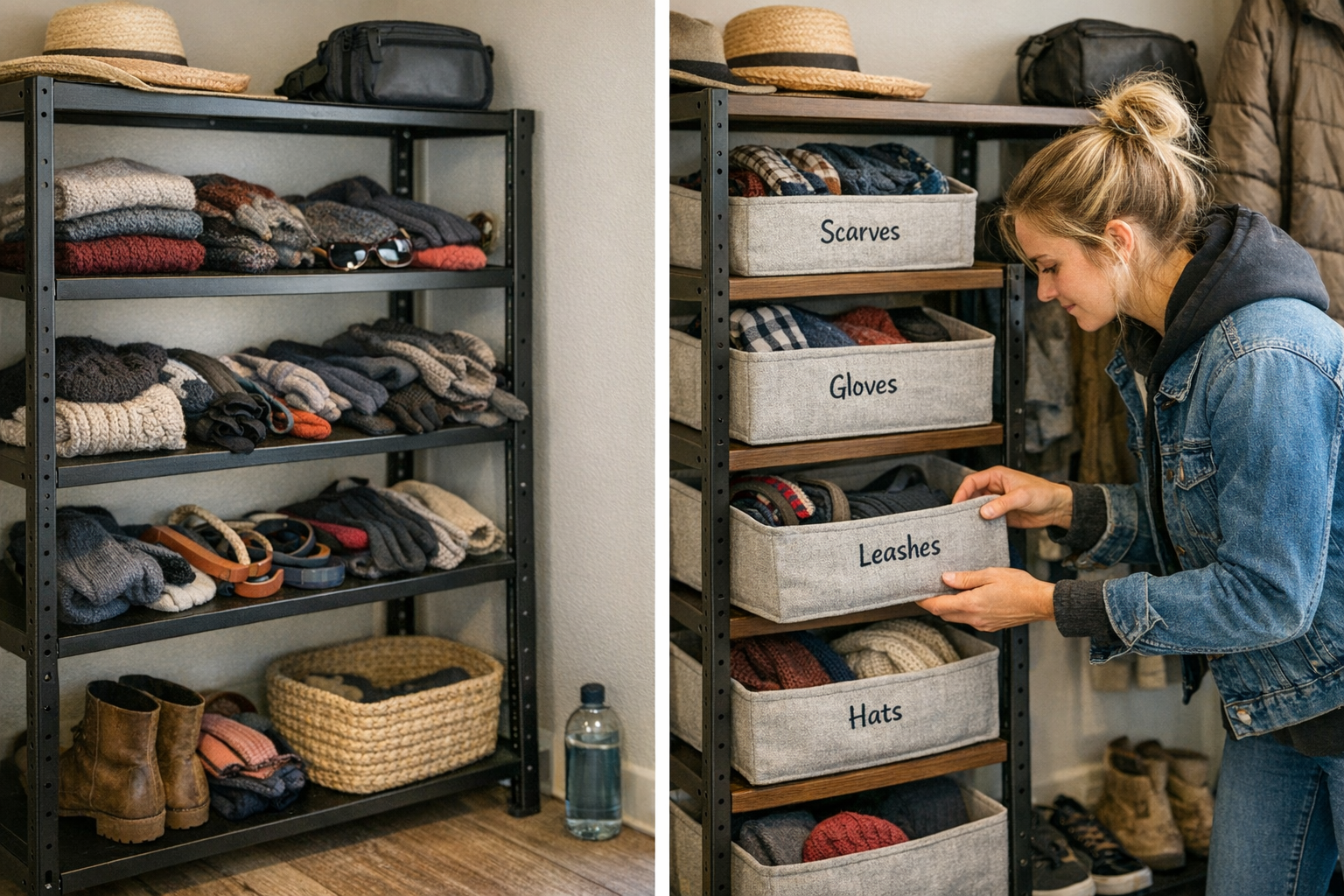
One day, after yet another round of shelf restacking, I tried swapping in a few shallow, fabric baskets. Instead of fighting with teetering piles or the slow creep of mess toward the front of the shelf, I just dropped the smaller things—scarves, gym towels, dog leashes—straight in.
It wasn’t a grand rearrangement. Just a test of containment.
Suddenly, the borderline between order and chaos felt less fragile. No more edge spillover. No more lost minutes searching for a single sock buried under a sweater.
There’s something quietly satisfying about seeing categories kept distinct, breezily labeled. Larger, sturdier pieces—folded jeans, boxes of boots—held their own fine on open shelves. But the smaller items found calm in contained quarters.
The Quiet Trade-Off We Often Overlook
Of course, baskets aren’t magic. Sometimes it takes a label or a quick peek to remember what’s inside. And if you overfill a bin, disorder returns in a new form—a jumble, just out of sight. Still, the daily effort softens. The motions become simpler, less fraught.
A small, lived-in closet tells you what works if you pause to notice: when pulling out a gym towel becomes a one-handed move, not an impromptu reset of the whole shelf, something has quietly improved. That’s the gentle refresh—a single shift that doesn’t chase perfection, just a bit less friction.
This subtle change doesn’t demand your attention, but it does nudge the day along a bit more smoothly.
Most of us aren’t after perfect closets. We want the practical comfort of a space that fits itself around our routines, not the other way around. When we listen to these little moments—the socks that wander, the scarves that blend into piles—we find ways to quietly reclaim clarity.
Closing the closet door, you sense the difference. The thought lingers, softer than before.
These reflections first came to me after resetting a cluttered closet on a rainy Saturday.