When Closet Space Shapes Daily Routine Challenges
Wardrobe towers with extra clearance or open sides handle daily use better, reducing blocked access and keeping categories organized long-term.
It’s surprising how fast a closet settles into its true shape after installation.
The new wardrobe tower looked perfect on the day it went in—every shirt, stack, and pair of shoes lined up as if the system itself had dictated the routine. For a little while, it did. But almost imperceptibly at first, the reality of hurried mornings and unfinished evenings began to work at the edges.
You don’t notice it immediately.
But you feel it.
Stability Isn't What the Shelf Promises
Living with a storage tower that just fits a narrow closet, you quickly learn the difference between fitting and functioning. The neat impression from install day fades once shirts start drifting into sweater zones and shoes edge under the lowest shelf. The shelves seemed to hold everything in place, yet after a single rushed week, items slip sideways, stacks wobble, and the floor begins to collect more clutter than it should.
That edge—just one lost centimeter—returns as tiny, persistent frustrations. The neat frame doesn’t reveal how much effort is needed to tuck something back without shifting another. Morning quiet is punctuated by the small tension of reaching awkwardly for a shirt stuck at the side.
Routine Finds the Weak Spots
The breakdown isn’t sudden. Instead, after a few cycles of use—shared spaces, tired hands, early departures—organization finds its weak spots. Clothes that once lived in separate zones start to overlap. Sleeves snake across side panels. What began as “everything in its place” slowly turns into a pattern of retrieval and quick returns, nudging each item further from where it started.
This part surprised me most. The tower didn’t fail on available space; it faltered on everyday flow. Once the side access was blocked by shifted items, resetting the closet after a long week became a small task you started avoiding. The original design couldn’t keep up with lived-in rhythms, shared hands, and shifting piles.
Letting the Return Process Breathe
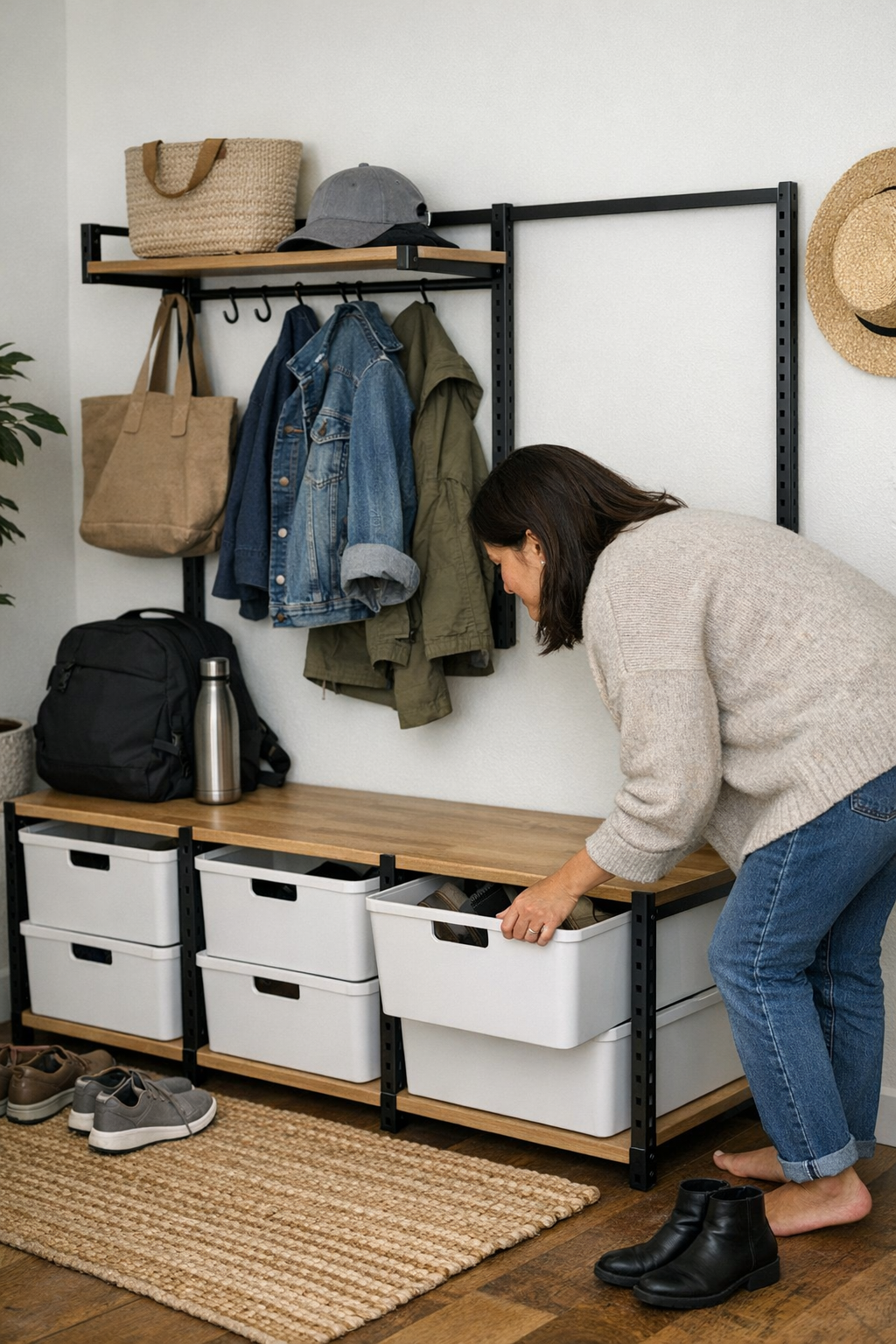
One change shifted everything: replacing the fixed, flush-sided tower with an open-sided one. Suddenly, returning something didn’t mean wrestling a pile back into shape. The open edge became a gap for recovery—a place where midweek disorder could be tidied up without a full overhaul.
There’s a quiet relief every time an item slips neatly into place from the side.
It’s hard to overstate how much a few centimeters of clearance transform the daily routine. It’s not about the measured capacity, but the ease of upkeep. Measuring the closet width at several points—and subtracting just enough to avoid a squeeze—did more than preserve symmetry: it meant the closet actually worked. And when overflow happened, it stayed visible, not hidden in the dark gaps between stacks and panels.
Some lessons work quietly in the background, surfacing at the edges of routines rather than the center. That was the part I kept coming back to.
If you want to see what I ended up with, it’s quietly sitting here: http://www.gridry.myshopify.com