When Entryway Chaos Meets a Flexible Rail Solution
A wall-mounted rail offers flexible, adaptive entryway storage that reduces clutter and maintains access during busy, overlapping arrivals.
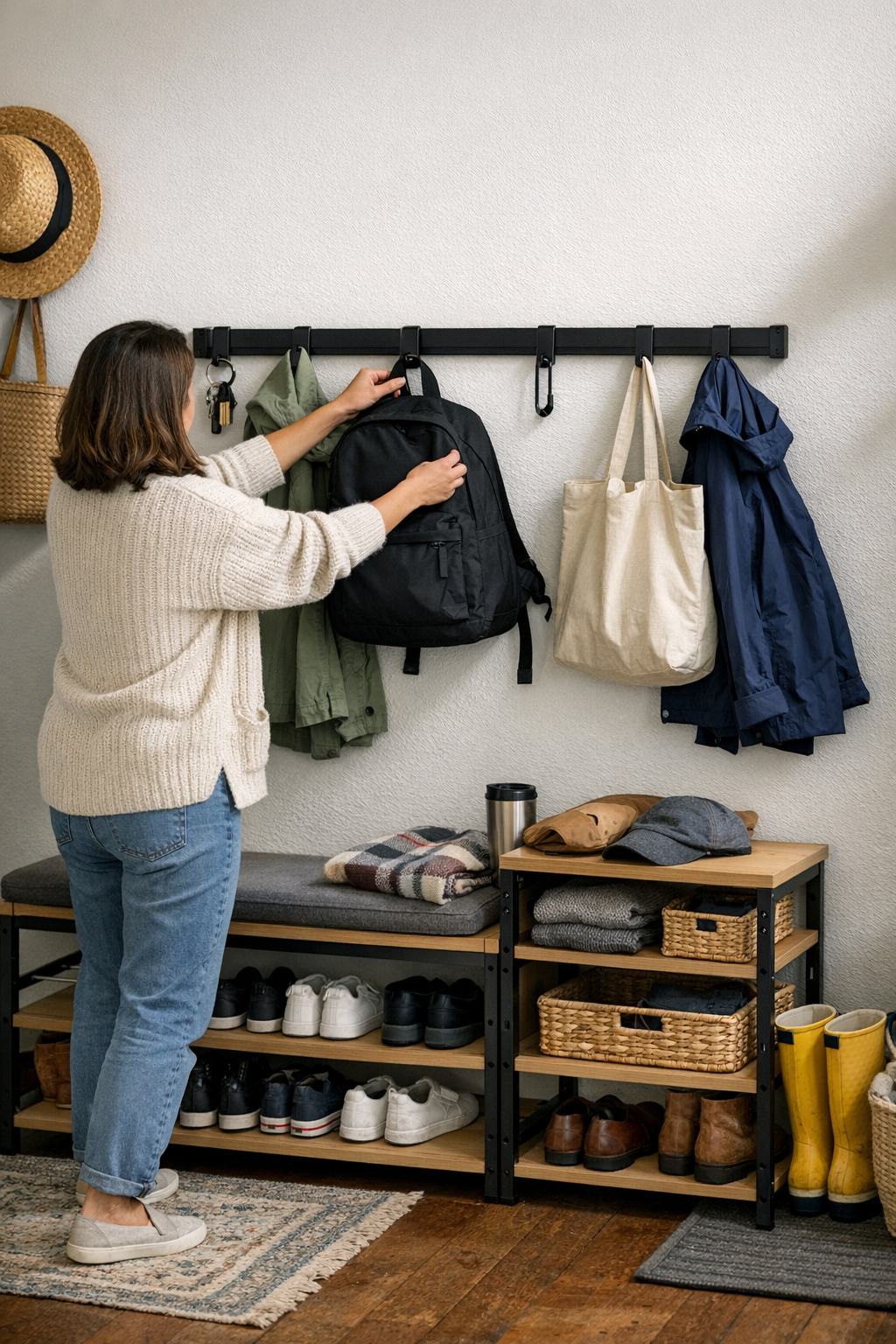
When the System Breaks Down, the Real Entryway Appears
Most days, you don’t give much thought to how things land by the door. It’s only during a sudden rush—three people arriving at once, arms full, someone late, bags dropping fast—that the system falters and the transition space becomes less a buffer and more a bottleneck. There’s a small, persistent anxiety buried in those moments, watching bench tops and shoe rows vanish beneath the overflow, each surface struggling to absorb the impact of arrival. Somehow, the entryway reveals what still doesn’t quite work.
A Tidy Plan, Until It Isn’t
Fixed hooks can look like a simple solution—one for keys, one for a bag, another for a jacket. It feels reasonable. But pressure builds quietly. After a restless night, everyone leaves early and returns all at once. Bags pile up, shoes drift out of line, and the orderly arrangement blurs. You try to reset things in twenty seconds flat, but end up pushing stray coats aside just to sit for a moment or reach the light switch.
You don’t notice it immediately. But you feel it every time the hallway narrows, or when you catch yourself apologizing for the mess.
A rail installed along the wall, with movable hooks, shifted something I hadn’t expected. The “places” for things became flexible, adjusting to the weather, the season, and everyone’s unpredictable schedules. On a wet day, I could slide hooks apart for damp jackets or group backpacks after a late soccer practice without everything collapsing into a pile. It didn’t make the space decorative—it simply absorbed more of the routines.
Containment, Not Perfection
The false sense of control often comes from symmetry—spaces and hooks laid out like a diagram. But real routines defy the plan every week. One afternoon, a lopsided stack of boots appeared where a bench seat was supposed to be. At first it annoyed me, then I realized the system was struggling, not failing. The fixed hooks couldn’t budge, so the overflow found its own place, sometimes several.
Letting the setup flex in small ways made the difference. If shoes threatened to take over the bench, a gentle reordering of hooks or moving the bench itself brought relief. These small pivots almost went unnoticed until I realized how rarely I now had to clear a full clog or fetch a jacket from a heap.
That was the part I kept coming back to. It wasn’t about eliminating mess, but about giving the space a chance to catch up—so nobody was forced to tiptoe around gear or shove things aside just to pass through.
Living with Movement
The transition zone, when it works, isn’t about silent display. It’s about letting the rush come in waves and allowing the space to bend, not break. Each arrival leaves its mark: a quick shoe swap, a backpack edge nudging the utility cabinet, the way umbrella handles peek over the rim of a storage bin. There’s always a little residue—the signs of life in motion.
I used to expect the entryway to hold its shape. Now, I find comfort in watching it flex and recover, letting reset moments arrive naturally, not by force. The quiet clarity isn’t perfect order, but an ease of access—paths unblocked, seats available, shoes close at hand even after a storm of arrivals.
Sometimes, clarity quietly lives between arrivals and departures.
If you want to see how other transition-space setups take on the day’s pressure, there’s more collected here: http://www.betweenry.myshopify.com



